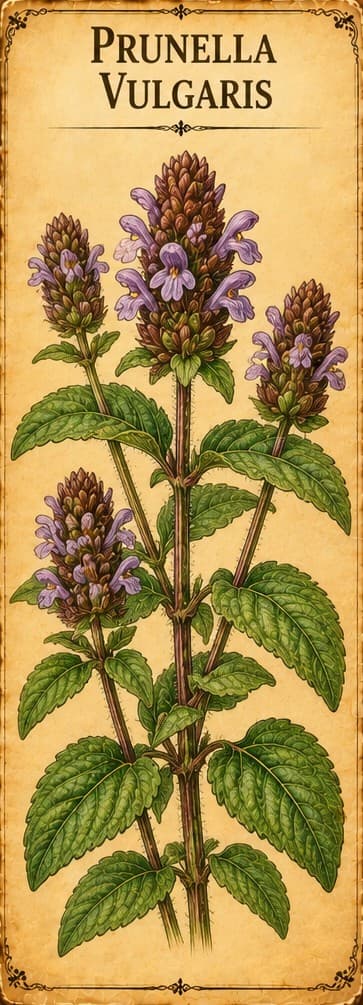
Prunella Vulgaris
Prunella vulgaris
Self-heal, called xia ku cao in China, a mint-family herb used in Chinese medicine since the Han Dynasty and eaten as a vegetable and tea. Low-quality trials suggest it may help when added to standard treatment for an overactive thyroid.
What is Prunella Vulgaris?
- Plant family
- Lamiaceae, the mint family
- Parts used
- The flower spikes and above-ground parts, as teas, porridge, tablets, granules and ointments
- Where it grows
- Widespread, including China, Korea, Japan and Europe
- Genus
- Prunella
- Species
- vulgaris
Also called
Self-heal, Heal-all
Traditional names
Xia Ku Cao
Traditionally used for
- Overactive thyroid (with standard treatment)
- Sore throat (traditional)
- Wounds (traditional)
- Herbal tea
Traditionally described as
- May help reduce inflammation (in lab studies)
Health topics
Where Prunella Vulgaris appears in symptom search, and why. Being listed doesn't mean it's a proven treatment.
- Sore Throat
Traditionally used in China for sore throats. Not tested for this in trials.
Traditions that use it
Traditional Chinese Medicine
Called xia ku cao; recorded since the Han Dynasty and used as both a medicine and a food.
What does the research say?
Traditional use
These are traditional uses, not proven treatments.
In China, prunella is called xia ku cao. It was recorded in Shen Nong's Herbal Classic of the Han Dynasty for swollen glands in the neck, head injuries, swollen feet, joint pain and "clearing the liver". It has been used for sore throats and to help wounds heal.
It's also eaten: the young leaves have been cooked as a vegetable since at least the Song Dynasty, and it's made into teas and porridge.[1]
Laboratory & animal research
Lab and animal results show what might be worth studying in people. They don't show that the herb has these effects in humans.
In lab and animal studies, compounds from prunella may help reduce inflammation and have shown antioxidant, antiviral and anti-tumor effects.[1]
Research in people
A 2025 review combined 17 trials with 1,366 people with an overactive thyroid (hyperthyroidism). Adding prunella products to standard antithyroid medicines improved thyroid hormone levels, shrank the thyroid gland and caused fewer side effects than the medicines alone. Relapse rates were similar.
The evidence was low quality, so better trials are needed. Prunella was always used alongside the standard medicines, not instead of them.[2]
Technical detail: free T3 SMD −0.98 (95% CI −1.39 to −0.57); adverse events RR 0.34 (95% CI 0.24–0.50) across 10 trials with 770 participants.
In short
Thyroid trials only tested it alongside standard medicines, and the evidence is low quality.
Sources
- [1] Anti-Tumor Effects and Toxicity Reduction Mechanisms of Prunella vulgaris: A Comprehensive Review · DOI: 10.3390/molecules29081843Peer-reviewed study
- [2] Efficacy and safety of Prunella vulgaris L. combined with antithyroid drugs for hyperthyroidism: a systematic review and meta-analysis · DOI: 10.3389/fphar.2025.1530152Review or clinical trial
This information is educational and traditional in nature, and is not a substitute for professional medical advice.