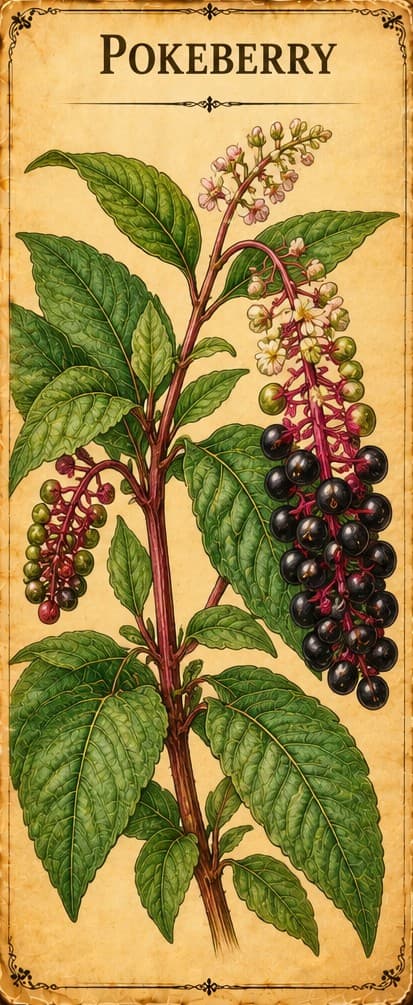
Pokeberry
Phytolacca americana
American pokeweed, a tall plant with purple-black berries. All parts are poisonous, especially the root. Some people eat the young leaves as "poke sallet" after boiling them twice, but this doesn't guarantee safety.
What is Pokeberry?
- Plant family
- Phytolaccaceae, the pokeweed family
- Parts used
- Young leaves and shoots, eaten after repeated boiling; the root and berries are poisonous
- Genus
- Phytolacca
- Species
- americana
Also called
Pokeweed, American Pokeweed, Poke Sallet, Poke Salad
Traditionally used for
- Poke sallet (food)
Traditionally described as
Health topics
Where Pokeberry appears in symptom search, and why. Being listed doesn't mean it's a proven treatment.
- Poisonous Plants
The whole plant is poisonous, especially the root; even cooked leaves have made people ill.
Safety
Toxicity testing
All parts of pokeweed are poisonous to people and animals, especially the root. The ripe berries are the least toxic. As little as half a teaspoon of root, or 10 or more berries, may cause poisoning.
Poisoning usually causes a burning mouth, vomiting and diarrhea, which can be bad enough to cause dehydration. Headache, drooling, vision problems and possibly seizures can also occur.[1]
Symptoms may take 2 to 3 hours to start. Even several rounds of boiling can't guarantee that pokeweed is safe to eat. Touching the plant can cause a skin rash. If you have young children or pets, consider removing pokeweed from your yard. If someone swallows pokeweed, call Poison Control (1-800-222-1222 in the US).[2]
Pokeweed leaves have caused a death. In China, where the plant has spread, a person died after eating them.[3]
What does the research say?
Traditional use
These are traditional uses, not proven treatments.
Some people eat young pokeweed leaves, a dish known as poke sallet. The leaves are boiled for 5 minutes, the water is thrown away, and they're boiled again in fresh water. This double boiling is said to destroy the poison, but people have still become ill after eating leaves prepared this way.[1]
In short
All parts are poisonous, especially the root; even small amounts can cause vomiting and diarrhea.
Sources
- [1] What is the toxicity of pokeweed? — Tennessee Poison Center, Vanderbilt University Medical CenterGovernment health agency
- [2] Pokeweed (Pokeberry) — Northern New England Poison CenterGovernment health agency
- [3] Description of a fatal case of acute Phytolacca americana poisoning due to leaf ingestion in China · DOI: 10.1016/j.toxicon.2025.108476Peer-reviewed study
This information is educational and traditional in nature, and is not a substitute for professional medical advice.