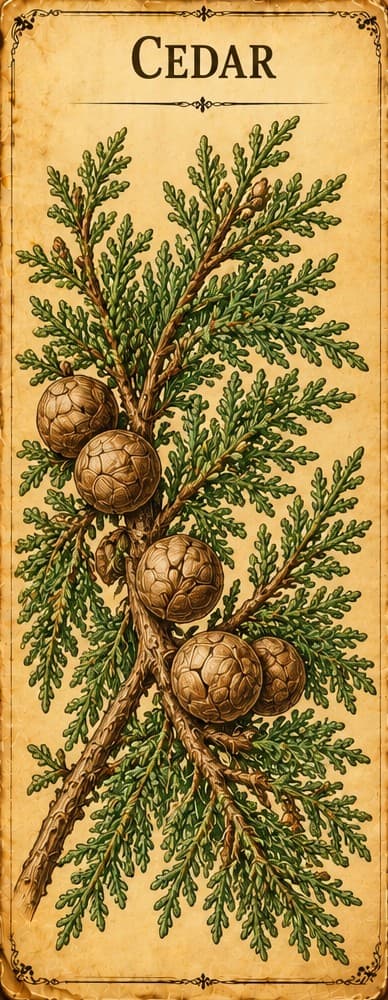
Cedar
Thuja occidentalis
Northern white cedar, or arborvitae, a North American evergreen. Indigenous people in Canada showed it to 16th-century explorers as a remedy for scurvy. Its fresh leaves contain thujone and can be poisonous.
What is Cedar?
- Plant family
- Cupressaceae, the cypress family
- Parts used
- The leafy twig tips
- Where it grows
- Eastern North America; grown in Europe as an ornamental tree
- Genus
- Thuja
- Species
- occidentalis
Also called
Northern White Cedar, White Cedar, Arborvitae, Thuja
Traditionally used for
- Scurvy (historical)
- Coughs (traditional)
- Rheumatism (traditional)
- Immune support
Traditionally described as
- May stimulate the immune system (in lab and animal studies)
Health topics
Where Cedar appears in symptom search, and why. Being listed doesn't mean it's a proven treatment.
- Immune Support (Colds and Flu)
Combined with echinacea and wild indigo in a product studied for colds. Not tested on its own.
Traditions that use it
Native American Ethnobotany
Indigenous people in Canada showed it to a 16th-century expedition as a remedy for weakness from scurvy.
Safety
Pregnancy
Don't use cedar during pregnancy or breastfeeding without first talking to a doctor.[1]
Toxicity testing
The fresh plant is poisonous because of its high thujone content; thujone makes up about 65% of its essential oil. Poisoning from the fresh plant can cause vomiting, stomach pain, diarrhea, headache, agitation and seizures, and damage to the liver, kidneys and heart. Infants who ate fresh leaves and twigs had mild stomach upset and vomiting.[1]
What does the research say?
Traditional use
These are traditional uses, not proven treatments.
Indigenous people in Canada first showed this tree to a 16th-century European expedition, and it proved effective for weakness from scurvy. In folk medicine it has been used for:
- Bronchitis with mucus
- Bedwetting and bladder infections
- Psoriasis
- Absent periods
- Rheumatism
Today it's used mainly in homeopathy.[1]
Laboratory & animal research
Lab and animal results show what might be worth studying in people. They don't show that the herb has these effects in humans.
In lab and animal studies, cedar extracts have shown antiviral activity and stimulated parts of the immune system.[1]
Research in people
No controlled trials have tested cedar on its own. Studies of a product that combines it with echinacea and wild indigo found it helped with colds and other upper respiratory infections. The review was written by scientists from the company that makes this product.[1]
In short
The fresh plant contains thujone; poisoning can cause vomiting, seizures and liver and kidney damage.
Sources
- [1] Thuja occidentalis (Arbor vitae): A Review of its Pharmaceutical, Pharmacological and Clinical Properties · DOI: 10.1093/ecam/neh065Peer-reviewed study
This information is educational and traditional in nature, and is not a substitute for professional medical advice.