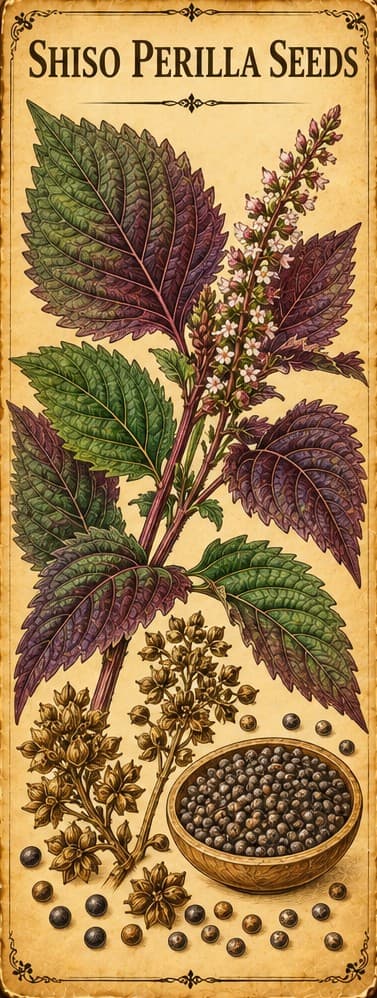
Shiso Perilla Seeds
Perilla frutescens
Seeds of the perilla (shiso) plant, an East Asian oilseed. They're about 30–45% oil, rich in an omega-3 fat called alpha-linolenic acid. Perilla seeds can cause serious allergic reactions, especially in young children.
What is Shiso Perilla Seeds?
- Plant family
- Lamiaceae, the mint family
- Parts used
- The seeds, eaten or pressed for oil
- Where it grows
- East Asia, including China, Korea, Japan, India and Thailand
- Genus
- Perilla
- Species
- frutescens
Also called
Perilla Seed, Shiso, Perilla
Traditionally used for
- Cooking oil
- Food
- Omega-3 source
Traditionally described as
- Rich in omega-3 fats
- Antioxidant (in lab tests)
Safety
Allergies
Perilla seeds can cause immediate allergic reactions. In a study of 21 children with perilla seed allergy in Korea (typically about 3 years old), more than 1 in 4 had anaphylaxis, a severe, life-threatening reaction.[1]
Technical detail: 28.6% had anaphylaxis; 85.7% had perilla seed-specific IgE.
What does the research say?
Traditional use
These are traditional uses, not proven treatments.
Perilla is an oilseed crop native to East Asia. One variety is grown mainly for its seeds and oil, and another for use in traditional medicine. The seeds are 30–45% oil and also provide fiber, protein, vitamins and minerals.[2]
Laboratory & animal research
Lab and animal results show what might be worth studying in people. They don't show that the herb has these effects in humans.
Perilla seed oil is about 60% alpha-linolenic acid, a plant omega-3 fat. In lab and animal studies, the seeds and oil have shown antioxidant activity and possible effects on inflammation, blood sugar, body weight, cholesterol and the heart.[2]
Research in people
Reviewers say large clinical trials in people are still needed to confirm the health effects of perilla seed oil.[3]
In short
Can cause severe allergic reactions (anaphylaxis), including in young children.
Sources
- [1] Clinical and Immunological Characterization of Perilla Seed Allergy in Children · DOI: 10.18176/jiaci.0756Peer-reviewed study
- [2] A comprehensive review on nutritional, nutraceutical, and industrial perspectives of perilla (Perilla frutscens L.) seeds: An orphan oilseed crop · DOI: 10.1016/j.heliyon.2024.e33281Peer-reviewed study
- [3] Perilla Seed Oil: A Review of Health Effects, Encapsulation Strategies and Applications in Food · DOI: 10.3390/foods13223615Peer-reviewed study
This information is educational and traditional in nature, and is not a substitute for professional medical advice.