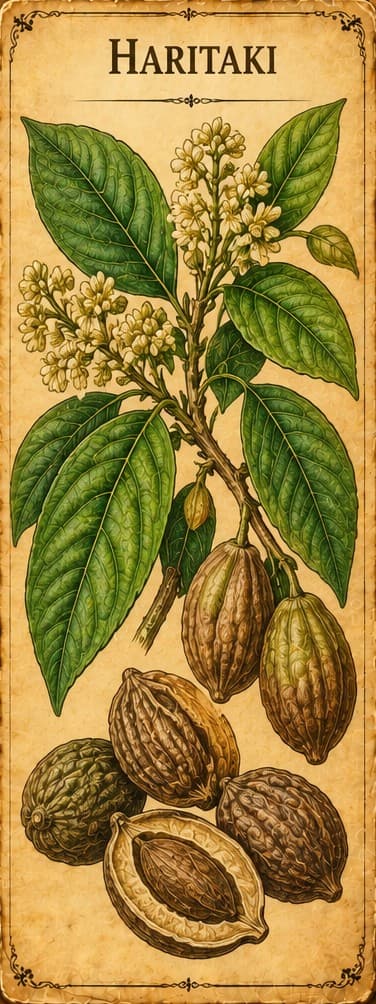
Haritaki
Terminalia chebula
The dried fruit of the chebulic myrobalan tree, called the "king of Tibetan medicines" and one of the three fruits in Triphala. It's used for constipation, digestion, coughs and dental health.
What is Haritaki?
- Plant family
- Combretaceae, the combretum family
- Parts used
- The dried fruit, usually as a powder
- Where it grows
- South and Southeast Asia
- Genus
- Terminalia
- Species
- chebula
Also called
Chebulic Myrobalan, Myrobalan, Chebulae Fructus
Traditionally used for
- Constipation
- Digestion
- Cough (traditional)
- Dental health
- Triphala ingredient
Traditionally described as
- Mild laxative (traditional)
- Kills bacteria (in lab tests)
- Antioxidant (in lab tests)
Health topics
Where Haritaki appears in symptom search, and why. Being listed doesn't mean it's a proven treatment.
- Constipation
Traditionally used for constipation; a small clinical study found it helped empty the bowels.
- Cough
Traditionally used for coughs and excess mucus. Not tested in trials.
- Indigestion
Traditionally used for indigestion, gas and poor appetite. Not well tested in trials.
Traditions that use it
Ayurveda
Named first in the Ayurvedic materia medica; one of the three fruits in Triphala.
Traditional Chinese Medicine
Used in China for thousands of years, first recorded in the Jin Dynasty (266–317 AD).
Safety
Toxicity testing
Haritaki has been used for many years without obvious toxic effects. In rats, a single large dose of extract caused no deaths or organ damage. However, thorough safety studies, especially of long-term use, are still lacking.[1]
Technical detail: single oral dose of 2000 mg/kg in rats; 14-day repeated dosing of the ethyl acetate fraction was well tolerated.
What does the research say?
Traditional use
These are traditional uses, not proven treatments.
Haritaki is called the "king of Tibetan medicines" and is named first in the Ayurvedic materia medica. It's also used in Unani and Siddha medicine, and in China, where it was first recorded in the Jin Dynasty (266–317 AD). It's one of the three fruits in Triphala.[1]
Traditional uses of the fruit include:
- Constipation (unripe fruit) and diarrhea or dysentery (ripe fruit)
- Indigestion, gas and poor appetite
- Coughs and excess mucus
- Piles, anemia, long-lasting fevers and skin disorders
- As a rejuvenating tonic
Laboratory & animal research
Lab and animal results show what might be worth studying in people. They don't show that the herb has these effects in humans.
In lab and animal studies, haritaki fruit extracts have shown antioxidant activity, killed bacteria including those that cause tooth decay, and may help reduce inflammation, as well as protective effects on the liver and kidneys. About 149 compounds have been found in the fruit, mainly tannins.[1]
Research in people
Small clinical studies suggest:
- Haritaki helped empty the bowels in people with simple constipation
- Rinsing with haritaki extract lowered the number of mouth bacteria, including those linked to tooth decay
- In a 2-week trial of 78 people, a 10% haritaki mouthwash worked about as well as chlorhexidine, a standard mouthwash, for gum health
Several Ayurvedic formulas containing haritaki have also been tested for constipation, stress and hay fever.[2]
In short
Its long-term safety hasn't been fully studied.
Sources
- [1] Comprehensive Review on Fruit of Terminalia chebula: Traditional Uses, Phytochemistry, Pharmacology, Toxicity, and Pharmacokinetics · DOI: 10.3390/molecules29235547Peer-reviewed study
- [2] A comprehensive review on the diverse pharmacological perspectives of Terminalia chebula Retz. · DOI: 10.1016/j.heliyon.2022.e10220Peer-reviewed study
This information is educational and traditional in nature, and is not a substitute for professional medical advice.