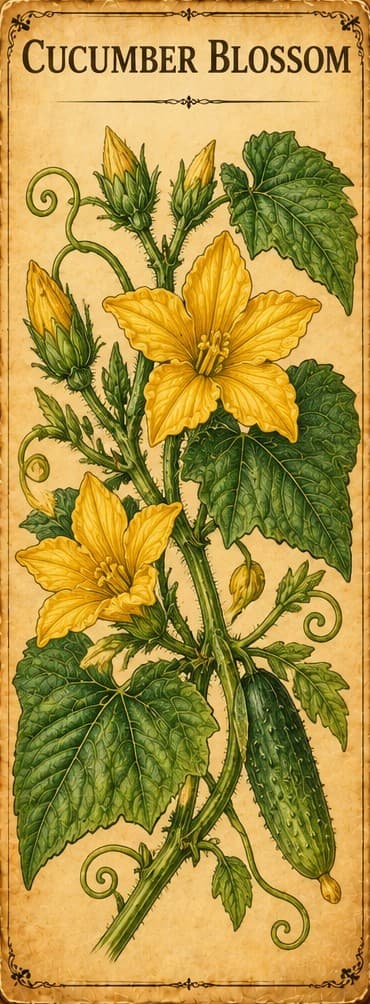
Cucumber Blossom
Cucumis sativus
The yellow flower of the cucumber vine. The flowers have barely been studied: one lab study found a flower extract slowed some bacteria and fungi, an effect the researchers called almost comparable to standard medicines.
What is Cucumber Blossom?
- Plant family
- Cucurbitaceae, the gourd and cucumber family
- Parts used
- The flowers; the fruit, seeds and leaves of the same plant are better known
- Genus
- Cucumis
- Species
- sativus
Also called
Cucumber Flower, Cucumber
Traditionally used for
- Food
Traditionally described as
- Kills bacteria and fungi (in lab tests)
What does the research say?
Traditional use
These are traditional uses, not proven treatments.
Cucumber is grown and eaten around the world as a vegetable and in salads. Much less is known about its medicinal value. There is little research on the flowers on their own.[1]
Laboratory & animal research
Lab and animal results show what might be worth studying in people. They don't show that the herb has these effects in humans.
In lab and animal studies, cucumber plant extracts have shown activity against bacteria and fungi, and effects on stomach acid, gut inflammation, the liver, blood sugar, cholesterol and wound healing. A safety study suggested the plant is safe to use. These studies weren't on the flowers specifically.[1]
In the only lab study found on the flowers themselves, a compound taken from cucumber flowers in India stopped the growth of four types of bacteria (including E. coli and Salmonella typhi) and two fungi (including Candida). It worked better at higher strengths, and the researchers described its effect as almost comparable to the standard antibiotic (chloramphenicol) and antifungal (fluconazole). It hasn't been tested in animals or people.[2]
Technical detail: ethyl acetate fraction of a 90% ethanol flower extract; disc diffusion at 10–40 mg/ml. At 40 mg/ml, inhibition zones were 13–16 mm (bacteria) and 13 mm (fungi), vs 19–22 mm for chloramphenicol and 19–21 mm for fluconazole at 1 mg/ml.
In short
The flowers haven't been tested in animals or people.
Sources
- [1] Cucumis sativus (cucumber): a review on its pharmacological activityPeer-reviewed study
- [2] Antimicrobial Activity of Cucumis sativas (Cucumber) FlowersPeer-reviewed study
This information is educational and traditional in nature, and is not a substitute for professional medical advice.