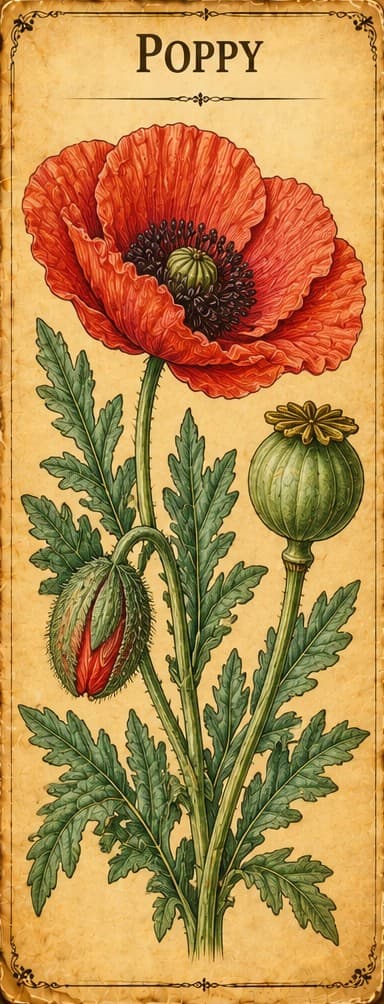
Poppy
Papaver rhoeas
The red corn poppy, a common field weed, used in folk medicine for coughs, sleep problems, diarrhea and pain, and eaten in salads. Eating it has poisoned adults, causing seizures and loss of consciousness. It's a different plant from the opium poppy.
What is Poppy?
- Plant family
- Papaveraceae, the poppy family
- Parts used
- The flowers, leaves and other above-ground parts, eaten raw or cooked or made into teas and syrups
- Where it grows
- Common in southern Europe, Turkey and Iran, often as a weed in cereal fields
- Genus
- Papaver
- Species
- rhoeas
Also called
Corn Poppy, Common Poppy, Red Poppy
Traditionally used for
- Cough (traditional)
- Sleep (traditional)
- Diarrhea (traditional)
- Pain (traditional)
Traditionally described as
- May make you feel sleepy or relaxed (in animal studies)
Health topics
Where Poppy appears in symptom search, and why. Being listed doesn't mean it's a proven treatment.
- Cough
Used in folk medicine for coughs. Not tested in trials, and eating the plant has caused poisoning.
- Sleep Problems (Insomnia)
Used in folk medicine for sleep problems. Not tested in trials, and eating the plant has caused poisoning.
Safety
Toxicity testing
Eating corn poppy can cause poisoning that resembles a morphine overdose. A hospital in Turkey reported five adults who had eaten it for its taste, not as medicine. Within 1 to 3 hours they had:
- Nausea and vomiting
- Restlessness, confusion and loss of consciousness
- Seizures
- Numbness and weakness in the arms and legs
- Breathing difficulty and a slow heartbeat
All recovered after a few days in hospital.[1]
What does the research say?
Traditional use
These are traditional uses, not proven treatments.
Corn poppy is used as a medicinal plant in Turkey, Iran and other countries:
- For diarrhea, coughs and sleep problems
- To ease pain and calm
- To reduce opioid withdrawal symptoms
- For bowel and bladder irritation, bronchitis, pneumonia and fevers with a rash
In some regions corn poppy is added to salads. Its main natural chemicals are alkaloids called rhoeadine and rhoeagenine.[2]
Laboratory & animal research
Lab and animal results show what might be worth studying in people. They don't show that the herb has these effects in humans.
In rats, corn poppy extract had a calming effect, reduced movement, and eased withdrawal symptoms in rats dependent on morphine.[1]
Research in people
In one trial, men took a syrup of corn poppy combined with other herbs, and reported better sexual experience, with no serious side effects. Because the syrup contained several herbs, the effect can't be put down to corn poppy alone.[2]
In short
Eating corn poppy has caused poisoning with seizures, confusion and breathing problems.
Sources
- [1] Intoxication due to Papaver rhoeas (Corn Poppy): Five Case Reports · DOI: 10.1155/2015/321360Peer-reviewed study
- [2] Papaver Plants: Current Insights on Phytochemical and Nutritional Composition Along with Biotechnological Applications · DOI: 10.1155/2022/2041769Peer-reviewed study
This information is educational and traditional in nature, and is not a substitute for professional medical advice.