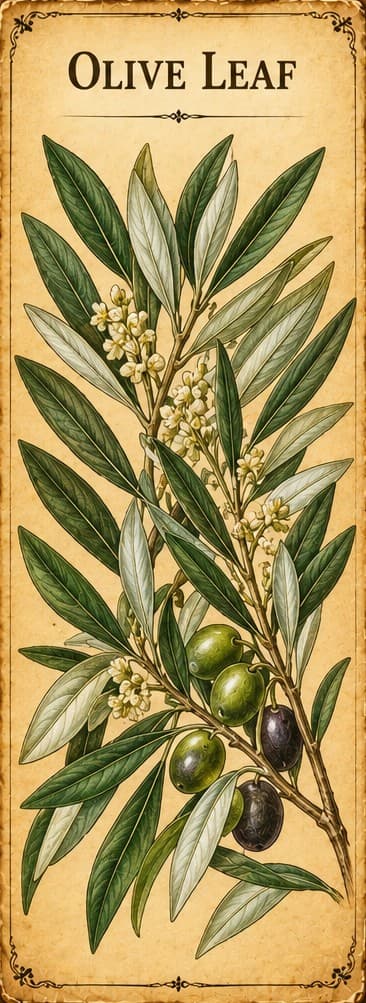
Olive Leaf
Olea europaea
Leaves of the olive tree, recognised in Europe as a traditional remedy for mild water retention. In one trial, olive leaf extract lowered blood pressure about as much as a standard medicine.
What is Olive Leaf?
- Plant family
- Oleaceae, the olive family
- Parts used
- The dried leaves, as a tea or extract
- Genus
- Olea
- Species
- europaea
Also called
Olive, Oleae Folium
Traditionally used for
- Water retention
- Blood pressure
Traditionally described as
- May increase urination (traditional)
- May lower blood pressure (one trial)
Health topics
Where Olive Leaf appears in symptom search, and why. Being listed doesn't mean it's a proven treatment.
- High Blood Pressure
In an 8-week trial in people with mildly high blood pressure, olive leaf extract lowered it about as much as captopril. Don't replace prescribed medicine without your doctor's advice.
Traditions that use it
European Folk Medicine
Recognised in Europe as a traditional remedy for mild water retention.
Safety
Who should avoid it
Don't use olive leaf if you have severe heart or kidney disease and have been told to drink less fluid. It's for adults only.[1]
How much to use
See a doctor if symptoms last more than 1 week or get worse while you're taking it.[1]
What does the research say?
Traditional use
These are traditional uses, not proven treatments.
The European Medicines Agency recognises olive leaf as a traditional herbal medicine to help the kidneys remove water in mild water retention, for adults. This is based on long use, not on clinical trials.[1]
Research in people
In an 8-week trial, people with mildly high blood pressure (stage 1) took olive leaf extract (500 mg twice a day) or captopril, a standard blood pressure medicine. Blood pressure fell by a similar amount in both groups. Triglycerides, a type of blood fat, also fell in the olive leaf group but not in the captopril group.[2]
Technical detail: double-blind, randomized, active-controlled; extract EFLA943; systolic −11.5 ± 8.5 vs −13.7 ± 7.6 mmHg and diastolic −4.8 ± 5.5 vs −6.4 ± 5.2 mmHg (olive vs captopril 12.5–25 mg twice daily); difference not significant.
In short
Don't use it if you have severe heart or kidney disease and have been told to limit fluids.
Sources
- [1] Oleae folium (olive leaf): herbal medicinal product summary — European Medicines Agency (EMA), Committee on Herbal Medicinal ProductsGovernment health agency
- [2] Olive (Olea europaea) leaf extract effective in patients with stage-1 hypertension: comparison with Captopril · DOI: 10.1016/j.phymed.2010.08.016Peer-reviewed study
This information is educational and traditional in nature, and is not a substitute for professional medical advice.