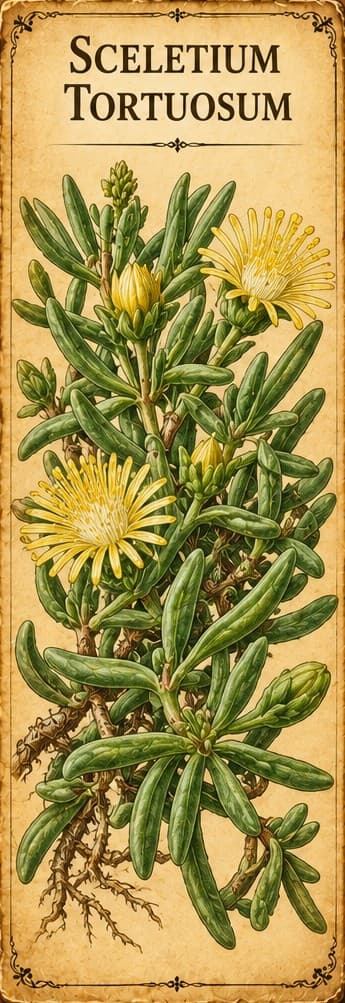
Sceletium Tortuosum
Sceletium tortuosum
A South African succulent, known as kanna, chewed for centuries by the San and Khoi peoples to ease hunger, thirst and tiredness and to lift mood. Small trials of an extract found it well tolerated.
What is Sceletium Tortuosum?
- Plant family
- Aizoaceae, the ice plant family
- Parts used
- The above-ground parts, traditionally fermented and dried, then chewed, smoked or made into tinctures; now also as a standardized extract
- Where it grows
- South Africa (found nowhere else)
- Genus
- Sceletium
- Species
- tortuosum
Also called
Kanna, Sceletium
Traditional names
Kougoed
Traditionally used for
- Mood (traditional)
- Stress
- Hunger and thirst (traditional)
- Toothache (traditional)
Traditionally described as
- May improve thinking flexibility (one small trial)
Health topics
Where Sceletium Tortuosum appears in symptom search, and why. Being listed doesn't mean it's a proven treatment.
- Memory and Thinking
In a 3-week trial of 21 healthy adults, the extract improved tests of task-switching and planning compared with a dummy pill.
- Stress
In a 3-month safety trial, some people taking the extract wrote that they coped better with stress. Stress wasn't measured directly.
Traditions that use it
African Traditional Medicine
Used for millennia by the San and Khoi peoples of South Africa to ease hunger, thirst and tiredness, and for social and spiritual purposes.
What does the research say?
Traditional use
These are traditional uses, not proven treatments.
The San and Khoi peoples of southern Africa have probably used sceletium for thousands of years. They chewed it to ease thirst and hunger and fight tiredness, and used it as a medicine and for social and spiritual purposes. Much of this knowledge has been lost over the last three centuries, and wild plants have been heavily over-harvested.[1]
Traditionally, sceletium is mainly chewed or smoked:
- To relieve toothache and belly pain
- To lift mood, ease anxiety and help sleep
- To curb thirst and hunger
- For its intoxicating, euphoric effects
Research in people
In a 3-month safety trial, 37 healthy adults took a sceletium extract (8 mg or 25 mg a day) or a dummy pill. Both doses were well tolerated, with no differences in heart tracings, blood tests or physical exams. Headache and belly pain were more common in the dummy-pill group. Some people taking the extract wrote in their diaries that they coped better with stress and slept better.[3]
Technical detail: randomized, double-blind, placebo-controlled; extract Zembrin (2:1 standardized); 12, 12 and 13 participants per group.
In a 3-week trial, 21 healthy adults (average age 55) took 25 mg of sceletium extract a day and a dummy pill, in random order. On the extract, they did better on tests of switching between tasks and planning, and reported better mood and sleep. It was well tolerated. The study was small and short.[4]
Technical detail: randomized, double-blind, placebo-controlled crossover; cognitive set flexibility p < 0.032 and executive function p < 0.022 vs placebo (CNS Vital Signs battery).
In short
Studied only in small, short trials in healthy adults.
Sources
- [1] Sceletium: a review update · DOI: 10.1016/j.jep.2008.07.043Peer-reviewed study
- [2] Sceletium tortuosum: A review on its phytochemistry, pharmacokinetics, biological, pre-clinical and clinical activities · DOI: 10.1016/j.jep.2021.114711Peer-reviewed study
- [3] A randomized, double-blind, parallel-group, placebo-controlled trial of Extract Sceletium tortuosum (Zembrin) in healthy adults · DOI: 10.1089/acm.2012.0185Peer-reviewed study
- [4] Proof-of-Concept Randomized Controlled Study of Cognition Effects of the Proprietary Extract Sceletium tortuosum (Zembrin) Targeting Phosphodiesterase-4 in Cognitively Healthy Subjects: Implications for Alzheimer's Dementia · DOI: 10.1155/2014/682014Peer-reviewed study
This information is educational and traditional in nature, and is not a substitute for professional medical advice.