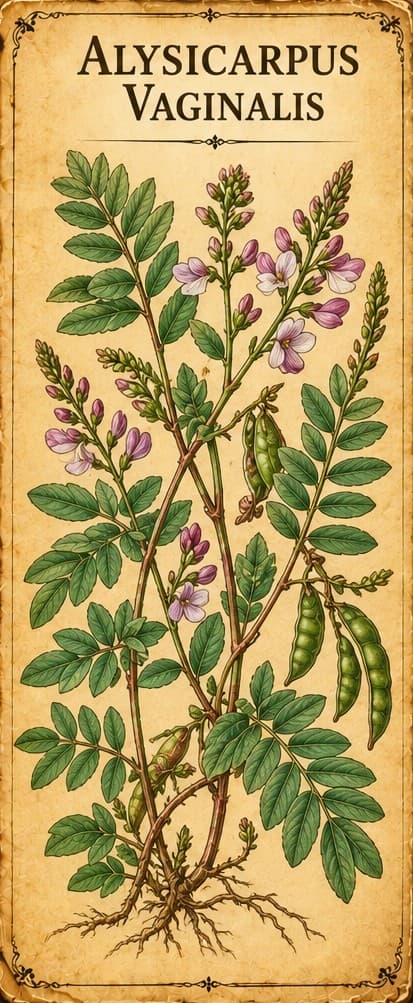
Alysicarpus Vaginalis
Alysicarpus vaginalis
A small creeping plant of the pea family, called medina in Jamaica, where it's one of the herbs boiled into the "strong back" root tonic drunk by men for stamina. Research so far is only in the lab and in animals.
What is Alysicarpus Vaginalis?
- Plant family
- Fabaceae, the pea and bean family
- Parts used
- The plant, boiled with other roots and herbs into a tonic
- Genus
- Alysicarpus
- Species
- vaginalis
Regional names
Medina
Traditionally used for
- Root tonic (traditional)
- Stamina (traditional)
- Impotence (traditional)
Traditionally described as
Health topics
Where Alysicarpus Vaginalis appears in symptom search, and why. Being listed doesn't mean it's a proven treatment.
- Sexual Health
An ingredient in Jamaican root tonic, which men traditionally drink for impotence and stamina. Not studied in people.
Traditions that use it
Caribbean Folk Medicine
Called medina; one of the herbs in Jamaican "root tonic" (strong back).
What does the research say?
Traditional use
These are traditional uses, not proven treatments.
In Jamaica, medina is one of the plants boiled into "root tonic", also called "strong back", along with chaney root, sarsaparilla, ginger and others. Men commonly drink it for impotence and to increase stamina.[1]
Laboratory & animal research
Lab and animal results show what might be worth studying in people. They don't show that the herb has these effects in humans.
In lab tests, an extract slowed the growth of breast cancer cells. In rats with breast tumors, it reduced tumor growth by about half.[2]
Technical detail: ethyl acetate fraction; maximum growth inhibition of MCF-7 cells 27.12% at 100 µg/ml; 50% tumor inhibition in MNU-induced mammary carcinoma in rats.
In short
Not studied in people.
Sources
- [1] Antiviral Activity of Jamaican Medicinal Plants and Isolated Bioactive Compounds — Molecules · DOI: 10.3390/molecules26030607Peer-reviewed study
- [2] Chemomodulatory effects of Alysicarpus vaginalis extract via mitochondria-dependent apoptosis and necroptosis in breast cancer · DOI: 10.1080/01635581.2019.1670855Peer-reviewed study
This information is educational and traditional in nature, and is not a substitute for professional medical advice.