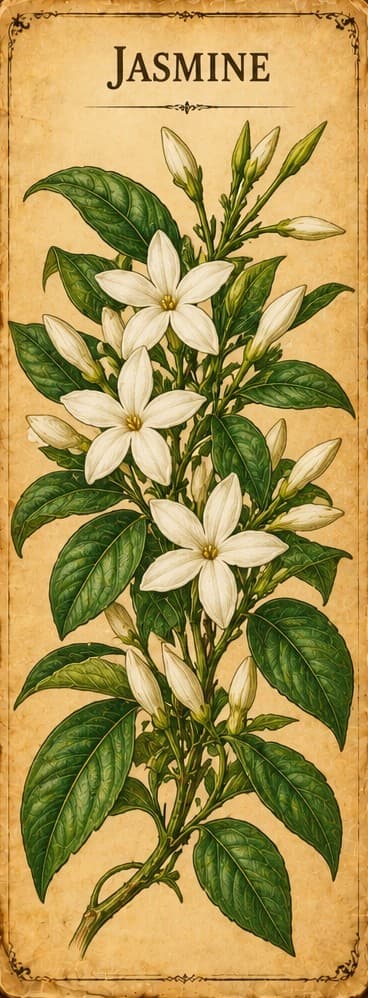
Jasmine
Jasminum sambac
Arabian jasmine, a fragrant white flower. Jasmine flowers placed on the breasts have been tested as a way to stop breast milk after childbirth, and a trial found they worked about as well as a standard medicine.
What is Jasmine?
- Plant family
- Oleaceae, the olive family
- Parts used
- The flowers
- Genus
- Jasminum
- Species
- sambac
Also called
Arabian Jasmine, Jasminum
Traditionally used for
- Stopping breast milk
- Fragrance
Traditionally described as
- May reduce breast milk (one trial)
Health topics
Where Jasmine appears in symptom search, and why. Being listed doesn't mean it's a proven treatment.
- Breast Milk Supply
In a trial, jasmine flowers placed on the breasts reduced breast milk as well as the medicine bromocriptine did, by clinical signs.
Safety
Breastfeeding
Jasmine flowers placed on the breasts reduced breast milk in a trial.[1]
What does the research say?
Research in people
In a trial, women who needed to stop breast milk after childbirth had jasmine flowers placed on their breasts or took bromocriptine, a medicine that stops milk production. Both lowered prolactin, the hormone that drives milk production, though bromocriptine lowered it more.
Breast swelling, milk production and use of pain relievers were similar in both groups, and both failed in a similar number of women. Some women on bromocriptine had their milk come back. The researchers called jasmine flowers a cheap alternative where bromocriptine isn't available.[1]
In short
Jasmine flowers placed on the breasts reduced breast milk in a trial.
Sources
- [1] Suppression of puerperal lactation using jasmine flowers (Jasminum sambac) · DOI: 10.1111/j.1479-828x.1988.tb01614.xPeer-reviewed study
This information is educational and traditional in nature, and is not a substitute for professional medical advice.