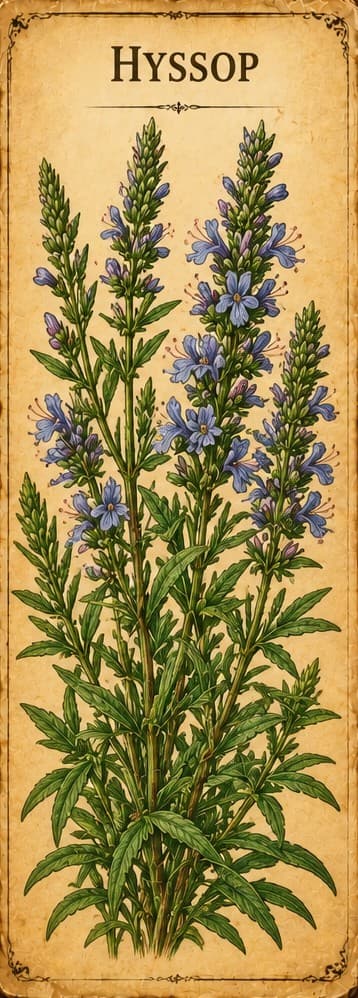
Hyssop
Hyssopus officinalis
A blue-flowered herb of the mint family, used for colds, coughs and poor appetite and as a flavoring. Its essential oil can cause seizures at high doses.
What is Hyssop?
- Plant family
- Lamiaceae, the mint family
- Parts used
- The above-ground parts, as an herb, and the essential oil
- Where it grows
- The eastern Mediterranean to central Asia
- Genus
- Hyssopus
- Species
- officinalis
Also called
Hyssopus
Traditionally used for
- Colds (traditional)
- Cough (traditional)
- Loss of appetite (traditional)
- Flavoring
Traditionally described as
- Kills bacteria and fungi (in lab tests)
Health topics
Where Hyssop appears in symptom search, and why. Being listed doesn't mean it's a proven treatment.
- Cough
Traditionally used for coughs. Not tested in trials.
- Immune Support (Colds and Flu)
Traditionally used for colds. Not tested in trials.
- Loss of Appetite
Traditionally used for loss of appetite. Not tested in trials.
Safety
Pregnancy
Very little research has looked at hyssop in pregnancy. It might make the womb contract or bring on menstruation.[1]
Toxicity testing
Hyssop essential oil contains pinocamphone, a substance that can cause seizures. In rats, high doses of the oil caused seizures and death. At high doses the oil may cause drowsiness and seizures in people.
There isn't enough information to set a safe dose. The herb is thought to be relatively safe in the amounts used in food.[1]
Technical detail: 80 mg/kg essential oil in Wistar rats produced subclinical spikes on EEG; 1.25 g/kg caused myoclonus, tonic-clonic seizures and lethal status epilepticus.
What does the research say?
Traditional use
These are traditional uses, not proven treatments.
Hyssop has been used for colds, coughs, loss of appetite, fungal infections and cramps. Its name comes from the Hebrew ezob, meaning "sacred herb". Its essential oil is used to flavor foods and drinks and in cosmetics.[1]
Laboratory & animal research
Lab and animal results show what might be worth studying in people. They don't show that the herb has these effects in humans.
In lab tests, hyssop essential oil killed a range of bacteria and fungi, and leaf extract slowed the growth of HIV. In animal studies, extracts made animals drowsy.[1]
In short
High doses of the essential oil can cause seizures; little is known about safety in pregnancy.
Sources
- [1] Hyssopus Essential Oil: An Update of Its Phytochemistry, Biological Activities, and Safety Profile · DOI: 10.1155/2022/8442734Peer-reviewed study
This information is educational and traditional in nature, and is not a substitute for professional medical advice.