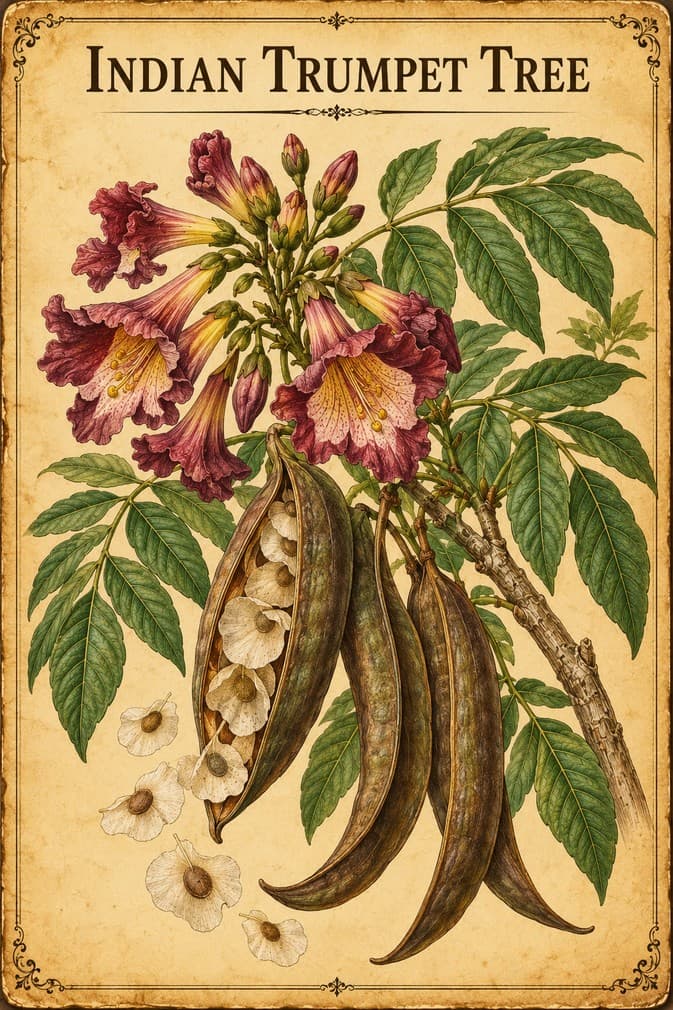
Indian Trumpet Tree
Oroxylum indicum
An Asian tree with huge sword-shaped seed pods, called shyonaka in Ayurveda, where its root bark and seeds are used for diarrhea, fever, coughs and joint pain. Its safety hasn't been studied in detail.
What is Indian Trumpet Tree?
- Plant family
- Bignoniaceae, the trumpet-creeper family
- Parts used
- The root bark, stem bark, seeds, leaves and fruit
- Where it grows
- Tropical Asia, including India, Sri Lanka, China, Malaysia and Japan
- Genus
- Oroxylum
- Species
- indicum
Also called
Tree of Damocles, Indian Trumpet Flower
Regional names
Sonapatha
Traditional names
Shyonaka
Traditionally used for
- Diarrhea (traditional)
- Fever (traditional)
- Cough (traditional)
- Joint pain (traditional)
- Ayurvedic tonics
Traditionally described as
- Antioxidant (in lab tests)
- May help reduce inflammation (in lab and animal studies)
Health topics
Where Indian Trumpet Tree appears in symptom search, and why. Being listed doesn't mean it's a proven treatment.
Traditions that use it
Ayurveda
Called shyonaka; the seeds go into Chyawanprash, and the root bark and bark are used for diarrhea, fever, coughs and joint pain.
Safety
Toxicity testing
No detailed safety study has been published. Available information puts the highest tolerated dose at about 100 mg per kg of body weight.[1]
What does the research say?
Traditional use
These are traditional uses, not proven treatments.
In Ayurveda and folk medicine, parts of the Indian trumpet tree are used for:
- Diarrhea and dysentery
- Fever
- Coughs, asthma and bronchitis
- Indigestion, gas and colic
- Joint pain and gout
- Ulcers and jaundice
The seeds are used in tonics such as Chyawanprash, and a bark paste is put on skin diseases.[1]
Laboratory & animal research
Lab and animal results show what might be worth studying in people. They don't show that the herb has these effects in humans.
In lab and animal studies, extracts and compounds from the tree have shown antioxidant activity, may help reduce inflammation, and have shown effects against ulcers, microbes and cancer cells, and protective effects on the liver. The review notes some traditional uses haven't been tested.[1]
Technical detail: main flavonoids include baicalein, chrysin, oroxylin A and scutellarein.
In short
No detailed safety studies have been published.
Sources
- [1] A Review on the Taxonomy, Ethnobotany, Chemistry and Pharmacology of Oroxylum indicum Vent. · DOI: 10.4103/0250-474x.98981Peer-reviewed study
This information is educational and traditional in nature, and is not a substitute for professional medical advice.