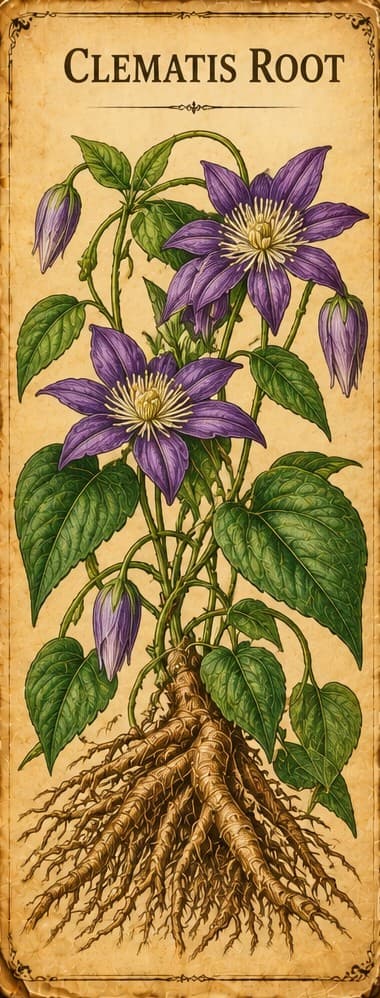
Clematis Root
Clematis chinensis
The root of a Chinese climbing plant, known as wei ling xian, used in traditional Chinese medicine for rheumatic joint pain and stiff, numb limbs. It can be toxic.
What is Clematis Root?
- Plant family
- Ranunculaceae, the buttercup family
- Parts used
- The root and underground stem
- Where it grows
- China
- Genus
- Clematis
- Species
- chinensis
Also called
Chinese Clematis, Clematidis Radix et Rhizoma
Traditional names
Wei Ling Xian
Traditionally used for
- Joint pain (traditional)
- Stiff limbs (traditional)
- Numbness (traditional)
Traditionally described as
- May help reduce inflammation (in lab and animal studies)
Health topics
Where Clematis Root appears in symptom search, and why. Being listed doesn't mean it's a proven treatment.
- Joint Discomfort
Used in traditional Chinese medicine for rheumatic joint pain. Not tested in trials, and it can be toxic.
Traditions that use it
Traditional Chinese Medicine
Used for rheumatic joint pain, numb limbs and stiff, tight tendons.
Safety
Toxicity testing
Clematis root can be toxic. Toxicity studies report mouth burning, swelling, belly pain, severe diarrhea, breathing difficulty, widened pupils, kidney damage and death. How it causes this hasn't been studied.[1]
What does the research say?
Traditional use
These are traditional uses, not proven treatments.
In traditional Chinese medicine, clematis root is used for:
- Rheumatic joint pain
- Numbness in the arms and legs
- Tight tendons and difficulty bending and straightening joints
It has also been used for neck and shoulder problems such as frozen shoulder, and for liver cancer and stomach complaints.[1]
Laboratory & animal research
Lab and animal results show what might be worth studying in people. They don't show that the herb has these effects in humans.
More than 200 compounds have been found in the plants used as clematis root. In lab and animal studies, extracts and compounds may help reduce inflammation and have shown activity against tumors and microbes, as well as antioxidant activity.[1]
In short
Toxicity studies report mouth burning, belly pain, severe diarrhea, breathing problems and death.
Sources
- [1] Uses, chemical compositions, pharmacological activities and toxicology of Clematidis Radix et Rhizome: a review · DOI: 10.1016/j.jep.2021.113831Peer-reviewed study
This information is educational and traditional in nature, and is not a substitute for professional medical advice.