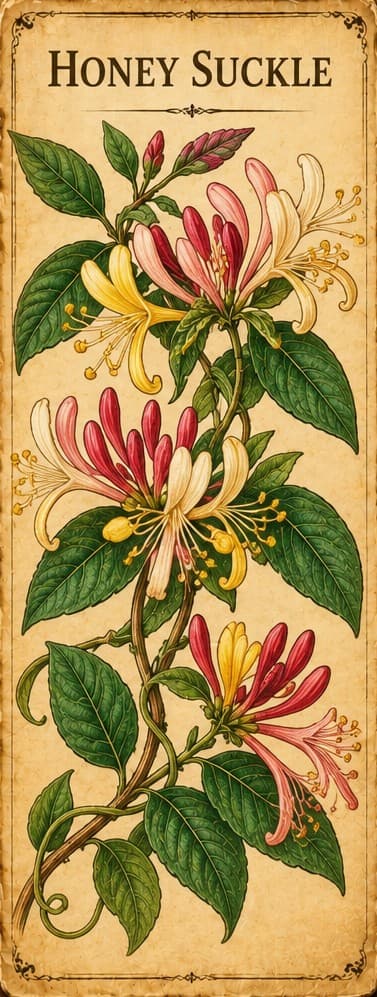
Honeysuckle
Lonicera japonica
Japanese honeysuckle, or jin yin hua, is a widely used herb in traditional Chinese medicine, taken for fevers, sore throats, skin sores and infections. Most research so far is in the lab and in animals.
What is Honeysuckle?
- Plant family
- Caprifoliaceae, the honeysuckle family
- Parts used
- The dried flowers and flower buds, and sometimes the vine and leaves, as teas and in herbal formulas
- Where it grows
- East Asia; now naturalized in the Americas, Australia and New Zealand
- Genus
- Lonicera
- Species
- japonica
Also called
Japanese Honeysuckle, Honey Suckle
Traditional names
Jin Yin Hua, Ren Dong
Traditionally used for
- Fever (traditional)
- Sore throat (traditional)
- Skin sores and boils (traditional)
- Infections (traditional)
Traditionally described as
- May help reduce inflammation (in animal studies)
- Antiviral (in lab tests)
Health topics
Where Honeysuckle appears in symptom search, and why. Being listed doesn't mean it's a proven treatment.
- Fever
Used in traditional Chinese medicine for fevers. Not tested for this in trials.
- Skin Irritation, Rashes and Itching
Used in traditional Chinese medicine for skin sores and boils. Not tested for this in trials.
- Sore Throat
An ingredient in traditional Chinese formulas for sore throat. Not tested on its own in trials.
Traditions that use it
Traditional Chinese Medicine
Known as jin yin hua; used for fevers, sore throats, skin sores and boils, and infectious diseases.
Safety
Pregnancy
In mice, dogs and monkeys, honeysuckle extract interrupted pregnancy, and in pregnant rats it lowered levels of progesterone, a hormone that maintains pregnancy.[1]
Toxicity testing
In short-term animal tests, honeysuckle flower bud extract was fairly nontoxic, even at very high doses, and didn't damage genes. Long-term safety hasn't been studied.[1]
Technical detail: oral LD50 > 15 g/kg body weight in mice; negative micronucleus and Ames tests.
What does the research say?
Traditional use
These are traditional uses, not proven treatments.
In traditional Chinese medicine, honeysuckle flowers are used to "clear heat". Uses include:
- Fevers and epidemic fevers
- Sore throat, headache and cough
- Skin sores, boils and abscesses
- Mumps in children
It's also eaten as a health food, used in cosmetics and grown as ground cover.[1]
Laboratory & animal research
Lab and animal results show what might be worth studying in people. They don't show that the herb has these effects in humans.
In lab and animal studies, honeysuckle extracts and their compounds may help reduce inflammation and have shown activity against bacteria and several viruses, as well as antioxidant activity and liver protection. In 2003 it was the most popular traditional Chinese medicine used in China against SARS.[1]
Technical detail: more than 140 compounds isolated; chlorogenic acid is the Chinese Pharmacopoeia quality marker. Antiviral activity reported against RSV, HIV, HSV, PRV and NDV.
In short
In animal studies, extracts interrupted pregnancy; long-term safety hasn't been studied.
Sources
- [1] Lonicera japonica Thunb.: ethnopharmacology, phytochemistry and pharmacology of an important traditional Chinese medicine · DOI: 10.1016/j.jep.2011.08.016Peer-reviewed study
This information is educational and traditional in nature, and is not a substitute for professional medical advice.