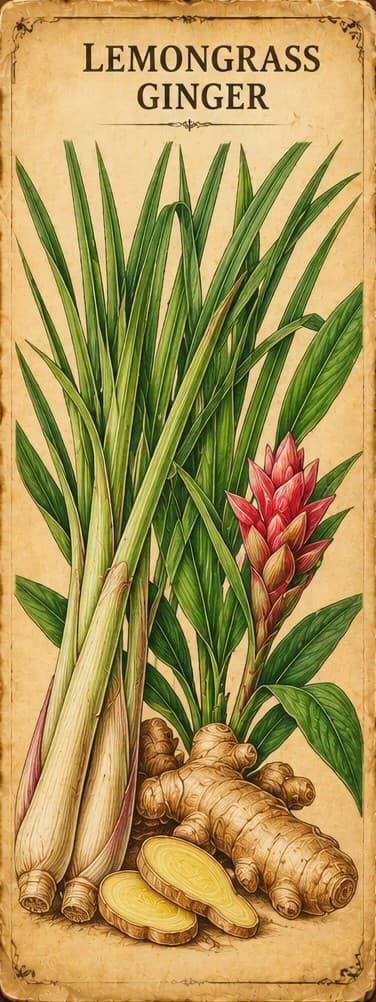
Lemongrass
Cymbopogon citratus
A lemon-scented grass, called fever grass in Jamaica, brewed as a tea for colds and flu and used in cooking. In a Brazilian study, lemongrass tea didn't help people sleep or feel less anxious.
What is Lemongrass?
- Plant family
- Poaceae, the grass family
- Parts used
- The fresh or dried leaves and stems, as a tea or in cooking
- Where it grows
- Grown in Jamaica and other warm countries; not native to Jamaica
- Genus
- Cymbopogon
- Species
- citratus
Also called
Lemon Grass
Regional names
Fever Grass, Fevergrass
Traditionally used for
- Colds and flu (traditional)
- Fever (traditional)
- Calming tea (traditional)
- Cooking
Traditionally described as
Health topics
Where Lemongrass appears in symptom search, and why. Being listed doesn't mean it's a proven treatment.
- Anxiety
Used as a calming tea, but in a study of 18 anxiety-prone people it didn't reduce anxiety.
- Immune Support (Colds and Flu)
One of Jamaica's most-used teas for colds and flu (as fever grass). Based on tradition, not research.
- Sleep Problems (Insomnia)
Used as a calming tea, but in a study of 50 volunteers it didn't help sleep more than a dummy drink.
Traditions that use it
Caribbean Folk Medicine
Called fever grass in Jamaica, where it's one of the most-used teas for colds and flu.
Safety
Contamination
Homemade lemongrass tea can carry pesticide residues or germs, so use cleanly grown plants. Side effects are generally mild, such as bloating, nausea, upset stomach, diarrhea and dizziness.[1]
What does the research say?
Traditional use
These are traditional uses, not proven treatments.
In Jamaica, lemongrass (fever grass) is one of the plants most often used for colds and flu. A handful of leaves and stems is brewed in a cup of water for about 10 minutes and sweetened to taste. This use rests on personal experience, not research.[1]
Lemongrass tea is one of the most popular herbal medicines in Brazil, where it's drunk to calm the nerves.[2]
Research in people
A Brazilian study tested lemongrass tea in healthy volunteers:
- Drinking it once, or daily for 2 weeks, caused no harmful changes in blood tests, urine tests, brain waves or heart tracings
- In 50 volunteers, it didn't help them fall asleep or sleep better than a dummy drink
- In 18 people prone to anxiety, it didn't reduce anxiety during a stressful test
The researchers concluded it isn't toxic but doesn't help sleep or anxiety.[2]
Technical detail: double-blind, placebo-controlled; slight rises in direct bilirubin and amylase in some volunteers, with no symptoms.
In short
Homemade teas can carry pesticide residues or germs; side effects can include bloating and nausea.
Sources
- [1] Antiviral Activity of Jamaican Medicinal Plants and Isolated Bioactive Compounds — Molecules · DOI: 10.3390/molecules26030607Peer-reviewed study
- [2] Pharmacology of lemongrass (Cymbopogon citratus Stapf). III. Assessment of eventual toxic, hypnotic and anxiolytic effects on humans · DOI: 10.1016/0378-8741(86)90074-7Peer-reviewed study
This information is educational and traditional in nature, and is not a substitute for professional medical advice.