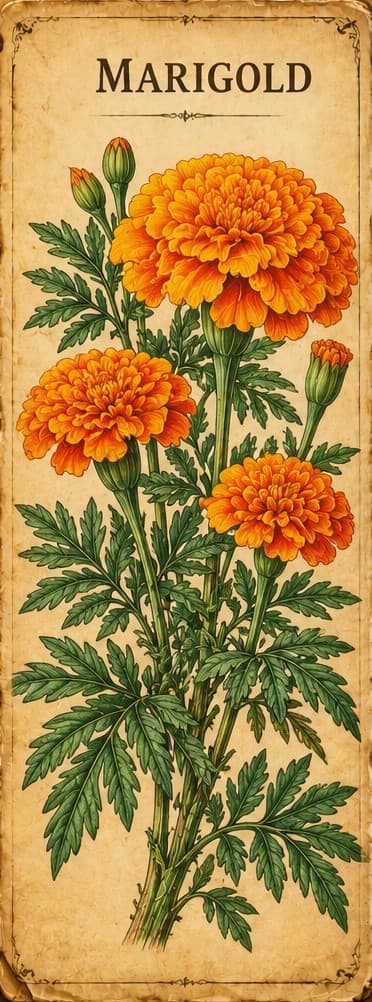
Marigold
Tagetes erecta
The orange-flowered Mexican marigold, or cempasúchil, used in folk medicine from Mexico to India for fevers, colds, stomach upsets and skin sores. It's a different plant from calendula (pot marigold).
What is Marigold?
- Plant family
- Asteraceae, the daisy family
- Parts used
- The flowers, leaves and other above-ground parts, as teas, syrups, ointments and baths
- Where it grows
- Mexico; now grown worldwide as an ornamental and for its color
- Genus
- Tagetes
- Species
- erecta
Also called
Mexican Marigold, African Marigold
Regional names
Cempasúchil, Cempazuchitl
Traditionally used for
- Fever (traditional)
- Colds and flu (traditional)
- Indigestion (traditional)
- Skin sores (traditional)
- Natural yellow color
Traditionally described as
- Source of lutein
Health topics
Where Marigold appears in symptom search, and why. Being listed doesn't mean it's a proven treatment.
- Cuts, Wounds, Burns and Skin Ulcers
Traditionally put on sores, wounds and burns in India and Guatemala. Not studied in people.
- Fever
Marigold flower tea is traditionally drunk for fever in Mexico, Guatemala and Rodrigues Island. Not studied in people.
- Immune Support (Colds and Flu)
Marigold flower tea is traditionally drunk for flu and sore throat in Mexico and Guatemala. Not studied in people.
Safety
Toxicity testing
There's no toxicity information on marigold extracts, whether raw or partly purified. The roots may contain substances that react with sunlight, though reports disagree.[1]
Technical detail: α-terthienyl (a phototoxic thiophene) reported in T. erecta roots.
What does the research say?
Traditional use
These are traditional uses, not proven treatments.
In Mexico and Guatemala, marigold has been used for:
- Stomach complaints such as indigestion, constipation and diarrhea in children
- Breathing problems such as pneumonia and asthma
- Colic, headache and parasites
- Wounds
The flowers are drunk as a tea for flu, fever, body aches, rashes and sore throat.[1]
Elsewhere:
- In India, the flowers are used on skin sores, wounds, burns, eczema and boils, and for earache, piles and muscle pain
- On Rodrigues Island, a tea of three flowers a day is drunk for fever
- In Madagascar, it's considered a remedy for malaria
Laboratory & animal research
Lab and animal results show what might be worth studying in people. They don't show that the herb has these effects in humans.
In lab research, marigold compounds have shown antioxidant activity and may help reduce inflammation. Marigold flowers are a major source of lutein, a natural yellow pigment approved by the UN Food and Agriculture Organization and the European Union that can be used to color food.[1]
Technical detail: dried flowers contain 0.1–0.2% carotenoids, about 80% of them lutein diesters; flavonols include quercetagetin glycosides and patuletin.
In short
There's no toxicity information on marigold extracts.
Sources
- [1] Tagetes spp. Essential Oils and Other Extracts: Chemical Characterization and Biological Activity · DOI: 10.3390/molecules23112847Peer-reviewed study
This information is educational and traditional in nature, and is not a substitute for professional medical advice.