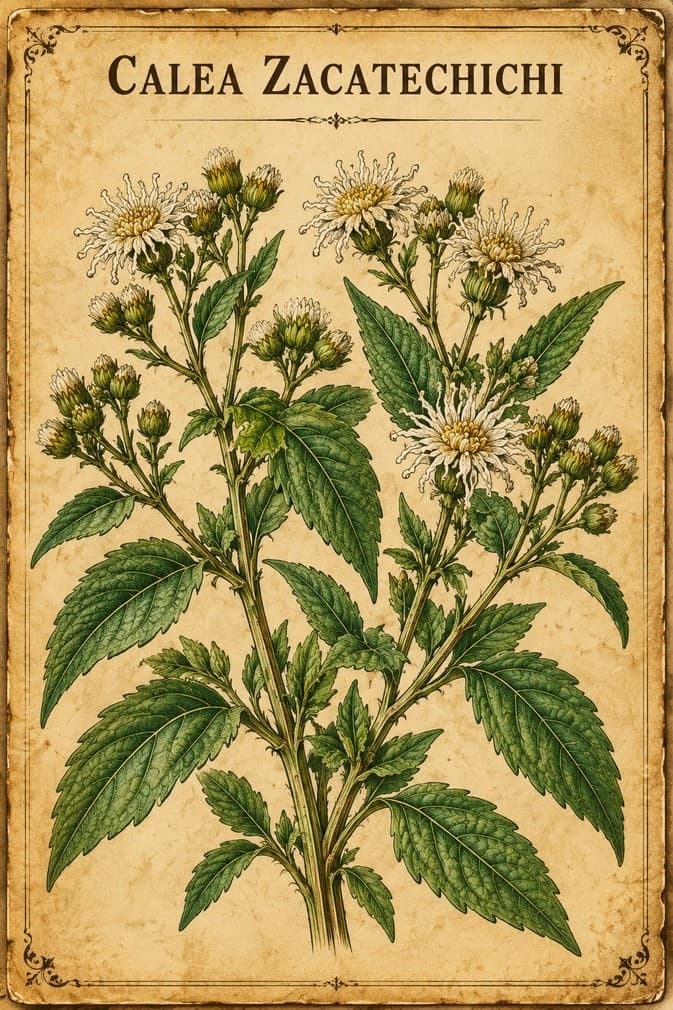
Calea Zacatechichi
Calea zacatechichi
A Mexican shrub in the daisy family, known as dream herb, used in rituals to bring on vivid dreams and in folk medicine for coughs, asthma and stomach problems. Its safety hasn't been properly studied.
What is Calea Zacatechichi?
- Plant family
- Asteraceae, the daisy family
- Parts used
- The leaves and other above-ground parts, as a tea or extract
- Where it grows
- Mexico
- Genus
- Calea
- Species
- zacatechichi
Also called
Dream Herb, Mexican Calea
Traditionally used for
- Dreams (ritual)
- Cough (traditional)
- Asthma (traditional)
- Stomach problems (traditional)
Traditionally described as
- May cause light sleep and more dream recall (one small study)
Safety
Toxicity testing
In lab tests on human kidney cells, calea extract caused cell damage even at low doses. The researchers said its safety needs closer study, especially since it's marketed for diabetes, which can itself harm the kidneys.[1]
In lab tests, calea extract harmed nerve and brain immune cells. Very little is known about its safety in people.[2]
Technical detail: cytotoxicity in SH-SY5Y neuronal and BV-2 microglial cells; effects on cholinergic and dopaminergic pathways.
What does the research say?
Traditional use
These are traditional uses, not proven treatments.
Its ritual use was long limited to Indigenous communities in Mexico, but it has recently become popular for recreational use in Western countries.[2]
The Chontal people of Mexico have used calea to receive messages through their dreams.[3]
In Mexican folk medicine calea is used for coughs, asthma and stomach and gut problems, and it has been used for centuries in rituals.[4]
Laboratory & animal research
Lab and animal results show what might be worth studying in people. They don't show that the herb has these effects in humans.
In cats, calea extracts at doses similar to those people take caused drowsiness and light sleep. Large doses caused drooling, unsteadiness, retching and sometimes vomiting.[3]
In mice and rats, a calea extract reduced signs of anxiety and depression, and a high dose made rats mildly drowsy and changed their brain activity during dreaming sleep.[5]
Technical detail: anxiolytic- and antidepressant-like effects at 0.5–50 mg/kg; mild sedation and more slow-wave sleep at 100 mg/kg; increased hippocampal gamma activity during REM sleep.
In mice, a water-based calea extract eased belly pain but had no effect on seizures, anxiety, activity or muscle strength.[4]
Research in people
In one small study, healthy volunteers took low doses of calea extract or a dummy pill without knowing which. Calea slowed their reaction times. During a nap, it increased light sleep and the number of times they woke up.
They also reported more dream-like images than with the dummy pill or with diazepam (a sleep and anxiety medicine).[3]
In short
Large doses caused vomiting in animals, and lab tests found it harmed kidney and brain cells.
Sources
- [1] Evaluation of "Dream Herb," Calea zacatechichi, for Nephrotoxicity Using Human Kidney Proximal Tubule Cells · DOI: 10.1155/2016/9794570Peer-reviewed study
- [2] Mexican calea (Calea zacatechichi Schltdl.) interferes with cholinergic and dopaminergic pathways and causes neuroglial toxicity · DOI: 10.1016/j.jep.2024.118915Peer-reviewed study
- [3] Psychopharmacologic analysis of an alleged oneirogenic plant: Calea zacatechichi · DOI: 10.1016/0378-8741(86)90002-4Peer-reviewed study
- [4] Neuropharmacological characterization of the oneirogenic Mexican plant Calea zacatechichi aqueous extract in mice · DOI: 10.1007/s11011-016-9794-1Peer-reviewed study
- [5] Calea zacatechichi Schltdl. (Compositae) produces anxiolytic- and antidepressant-like effects, and increases the hippocampal activity during REM sleep in rodents · DOI: 10.1016/j.jep.2020.113316Peer-reviewed study
This information is educational and traditional in nature, and is not a substitute for professional medical advice.