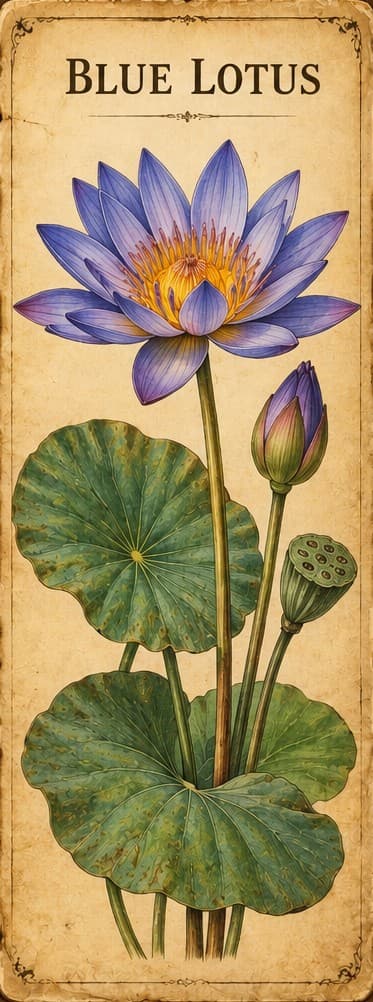
Blue Lotus
Nymphaea caerulea
A water lily that was used in rituals in ancient Egypt. It's now sold as teas, vapes and gummies for calming or euphoric effects, and has sent some users to the emergency room.
What is Blue Lotus?
- Plant family
- Nymphaeaceae, the water lily family
- Parts used
- The flowers, sold dried, as teas, extracts and tinctures, and in vapes and gummies
- Where it grows
- Northern and central Africa
- Genus
- Nymphaea
- Species
- caerulea
Also called
Blue Egyptian Lotus, Blue Water Lily
Traditionally used for
- Calming (traditional)
- Rituals (historical)
Traditionally described as
Safety
Toxicity testing
Blue lotus can cause confusion, agitation, strange behavior, drowsiness and hallucinations. In one reported case, a 22-year-old man who had vaped blue lotus for several weeks had seizures and kidney and liver injury.
Serious poisoning seems to be rare, but little is known about the short- and long-term effects of these products.[1]
Contamination
Blue lotus products aren't regulated by the FDA, so what's in them may not match the label. Some have contained added fragrances, and products may be mixed with other drugs such as synthetic cannabinoids.[1]
What does the research say?
Traditional use
These are traditional uses, not proven treatments.
In ancient Egypt, blue lotus was used in rituals, celebrations and burials. It has also been used medicinally as an aphrodisiac and for calming.[1]
Laboratory & animal research
Lab and animal results show what might be worth studying in people. They don't show that the herb has these effects in humans.
Blue lotus is thought to contain two chemicals, apomorphine and nuciferine, that act on the brain. Lab tests of products sold in shops found very different amounts of these chemicals, and some had little or none.[1]
Technical detail: apomorphine is a non-selective dopamine agonist (approved as an injection for Parkinson's disease "off" periods); nuciferine acts at 5-HT2, 5-HT1A and dopamine D2, D4 and D5 receptors.
Research in people
In a 2023 report, five soldiers went to the emergency room after vaping blue lotus or drinking a drink made with it. They were drowsy and had disturbances in what they saw or sensed. All got better with supportive care, without needing sedating medicines.[2]
In short
Not regulated; has caused confusion, agitation, hallucinations and, in one case, seizures.
Sources
- [1] ToxTalks: Blue Lotus — Blue Ridge Poison Center at UVA HealthGeneral reference
- [2] Toxicity From Blue Lotus (Nymphaea caerulea) After Ingestion or Inhalation: A Case Series · DOI: 10.1093/milmed/usab328Peer-reviewed study
This information is educational and traditional in nature, and is not a substitute for professional medical advice.