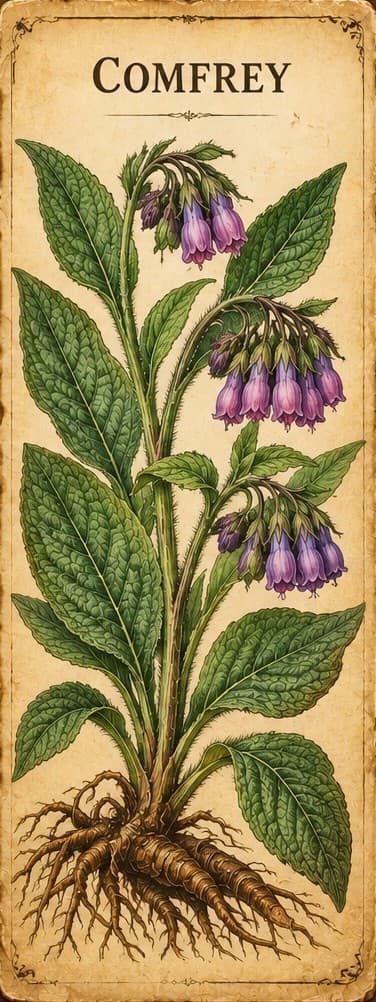
Comfrey
Symphytum officinale
A plant whose root is made into creams for minor sprains and bruises, recognised in Europe as a traditional remedy. Never take comfrey by mouth: it contains substances that damage the liver.
What is Comfrey?
- Plant family
- Boraginaceae, the borage family
- Parts used
- The root, made into creams and ointments for the skin. Not for taking by mouth.
- Genus
- Symphytum
- Species
- officinale
Also called
Comfrey Root
Traditional names
Knitbone, Boneset
Traditionally used for
- Sprains
- Bruises
- Back pain
- Joint pain
Traditionally described as
- May relieve pain (on the skin)
Health topics
Where Comfrey appears in symptom search, and why. Being listed doesn't mean it's a proven treatment.
- Joint Discomfort
In trials, comfrey root creams eased knee arthritis pain and back pain more than a dummy cream. Use on the skin only.
- Sprains and Bruises
Recognised in Europe as a traditional cream for minor sprains and bruises. In trials, comfrey creams eased ankle sprain pain more than a dummy cream.
Traditions that use it
European Folk Medicine
Used for centuries on painful muscles and joints; recognised in Europe as a traditional cream for minor sprains and bruises.
Safety
Who should avoid it
Don't put comfrey on broken or irritated skin, and keep it away from your eyes, mouth and other moist areas. Don't use it if you're allergic to it.[1]
Pregnancy
Not recommended during pregnancy or breastfeeding. Its safety hasn't been established, and the pyrrolizidine alkaloids it contains harmed unborn young in animal studies.[1]
Toxicity testing
Never take comfrey by mouth. It contains pyrrolizidine alkaloids, which damage the liver in animals and are generally accepted to be toxic to people. Outbreaks of a serious liver disease caused by these substances have been reported in several countries, and they may also cause cancer.
In 2001 the FDA told companies to stop selling comfrey supplements and to tell customers to stop using them right away.[2]
Technical detail: the liver disease is hepatic veno-occlusive disease (VOD), the blockage of small veins in the liver.
How much to use
For adults: a thin layer twice a day, for no more than 10 days. Not recommended for anyone under 18. See a doctor if symptoms don't improve or get worse.[1]
Technical detail: semi-solid preparation with 10% liquid extract (DER 2:1, ethanol 65%); daily pyrrolizidine alkaloid exposure must be below 1 µg.
What does the research say?
Traditional use
These are traditional uses, not proven treatments.
Comfrey has been used for centuries for painful muscle and joint complaints. Its old names, knitbone and boneset, reflect its use for injuries.[3]
The European Medicines Agency recognises comfrey root creams and ointments as a traditional herbal medicine for relieving the symptoms of minor sprains and bruises in adults. This is based on long use alone.[1]
Research in people
Several trials have tested comfrey root creams on the skin against a dummy cream:
- 120 people with back pain: pain on movement fell much more with comfrey
- 220 people with knee arthritis: knee pain fell more with comfrey over 3 weeks
- 142 people with ankle sprains: tenderness eased more with comfrey
- 306 children aged 3 to 12 with bruises and sprains: symptoms improved and the cream was well tolerated
This summary was written by a scientist working for the drug company Merck.[3]
Technical detail: back pain −95.2% vs −37.8% (placebo); knee osteoarthritis −54.7% vs −10.7% over 21 days. A separate 164-person ankle sprain trial found comfrey better than diclofenac gel.
In short
Never take it by mouth; don't put it on broken skin or use it for more than 10 days.
Sources
- [1] European Union herbal monograph on Symphytum officinale L., radix — European Medicines Agency (EMA), Committee on Herbal Medicinal ProductsGovernment health agency
- [2] FDA advises dietary supplement manufacturers to remove comfrey products from the market — US Food and Drug AdministrationGovernment health agency
- [3] Comfrey: a clinical overview · DOI: 10.1002/ptr.4612Peer-reviewed study
This information is educational and traditional in nature, and is not a substitute for professional medical advice.