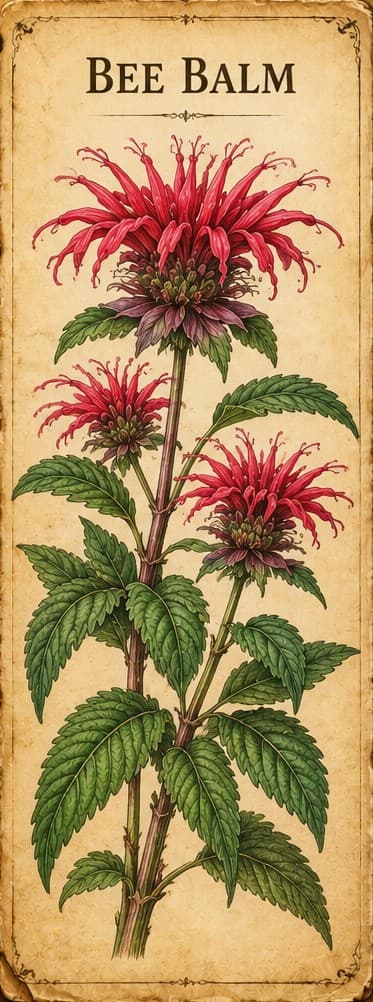
Bee Balm
Monarda didyma
A red-flowered North American mint, also called Oswego tea, used by the Cherokee as a tea and as a poultice for colds and headaches. Human research is very limited.
What is Bee Balm?
- Plant family
- Lamiaceae, the mint family
- Parts used
- The leaves, as a tea or a poultice (a moist paste put on the skin); the flowers and leaves for essential oil
- Where it grows
- North America; all 17 Monarda species are native there
- Genus
- Monarda
- Species
- didyma
Also called
Scarlet Bee Balm, Scarlet Beebalm, Oswego Tea, Monarda, Bergamot Flower
Traditionally used for
- Colds (traditional)
- Headache (traditional)
- Tea
Traditionally described as
- Kills bacteria and fungi (in lab tests)
- Antioxidant (in lab tests)
Health topics
Where Bee Balm appears in symptom search, and why. Being listed doesn't mean it's a proven treatment.
- Colds and Nasal Congestion
Traditionally used by the Cherokee as a poultice for colds. Not studied for colds in people.
- Cough
Monarda plants, including bee balm, were traditionally used by Native American tribes for cough. Not studied for cough in people.
- Fever
Monarda plants, including bee balm, were traditionally used by Native American tribes for fever. Not studied for fever in people.
- Headache
Traditionally used by the Cherokee as a poultice for headaches, and Monarda plants were used by many Native American tribes for headache. Not studied for headaches in people.
Traditions that use it
Native American Ethnobotany
Monarda plants were used by many tribes for fever, headache, cough and pain; the Cherokee used bee balm as a poultice for colds and headaches.
Safety
Pregnancy
The Cherokee traditionally used bee balm tea to cause miscarriage.[1]
What does the research say?
Traditional use
These are traditional uses, not proven treatments.
The Cherokee used bee balm leaves:
- As a poultice (a moist paste put on the skin) for colds and headaches
- As a tea to cause miscarriage
Many Native American tribes used Monarda plants, the group bee balm belongs to, for fever, headache and cough. Crushed leaves were also rubbed on the body to ease pain. The name bee balm probably comes from its use to soothe bee stings.
Other historical uses include perfume and food seasoning.[2]
Bee balm is also called Oswego tea after Oswego, New York, where Native Americans and early settlers flavored their drinks with its leaves. After the Boston Tea Party it reportedly replaced English tea in New England.[2]
Laboratory & animal research
Lab and animal results show what might be worth studying in people. They don't show that the herb has these effects in humans.
In lab tests, essential oils from bee balm leaves and flowers showed strong antioxidant activity and killed a range of bacteria and yeasts. Their main ingredient was thymol, the same aromatic compound found in thyme.[3]
Technical detail: thymol 51.55–68.63% of the essential oils; DPPH IC50 0.77–0.92 µL. Hydrosols had selective antifungal but no significant antibacterial activity.
Research in people
In one trial, 81 healthy adults aged 45 to 65 took a bee balm extract (100 mg a day) or a dummy pill for 12 weeks. Blood markers linked to aging held steady or improved in the bee balm group and worsened in the dummy-pill group. The bee balm group also reported better quality of life and sleep.
No significant side effects were reported. The study was small and short, and it was partly paid for by the company that makes the extract.[4]
Technical detail: randomized, double-blind, placebo-controlled; 40 extract vs 41 placebo (maltodextrin); outcomes were leukocyte telomere length and DNA methylation age. Funded in part by Mibelle AG Biochemistry.
In short
The Cherokee traditionally used bee balm tea to cause miscarriage.
Sources
- [1] The Phytochemistry of Cherokee Aromatic Medicinal Plants · DOI: 10.3390/medicines5040121Peer-reviewed study
- [2] Monarda for the Mid-Atlantic Region (research report) — Mt. Cuba CenterGeneral reference
- [3] Chemical Composition, and Antioxidant and Antimicrobial Properties of Monarda didyma L.'s Essential Oils and Hydrosols · DOI: 10.3390/molecules31132252Peer-reviewed study
- [4] Unveiling the geroprotective potential of Monarda didyma L.: insights from in vitro studies and a randomized clinical trial on slowing biological aging and improving quality of life · DOI: 10.1007/s11357-025-01580-2Peer-reviewed study
This information is educational and traditional in nature, and is not a substitute for professional medical advice.