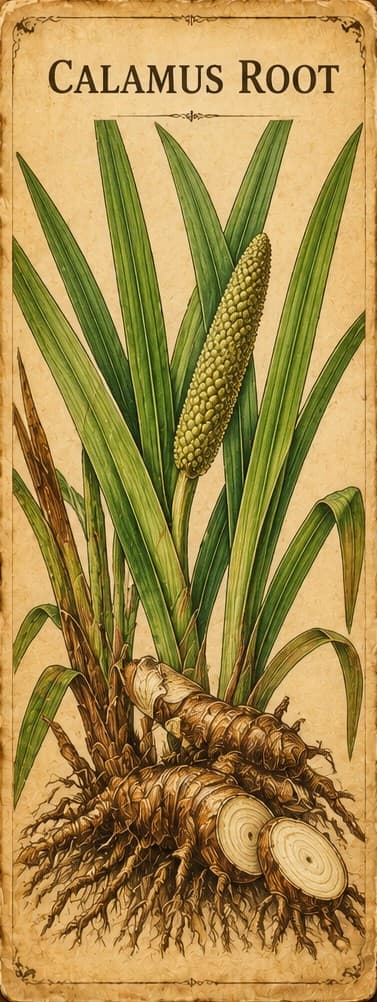
Calamus Root
Acorus calamus
The root of sweet flag, a marsh plant used in traditional medicine around the world for stomach cramps and asthma. It contains beta-asarone, which caused cancer in animal studies; adding it to food is banned in the US.
What is Calamus Root?
- Plant family
- Acoraceae, the sweet flag family
- Parts used
- The underground stem (rhizome), often called the root
- Genus
- Acorus
- Species
- calamus
Also called
Sweet Flag, Calamus
Traditionally used for
- Stomach cramps (traditional)
- Dysentery (traditional)
- Asthma (traditional)
- Worms (traditional)
Traditionally described as
Safety
Who should avoid it
In the US, food with any added calamus, calamus oil or calamus extract is illegal. It was banned in 1968.[1]
Toxicity testing
Calamus contains asarone, which caused cancer in animal studies. The European Medicines Agency says the amount in herbal medicines should be kept as low as possible.
How much a plant contains depends on its variety: one variety had none in testing, while others contain small or large amounts. The agency says the variety without it should always be preferred.[2]
Technical detail: β-asarone in dried rhizome: not detected (diploid var. americanus), 0.3% (triploid var. calamus), 4.4–8.3% (tetraploid var. angustatus). Temporary limit about 115 µg/day (about 2 µg/kg body weight/day) until a full benefit/risk assessment.
What does the research say?
Traditional use
These are traditional uses, not proven treatments.
Calamus root is used widely in traditional medicine around the world. Reported uses include:
- Stomach cramps
- Dysentery (bloody diarrhea)
- Asthma
- Getting rid of worms
- As a tonic and stimulant
- As an insecticide
Laboratory & animal research
Lab and animal results show what might be worth studying in people. They don't show that the herb has these effects in humans.
In animal studies, asarone, a natural chemical in calamus, damaged genes and caused liver cancer in rodents. In rats it also slowed blood clotting and made them drowsy.[2]
Technical detail: α- and β-asarone are genotoxic and hepatocarcinogenic in rodents; β-asarone showed anticoagulant effects in mice and rats and sedative and hypothermic effects in rats.
In short
Contains beta-asarone, which caused cancer in rodents; calamus is banned as a food ingredient in the US.
Sources
- [1] 21 CFR 189.110: Calamus and its derivatives (substances prohibited from use in human food) — US Food and Drug Administration (Code of Federal Regulations)Government health agency
- [2] Public statement on the use of herbal medicinal products containing asarone — European Medicines Agency (EMEA), Committee on Herbal Medicinal ProductsGovernment health agency
This information is educational and traditional in nature, and is not a substitute for professional medical advice.