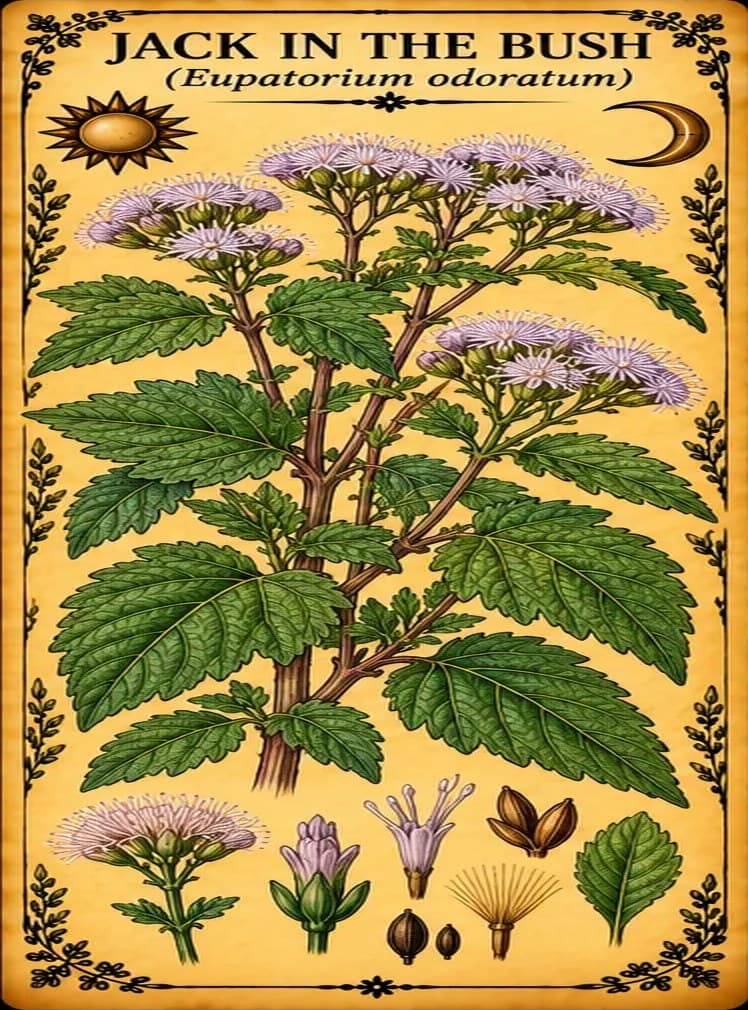
Jack in the Bush
Chromolaena odorata
One of Jamaica's most popular bush teas for colds and flu, also used in Africa and Asia for fever, wounds and diabetes. Research so far is in the lab and in animals.
What is Jack in the Bush?
- Plant family
- Asteraceae, the daisy family
- Parts used
- The leaves, usually made into a tea
- Genus
- Chromolaena
- Species
- odorata
Regional names
Jack-in-the-bush
Older scientific names
Eupatorium odoratum
Traditionally used for
- Colds
- Flu
- Fever
- Wounds
- Diabetes (traditional)
Traditionally described as
- Antioxidant (in lab tests)
- May help wounds heal (in animal studies)
Health topics
Where Jack in the Bush appears in symptom search, and why. Being listed doesn't mean it's a proven treatment.
- Colds and Nasal Congestion
One of the plants used most often in Jamaica for colds and flu.
- Cuts, Wounds, Burns and Skin Ulcers
Traditionally used for wounds. It helped wounds heal in lab and animal studies.
- Fever
Traditionally used for fever in Africa and Asia. It lowered fever in animal studies.
- High Blood Sugar
Traditionally used for diabetes. Lab and animal studies suggest effects on blood sugar; it hasn't been tested in people.
- Immune Support (Colds and Flu)
One of the plants used most often in Jamaica for colds and flu.
Traditions that use it
Caribbean Folk Medicine
One of Jamaica's most popular bush medicines, used by at least 20% of people for colds and flu.
African Traditional Medicine
Used in sub-Saharan Africa for diabetes, malaria, wounds, inflammation and fever.
Safety
Toxicity testing
Researchers have found pyrrolizidine alkaloids in the roots of jack-in-the-bush from southern Africa. Its safety in people hasn't been studied.[1]
Technical detail: rinderine and intermidine isolated from root extracts.
What does the research say?
Traditional use
These are traditional uses, not proven treatments.
In Jamaica, jack-in-the-bush is one of the plants used most often for colds and flu. In surveys, 20% or more of people named it for these infections.[2]
A book based on interviews with more than 100 people in Portland and Kingston, Jamaica, includes jack-in-the-bush among the 25 most popular medicinal plants in those communities.[3]
In Asia and sub-Saharan Africa, where it grows widely, it's traditionally used for diabetes, malaria, wounds, inflammation and fever.[4]
In Nepal and elsewhere, it's traditionally used for diabetes, wounds, skin infections, diarrhea and malaria.[5]
Laboratory & animal research
Lab and animal results show what might be worth studying in people. They don't show that the herb has these effects in humans.
A 2022 review of lab and animal studies reported effects against diabetes, cancer cells, inflammation, germs and parasites, as well as pain relief, lowering fever and helping wounds heal. The reviewers say how it works is still poorly understood.[4]
In lab tests, leaf and flower extracts acted as antioxidants, blocked an enzyme that breaks down starch into sugar, and slowed some bacteria.[5]
Technical detail: methanol leaf extract active against K. pneumoniae, B. subtilis and E. coli; α-glucosidase inhibition; brine shrimp toxicity assay.
In short
Its safety in people hasn't been studied; pyrrolizidine alkaloids have been found in its roots.
Sources
- [1] First record of pyrrolizidine alkaloids in the southern African biotype of Chromolaena odorata (Asteraceae) — South African Journal of BotanyPeer-reviewed study
- [2] Antiviral Activity of Jamaican Medicinal Plants and Isolated Bioactive Compounds — Molecules · DOI: 10.3390/molecules26030607Peer-reviewed study
- [3] Popular Medicinal Plants in Portland and Kingston, Jamaica — Springer (Advances in Economic Botany) · DOI: 10.1007/978-3-030-48927-4Peer-reviewed study
- [4] Biological activities of Chromolaena odorata: A mechanistic review — South African Journal of BotanyPeer-reviewed study
- [5] Phytochemistry, Biological, and Toxicity Study on Aqueous and Methanol Extracts of Chromolaena odorata — The Scientific World Journal · DOI: 10.1155/2023/6689271Peer-reviewed study
This information is educational and traditional in nature, and is not a substitute for professional medical advice.