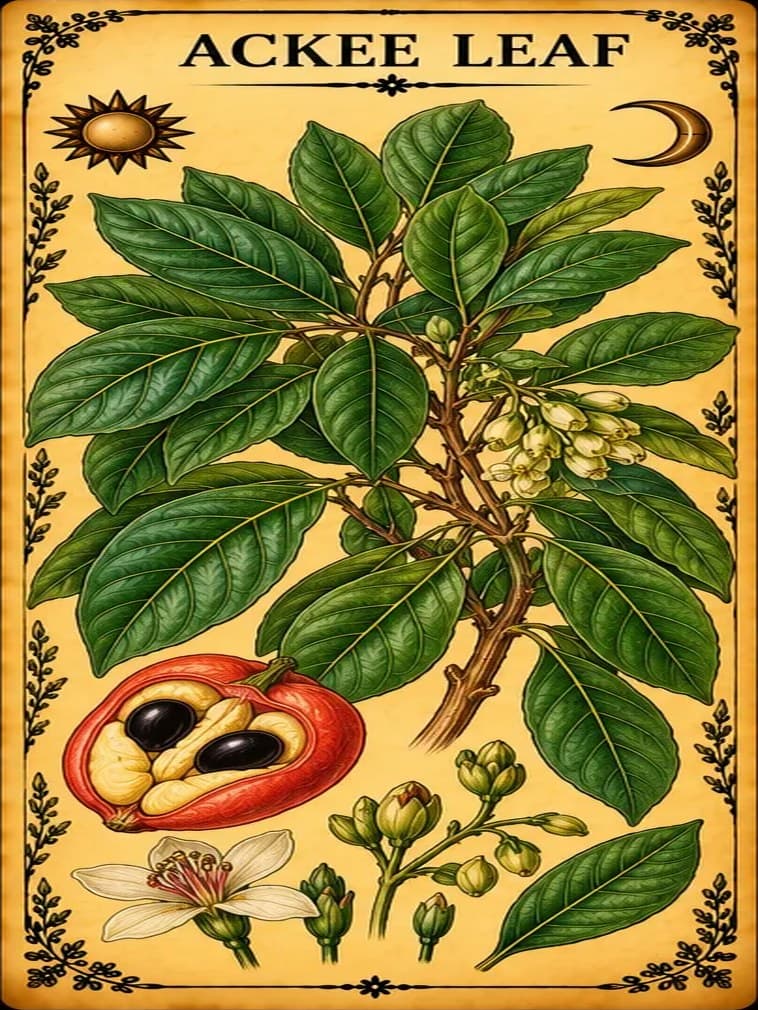
Ackee Leaf
Blighia sapida
Leaves of the ackee tree, whose fruit is Jamaica's national dish. The leaves are used in folk medicine for pain, fever and stomach problems. Unripe ackee fruit is poisonous.
What is Ackee Leaf?
- Plant family
- Sapindaceae, the soapberry family
- Parts used
- The leaves. The bark, roots, seeds and fruit pods are also used in traditional medicine.
- Where it grows
- Originally from sub-Saharan Africa; now grown in the Caribbean, the Americas and elsewhere
- Genus
- Blighia
- Species
- sapida
Also called
Ackee, Akee
Traditionally used for
- Pain (traditional)
- Fever (traditional)
- Stomach ache (traditional)
- Skin (traditional)
Traditionally described as
- May relieve pain (in animal studies)
Health topics
Where Ackee Leaf appears in symptom search, and why. Being listed doesn't mean it's a proven treatment.
- Fever
Parts of the ackee plant are traditionally used for fever. This use hasn't been tested in people.
- Indigestion
Traditionally used for stomach ache. This use hasn't been tested in people.
- Joint Discomfort
Traditionally used for backache and rheumatism; the leaf reduced pain in mice. It hasn't been tested in people.
- Poisonous Plants
Unripe ackee fruit contains hypoglycin A, a poison that has killed children.
- Skin Irritation, Rashes and Itching
Traditionally used for skin infections and skin diseases. This use hasn't been tested in people.
Traditions that use it
African Traditional Medicine
Used in sub-Saharan Africa, where it originated, for many ailments, including pain, fever and stomach problems.
Caribbean Folk Medicine
The fruit's aril is the main ingredient of Jamaica's national dish.
Safety
Toxicity testing
Unripe ackee fruit is poisonous. It contains large amounts of hypoglycin A, a toxic compound. Between 1998 and 2001, 16 children died in Suriname from suspected ackee poisoning, linked to its misuse by traditional healers; hypoglycin A was found in one child's stomach.[1]
Technical detail: hypoglycin A measured at 9.2 mg/g in fruit from Jamaica, 8.1 mg/g from Burkina Faso and 5.1 mg/g from Suriname.
What does the research say?
Traditional use
These are traditional uses, not proven treatments.
Ackee comes from sub-Saharan Africa and is now grown in the Caribbean and elsewhere. The fruit's soft aril is the main ingredient of Jamaica's national dish. Parts of the plant, including the leaves, are traditionally used for:
- Fever, including in young children
- Stomach ache, constipation, diarrhea and dysentery
- Backache and rheumatism
- Skin infections and conjunctivitis (pink eye)
- Malaria and typhoid
The leaves are traditionally used for pain between the ribs, stomach ache, back pain, skin diseases and psychosis.[3]
Laboratory & animal research
Lab and animal results show what might be worth studying in people. They don't show that the herb has these effects in humans.
In mice, a water-based leaf extract reduced pain. The researchers think it works in the body's tissues rather than in the brain.[3]
Technical detail: 250 and 500 mg/kg by mouth; contains chlorogenic acid, saponins, tannins, caffeic acid, quercetin and gallic acid.
In fruit flies, leaf and aril extracts helped protect against damage caused by the heavy metal cadmium, acting as antioxidants.[4]
In short
Unripe ackee fruit contains hypoglycin A, which has caused deadly poisoning.
Sources
- [1] Fatal intoxication due to ackee (Blighia sapida) in Suriname and French Guyana. GC-MS detection and quantification of hypoglycin-A — Forensic Science International · DOI: 10.1016/j.forsciint.2011.01.018Peer-reviewed study
- [2] Blighia sapida K.D. Koenig: A review on its phytochemistry, pharmacological and nutritional properties — Journal of Ethnopharmacology · DOI: 10.1016/j.jep.2019.01.017Peer-reviewed study
- [3] Phytochemical screening of aqueous leaf extract of Blighia sapida K.D. Koenig (Sapindaceae) and its analgesic property in mice — Journal of Ethnopharmacology · DOI: 10.1016/j.jep.2021.113977Peer-reviewed study
- [4] Ackee (Blighia sapida K.D. Koenig) Leaves and Arils Methanolic Extracts Ameliorate CdCl2-Induced Oxidative Stress Biomarkers in Drosophila melanogaster — Oxidative Medicine and Cellular Longevity · DOI: 10.1155/2022/3235031Peer-reviewed study
This information is educational and traditional in nature, and is not a substitute for professional medical advice.