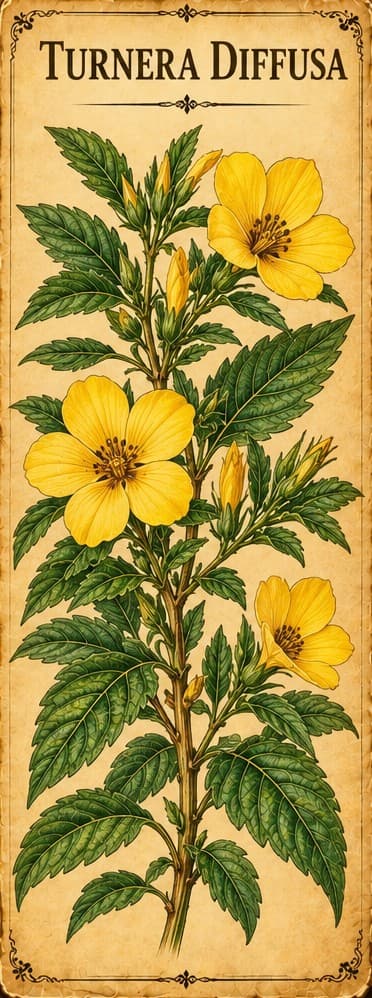
Damiana
Turnera diffusa
A plant used in folk medicine as an aphrodisiac. Lab and animal studies suggest effects on sexual function, but it hasn't been tested on its own in people.
What is Damiana?
- Plant family
- Passifloraceae, the passionflower family
- Parts used
- The leaves
- Genus
- Turnera
- Species
- diffusa
Traditionally used for
- Aphrodisiac (traditional)
- Sexual health
Traditionally described as
- Antioxidant (in lab tests)
Health topics
Where Damiana appears in symptom search, and why. Being listed doesn't mean it's a proven treatment.
- Sexual Health
A folk aphrodisiac. Lab and animal studies suggest effects on sexual function, but it hasn't been tested on its own in people.
What does the research say?
Traditional use
These are traditional uses, not proven treatments.
In Brazilian folk medicine, damiana is one of the plants used as an aphrodisiac and for male sexual problems.[1]
Laboratory & animal research
Lab and animal results show what might be worth studying in people. They don't show that the herb has these effects in humans.
A 2024 review found damiana is one of the few Brazilian folk aphrodisiacs tested in lab and animal studies. Possible effects include acting as an antioxidant, acting like male hormones, and affecting blood flow and brain chemicals involved in sexual function. The reviewers say more research is needed.[1]
Technical detail: proposed mechanisms include androgenic activity, PDE5 inhibition, increased nitric oxide, and dopaminergic and noradrenergic activation.
In lab tests on human cells, a commercial damiana extract lowered levels of an enzyme targeted by erection medicines, blocked an enzyme that turns testosterone into estrogen, and slightly raised nitric oxide, which helps blood vessels relax. These were cell tests only.[2]
Technical detail: Liboost extract; 49 compounds, mainly flavonoids (15.9 mg/g); reduced PDE5 expression, inhibited aromatase.
In short
Not tested on its own in people; its safety is unknown.
Sources
- [1] The traditional use of native Brazilian plants for male sexual dysfunction: Evidence from ethnomedicinal applications, animal models, and possible mechanisms of action — Journal of Ethnopharmacology · DOI: 10.1016/j.jep.2023.116876Peer-reviewed study
- [2] Flavonoid Composition and Molecular Basis of the Potential Sexual-Enhancing Properties of a Turnera diffusa Extract (Liboost) — Pharmaceuticals · DOI: 10.3390/ph19040597Peer-reviewed study
This information is educational and traditional in nature, and is not a substitute for professional medical advice.