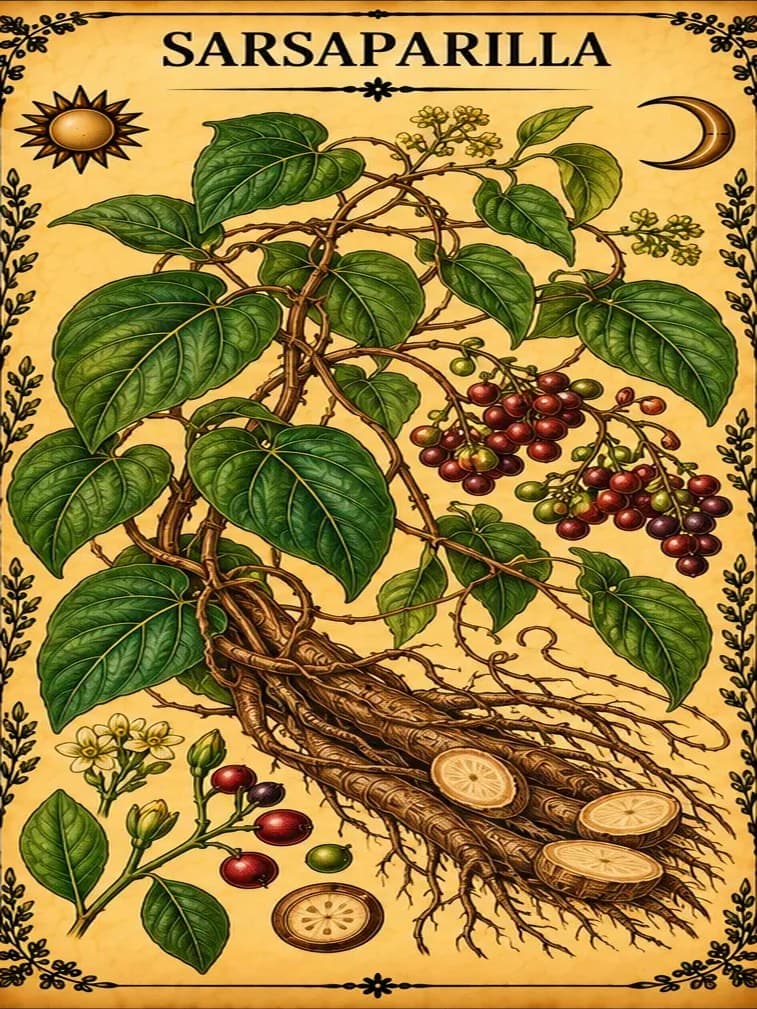
Sarsaparilla
Smilax ornata
A plant whose root is boiled into Jamaican roots tonics and used for colds and flu. Research on sarsaparilla plants is mostly preliminary lab and animal work.
What is Sarsaparilla?
- Plant family
- Smilacaceae, the greenbrier family
- Parts used
- The root, boiled into tonics and roots drinks
- Genus
- Smilax
- Species
- ornata
Also called
Sarsaparilla Root
Traditionally used for
- Roots tonic
- Colds
- Flu
- Stamina (traditional)
- Skin (traditional)
Traditionally described as
- Antioxidant (in lab tests)
Health topics
Where Sarsaparilla appears in symptom search, and why. Being listed doesn't mean it's a proven treatment.
- Colds and Nasal Congestion
One of the plants used most often in Jamaica for colds and flu.
- Immune Support (Colds and Flu)
One of the plants used most often in Jamaica for colds and flu.
- Joint Discomfort
Sarsaparilla plants have traditionally been used for gout and rheumatism.
- Sexual Health
One of the roots in Jamaica's "strong back" tonic, used by men for impotence and stamina.
- Skin Irritation, Rashes and Itching
Sarsaparilla plants have traditionally been used for skin problems.
Traditions that use it
Caribbean Folk Medicine
Used in Jamaica for colds and flu, and as one of the roots in the "strong back" roots tonic.
What does the research say?
Traditional use
These are traditional uses, not proven treatments.
In Jamaica, sarsaparilla is one of the plants used most often for colds and flu. It's also one of the roots boiled into the "roots tonic" or "strong back" drink, which men commonly use for impotence and stamina.[1]
Sarsaparilla plants (the genus Smilax) have been used for centuries for diabetes, gout, rheumatism, skin problems and syphilis. The root is the main part used.[2]
Laboratory & animal research
Lab and animal results show what might be worth studying in people. They don't show that the herb has these effects in humans.
A 2026 review reported more than 1,000 natural compounds found in sarsaparilla plants. In lab and animal studies, they showed effects against cancer cells, diabetes, inflammation, germs and viruses, as antioxidants, on the immune system, and protecting the liver. The reviewers say most findings are preliminary and studies in people are needed.[2]
Technical detail: at least 1058 compounds, including flavonoids, phenolic acids, steroidal saponins, polysaccharides and stilbenoids.
In short
Most research is preliminary; its safety in people hasn't been well studied.
Sources
- [1] Antiviral Activity of Jamaican Medicinal Plants and Isolated Bioactive Compounds — Molecules · DOI: 10.3390/molecules26030607Peer-reviewed study
- [2] The genus Smilax L.: A comprehensive review of traditional uses, phytochemistry, pharmacological activities, and toxicity — South African Journal of BotanyPeer-reviewed study
This information is educational and traditional in nature, and is not a substitute for professional medical advice.