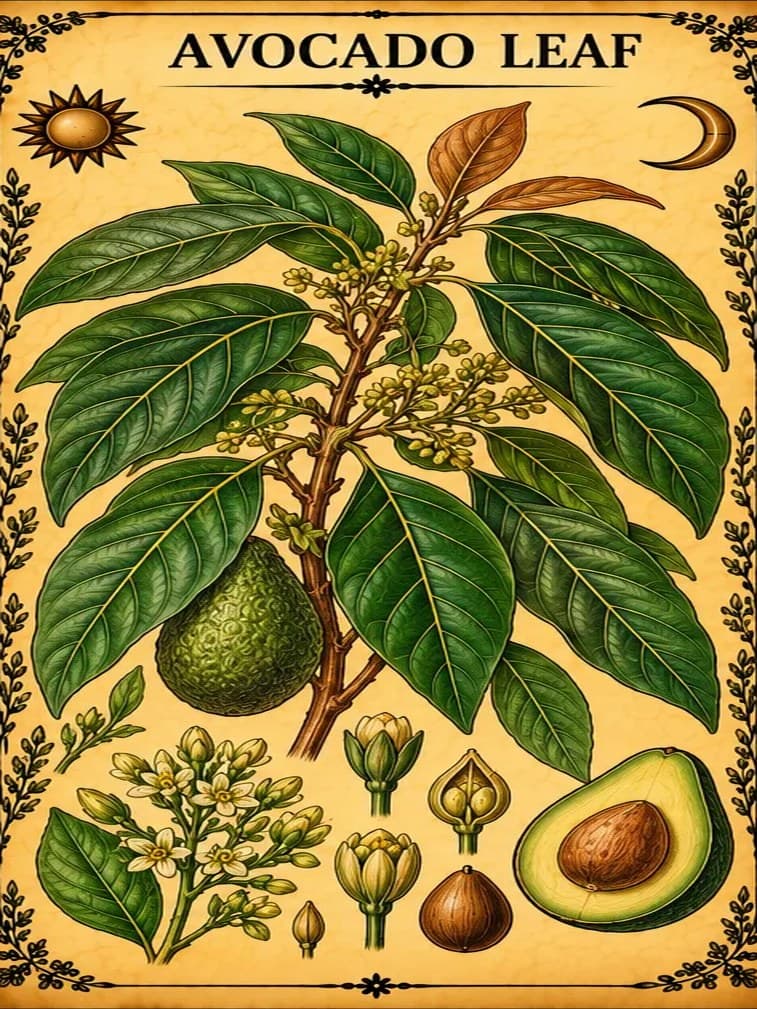
Avocado Leaf
Persea americana
Leaves of the avocado tree, made into a tea and used in Caribbean folk medicine for high blood pressure. They lowered blood pressure in rats but haven't been tested in people.
What is Avocado Leaf?
- Plant family
- Lauraceae, the laurel family
- Parts used
- The leaves, usually made into a tea
- Genus
- Persea
- Species
- americana
Also called
Avocado
Traditionally used for
- High blood pressure (traditional)
- Tea
Traditionally described as
- May lower blood pressure (in animal studies)
Health topics
Where Avocado Leaf appears in symptom search, and why. Being listed doesn't mean it's a proven treatment.
- High Blood Pressure
Traditionally used for high blood pressure in the Caribbean. It lowered blood pressure in rats but hasn't been tested in people.
Traditions that use it
Caribbean Folk Medicine
Used in Trinidad and Tobago for high blood pressure.
What does the research say?
Traditional use
These are traditional uses, not proven treatments.
Laboratory & animal research
Lab and animal results show what might be worth studying in people. They don't show that the herb has these effects in humans.
In rats with high blood pressure caused by salt, avocado leaf extract given for 14 days brought blood pressure back to near normal and increased urination. In lab tests it blocked ACE, the same enzyme targeted by some blood pressure medicines.[2]
Technical detail: 16% NaCl-induced hypertension in 24 Wistar rats; extract lowered systolic pressure from 164.9 to 116.8 mmHg and diastolic from 118.4 to 82.8 mmHg; ACE inhibition about 60%; rich in quercetin and potassium.
In short
Not studied in people; its safety is unknown.
Sources
- [1] Ethnomedicines used in Trinidad and Tobago for urinary problems and diabetes mellitus — Journal of Ethnobiology and Ethnomedicine · DOI: 10.1186/1746-4269-2-45Peer-reviewed study
- [2] Effectiveness of avocado leaf extract (Persea americana Mill.) as antihypertensive — F1000Research · DOI: 10.12688/f1000research.124643.2Peer-reviewed study
This information is educational and traditional in nature, and is not a substitute for professional medical advice.