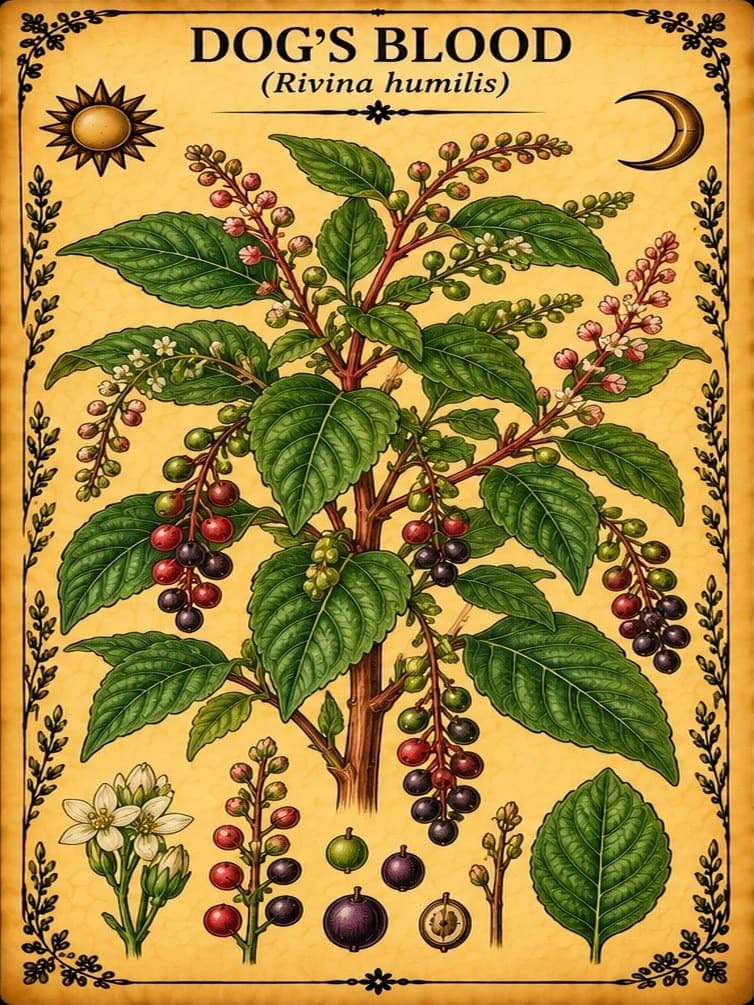
Dog's Blood
Rivina humilis
A small plant with red berries, known in Jamaica as dogberry and elsewhere as pigeon berry or blood berry. Its leaves are cooked as a leafy green; research so far is in the lab and in rats.
What is Dog's Blood?
- Plant family
- Petiveriaceae, the guinea hen weed family
- Parts used
- The leaves are eaten cooked, and the red berries are also eaten
- Where it grows
- Native to the Caribbean and tropical America; now naturalised in South and Southeast Asia and the Pacific
- Genus
- Rivina
- Species
- humilis
Also called
Pigeon Berry, Blood Berry, Dogs Blood
Regional names
Dogberry
Traditionally used for
- Leafy green
- Berries
- Blood sugar
Traditionally described as
- Antioxidant (in lab tests)
Health topics
Where Dog's Blood appears in symptom search, and why. Being listed doesn't mean it's a proven treatment.
- High Blood Sugar
Lowered blood sugar in diabetic rats. It hasn't been tested in people.
Traditions that use it
Caribbean Folk Medicine
Known in Jamaica as dogberry. Haitian communities grow it for its leaves, which are cooked and eaten.
What does the research say?
Traditional use
These are traditional uses, not proven treatments.
Laboratory & animal research
Lab and animal results show what might be worth studying in people. They don't show that the herb has these effects in humans.
Lab analysis found the seeds are rich in carbohydrates, protein and fat, including omega fatty acids. Extracts of different parts of the plant acted as antioxidants. The berries contain betalains, the red pigments also found in beetroot.[3]
Technical detail: seeds 50.15 g/100 g carbohydrate, 10.96 g protein, 11.25 g fat.
In diabetic rats, an alcohol-based extract given for 21 days lowered blood sugar, kept liver and kidney tests normal, and boosted the liver's antioxidant defenses.[4]
Technical detail: streptozotocin- and fructose-induced type 2 diabetes; ethanol extract; improved oral glucose tolerance at 90 and 120 minutes; HbA1c normal in treated groups.
In short
Hasn't been studied in people, so its safety as a medicine is unknown.
Sources
- [1] Common Name Database — Natural History Museum of Jamaica, Institute of JamaicaGeneral reference
- [2] The Consumption of Edible Leaves by Afro-Descendants in French Guiana and Suriname: An Overview of a Constantly Evolving Ethno-Culinary Practice — Plants · DOI: 10.3390/plants15132096Peer-reviewed study
- [3] Phytoconstituents, GC-MS Characterization of Omega Fatty Acids, and Antioxidant Potential of Less-Known Plant Rivina humilis L. — ACS Omega · DOI: 10.1021/acsomega.3c02883Peer-reviewed study
- [4] In vivo antioxidant and hypoglycaemic potentials of Rivina humilis extract against streptozotocin induced diabetes and its complications in wistar rats — Journal of Diabetes and Metabolic Disorders · DOI: 10.1007/s40200-023-01258-6Peer-reviewed study
This information is educational and traditional in nature, and is not a substitute for professional medical advice.