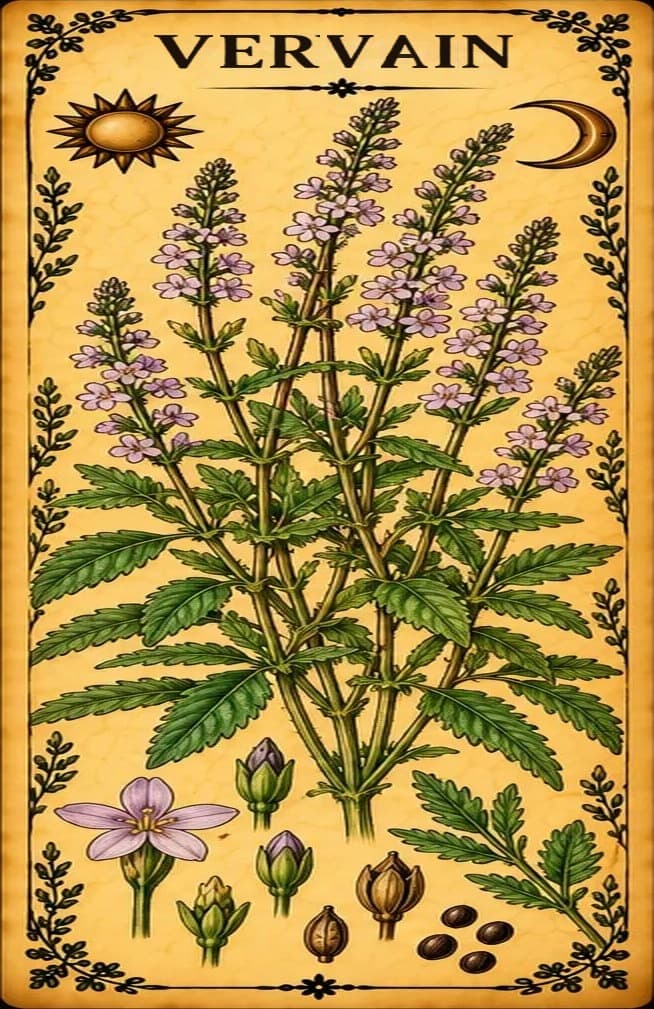
Vervain
Stachytarpheta jamaicensis
Called vervain in Jamaica and vervine in Antigua and Trinidad, a weedy plant whose leaves make a "cooling" tea used for the stomach, colds and coughs, and to clean wounds.
What is Vervain?
- Plant family
- Verbenaceae, the verbena family
- Parts used
- The leaves and stems, usually made into a tea. The leaves are also put on the skin.
- Genus
- Stachytarpheta
- Species
- jamaicensis
Also called
Blue Porterweed, Brazilian Tea
Regional names
Vervine
Traditionally used for
- Cooling tea
- Indigestion
- Colds
- Cough
- Wounds
Traditionally described as
- Fights bacteria and fungi (in lab tests)
Health topics
Where Vervain appears in symptom search, and why. Being listed doesn't mean it's a proven treatment.
- Asthma and Wheezing
Traditionally used for asthma.
- Breast Milk Supply
Traditionally used in southern Nigeria to increase breast milk.
- Colds and Nasal Congestion
Traditionally used for colds and flu.
- Constipation
Traditionally used for constipation.
- Cough
Traditionally used for cough and bronchitis.
- Cuts, Wounds, Burns and Skin Ulcers
The leaves are traditionally used to clean cuts, wounds and sores.
- Indigestion
Traditionally used as a "cooling" tea for indigestion and acid reflux.
- Pregnancy and Childbirth
Not recommended during pregnancy; it's thought to be able to cause miscarriage.
- SIBO and Intestinal Parasites
Leaf juice is traditionally used for worms.
Traditions that use it
Caribbean Folk Medicine
Called vervain in Jamaica and vervine in Antigua and Trinidad; used as a "cooling" remedy.
African Traditional Medicine
Used by women in southern Nigeria for menstrual problems and after childbirth.
Safety
Who should avoid it
It isn't recommended if you have low blood pressure, because it's thought to lower blood pressure.[1]
Pregnancy
It isn't recommended during pregnancy, because it's thought to be able to cause miscarriage.[1]
What does the research say?
Traditional use
These are traditional uses, not proven treatments.
It's called vervain in Jamaica and vervine in Antigua and Barbuda, among other Caribbean names.[2]
In Trinidad and Tobago, vervine leaves are used as a "cooling" remedy.[3]
Older people often use it as a "cooling" tea for the stomach, made from the leaves and stems. Traditional uses include:
- Digestion: indigestion, acid reflux, ulcers and constipation
- Breathing: asthma, colds, flu, bronchitis and cough
- Allergies, and liver problems such as cirrhosis and hepatitis
- Dysentery and worms (leaf juice)
- Cleaning cuts, wounds and sores (leaves on the skin)
- In southern Nigeria, menstrual problems, a tea after childbirth, and to increase breast milk
Laboratory & animal research
Lab and animal results show what might be worth studying in people. They don't show that the herb has these effects in humans.
A 2016 review reported that in lab and animal studies it fought bacteria and fungi, its main effects. Its main active compound is verbascoside. Other reported effects include protecting the liver in rats and improving blood fats in animals.[1]
In rats, large amounts of the powdered leaf mostly caused no harm. One study found mild damage in the liver, kidneys, lungs and other organs. A water-based extract wasn't toxic even at very high single doses. The reviewers say long-term safety still needs study.[1]
Technical detail: 25, 50 and 75 g of powdered leaves in feed; aqueous extract non-toxic up to 4 g/kg in Wistar rats; one study reported congestion, fatty change and necrosis in liver, blood vessels, kidney, lung and testis.
In short
Not recommended during pregnancy or if you have low blood pressure.
Sources
- [1] Stachytarpheta jamaicensis (L.) Vahl: From Traditional Usage to Pharmacological Evidence — Evidence-Based Complementary and Alternative Medicine · DOI: 10.1155/2016/7842340Peer-reviewed study
- [2] Stachytarpheta jamaicensis — TRAMIL (Traditional Medicine in the Islands)Traditional text
- [3] Ethnomedicines used in Trinidad and Tobago for urinary problems and diabetes mellitus — Journal of Ethnobiology and Ethnomedicine · DOI: 10.1186/1746-4269-2-45Peer-reviewed study
This information is educational and traditional in nature, and is not a substitute for professional medical advice.