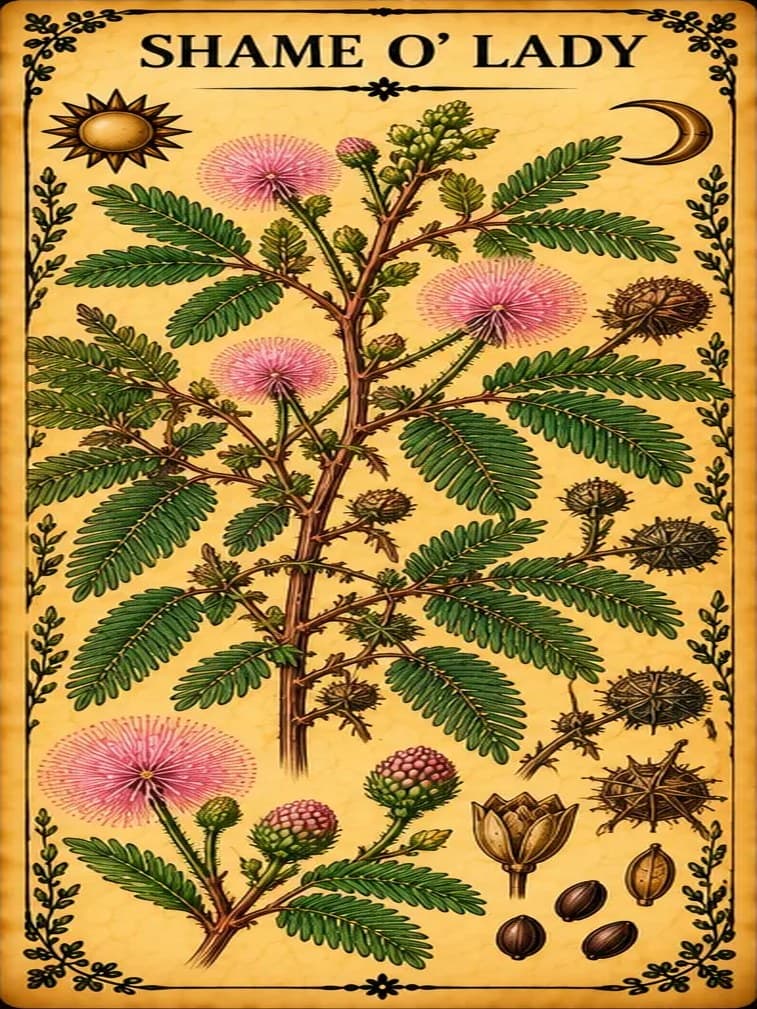
Shame O' Lady
Mimosa pudica
The sensitive plant, whose leaves fold up when touched. TRAMIL, the Caribbean traditional-medicine network, recommends it as a tea for period cramps.
What is Shame O' Lady?
- Plant family
- Fabaceae, the pea and bean family
- Parts used
- The leaves and roots
- Where it grows
- Widespread in tropical America; now naturalised in the tropics worldwide
- Genus
- Mimosa
- Species
- pudica
Also called
Shame Plant, Sensitive Plant, Touch Me Not
Regional names
Shame Old Lady, Shame Ol' Lady, Dead and Wake, Shamey Macca
Traditionally used for
- Period cramps
- Dysentery (traditional)
- Wounds (traditional)
- Piles (traditional)
Traditionally described as
- Fights bacteria (in lab tests)
Health topics
Where Shame O' Lady appears in symptom search, and why. Being listed doesn't mean it's a proven treatment.
- Cuts, Wounds, Burns and Skin Ulcers
Traditionally put on wounds.
- Diarrhea
Traditionally used for dysentery (bloody diarrhea).
- Menstrual Discomfort
TRAMIL recommends it as a tea for period cramps, based on traditional use and research. See a doctor first to rule out other causes.
- Pregnancy and Childbirth
TRAMIL advises not to use it during pregnancy or breastfeeding.
Traditions that use it
Caribbean Folk Medicine
Recommended by TRAMIL, the Caribbean traditional-medicine research network, as a tea for period cramps.
Safety
What does the research say?
Traditional use
These are traditional uses, not proven treatments.
In Jamaica it's called shame old lady, dead and wake, or shamey macca, because its leaves fold up when touched. They also close at night and in strong heat or rain.[2]
TRAMIL, a Caribbean research network that reviews traditional remedies, recommends it for period cramps, based on significant traditional use and published research. Their preparation: 5 grams of leaves and roots boiled for 10 minutes, or steeped, in 4 cups (1 litre) of water. Drink 1 cup 3 times a day for no more than 3 to 5 days, and don't keep the tea for more than 24 hours.[1]
It has long been used for urinary and reproductive problems, piles, dysentery (bloody diarrhea) and sinus problems, and is put on wounds.[3]
Laboratory & animal research
Lab and animal results show what might be worth studying in people. They don't show that the herb has these effects in humans.
Lab and animal studies report that it may fight bacteria, counter snake venom, reduce fertility, prevent seizures, ease depression and act as an aphrodisiac.[3]
In chicks, a leaf extract caused no deaths even at very high single doses, and no harm when given daily for 42 days.[4]
Technical detail: hydroalcoholic leaf extract, single oral doses 40–5120 mg/kg; 80–640 mg/kg/day for 42 days.
In short
Not for use during pregnancy or breastfeeding, or in children under 12.
Sources
- [1] Mimosa pudica — TRAMIL (Traditional Medicine in the Islands)Traditional text
- [2] The fascinating 'shame plant' — Jamaica ObserverGeneral reference
- [3] Mimosa pudica L. (Laajvanti): An overview — Pharmacognosy Reviews · DOI: 10.4103/0973-7847.99945Peer-reviewed study
- [4] Acute and sub-chronic toxicity studies of three plants used in Cameroonian ethnoveterinary medicine: Aloe vera (L.) Burm. f. (Xanthorrhoeaceae) leaves, Carica papaya L. (Caricaceae) seeds or leaves, and Mimosa pudica L. (Fabaceae) leaves in Kabir chicks — Journal of Ethnopharmacology · DOI: 10.1016/j.jep.2015.11.049Peer-reviewed study
This information is educational and traditional in nature, and is not a substitute for professional medical advice.