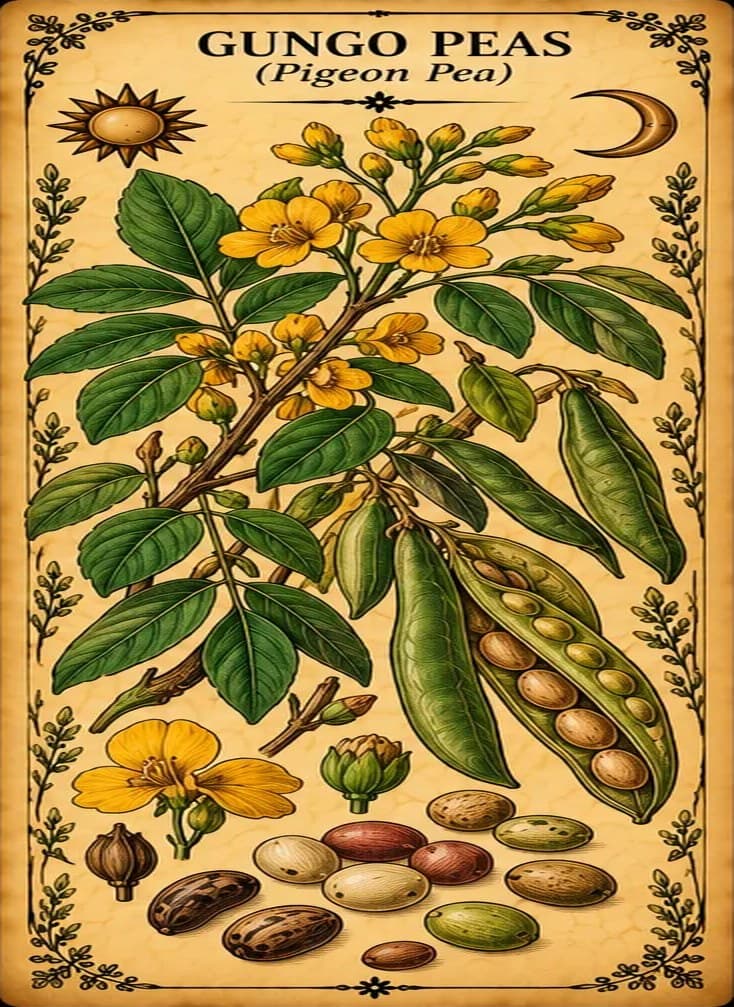
Gungo Peas
Cajanus cajan
Pigeon peas, a major food crop around the world. The leaves are used in Chinese medicine for bone conditions.
What is Gungo Peas?
- Plant family
- Fabaceae, the pea and bean family
- Parts used
- The peas (seeds) are eaten. The leaves are used in Chinese medicine.
- Genus
- Cajanus
- Species
- cajan
Also called
Pigeon Pea, Pigeonpea
Regional names
Gungo Pea
Traditionally used for
- Food
- Bone conditions (leaves
- traditional)
Traditionally described as
- Source of flavonoids
Health topics
Where Gungo Peas appears in symptom search, and why. Being listed doesn't mean it's a proven treatment.
- Joint Discomfort
The leaves are used in Chinese medicine for bone and joint conditions. Gungo peas as food haven't been studied for this.
Traditions that use it
Traditional Chinese Medicine
The leaves are a well-known Chinese medicine for bone conditions such as osteoporosis and osteonecrosis.
What does the research say?
Traditional use
These are traditional uses, not proven treatments.
Pigeon pea is the sixth-largest grain legume crop in the world by volume, and a major food for people and livestock.[1]
The leaves are a well-known traditional Chinese medicine for bone conditions, including osteoporosis (thinning bones) and osteonecrosis (bone tissue dying from poor blood supply). For over 40 years, Chinese hospitals have used a leaf preparation for osteonecrosis of the hip and infections linked to osteoarthritis.[2]
Laboratory & animal research
Lab and animal results show what might be worth studying in people. They don't show that the herb has these effects in humans.
Lab studies have found 27 flavonoids in different parts of the plant. The reviewers say there are still gaps in research on its natural compounds.[1]
A 2025 review reported that extracts and compounds from the leaves showed a range of effects in lab and animal studies.[2]
Technical detail: constituents include flavonoids, flavonoid glycosides, stilbenes, flavonostilbenes, steroids and triterpenoids.
In short
No specific safety concerns were found in the sources reviewed.
Sources
- [1] The flavonoid profile of pigeonpea, Cajanus cajan: a review — SpringerPlus · DOI: 10.1186/s40064-015-0906-xPeer-reviewed study
- [2] Cajanus cajan (L.) Millsp. Leaves: A Comprehensive Review of Phytochemistry, Pharmacological Properties, Safety, and Clinical Applications — Chemistry & Biodiversity · DOI: 10.1002/cbdv.202500137Peer-reviewed study
This information is educational and traditional in nature, and is not a substitute for professional medical advice.