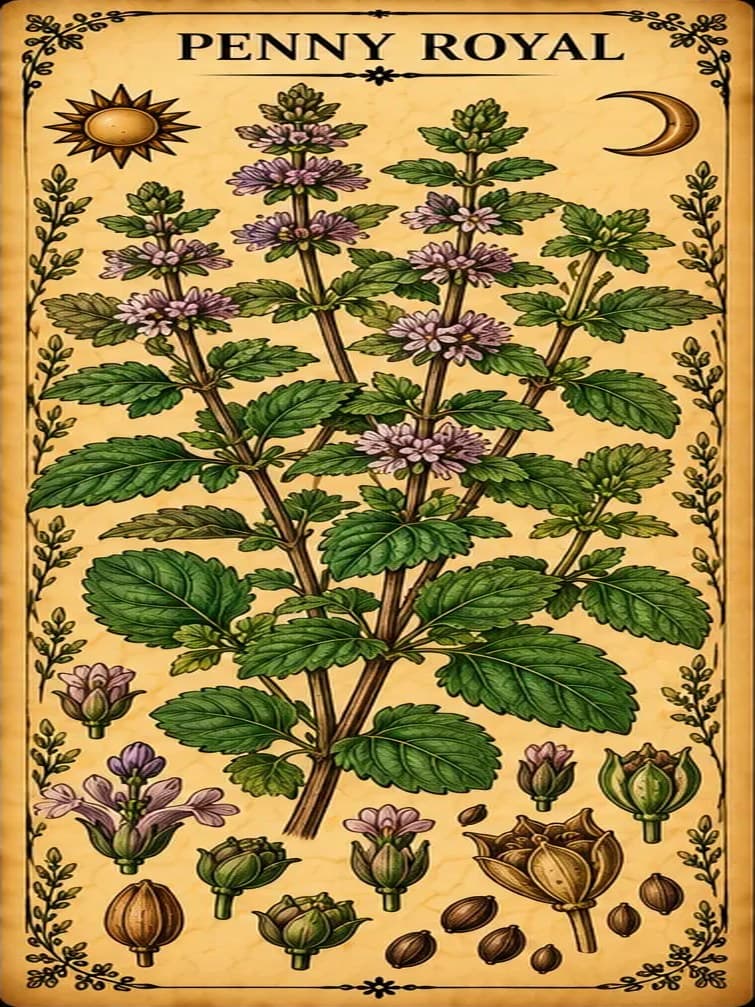
Penny Royal
Clinopodium brownei
Jamaican pennyroyal, one of the island's popular bush medicines for breathing and digestive problems. It is a different plant from European pennyroyal, but its oil contains the same toxic compound, pulegone.
What is Penny Royal?
- Plant family
- Lamiaceae, the mint family
- Parts used
- The leaves and other above-ground parts
- Where it grows
- Widespread in tropical and subtropical America
- Genus
- Clinopodium
- Species
- brownei
Also called
Pennyroyal
Regional names
Jamaican Pennyroyal
Older scientific names
Satureja brownei
Traditionally used for
- Breathing problems
- Digestion
- Pain (traditional)
Traditionally described as
- Antioxidant (in lab tests)
Health topics
Where Penny Royal appears in symptom search, and why. Being listed doesn't mean it's a proven treatment.
- Colds and Nasal Congestion
Traditionally used for breathing problems in tropical America. This use hasn't been tested in people.
- Indigestion
Traditionally used for digestive problems in tropical America. This use hasn't been tested in people.
- Liver Safety Warnings
Its oil contains pulegone, also found in European pennyroyal, whose oil has caused deadly liver damage.
- Poisonous Plants
The essential oil has caused moderate to severe poisoning.
- Pregnancy and Childbirth
Don't confuse with European pennyroyal, which has been misused to cause abortion and has caused deadly poisoning.
Traditions that use it
Caribbean Folk Medicine
One of the 25 most popular medicinal plants in a study of two Jamaican communities.
Native American Ethnobotany
One of the most culturally important medicinal plants for the Q'eqchi' Maya of Guatemala, used to bathe sick children.
Safety
Toxicity testing
Its essential oil is about one-fifth to one-third pulegone. Pulegone is also found in European pennyroyal (Mentha pulegium), a different plant whose oil is a known poison.[1]
European pennyroyal has caused deadly liver damage, and it has long been misused to try to cause abortion. A 1996 review found moderate to severe poisoning in people who took at least 10 mL of the oil. Pulegone and its breakdown product menthofuran were found in the blood of poisoned patients. Don't confuse the two plants.[2]
Technical detail: 4 new cases (1 death) plus 18 previously reported cases.
What does the research say?
Traditional use
These are traditional uses, not proven treatments.
A book based on interviews with more than 100 people in Portland and Kingston, Jamaica, includes pennyroyal (Clinopodium brownei) among the 25 most popular medicinal plants in those communities.[3]
This pennyroyal grows widely in tropical and subtropical America. It's traditionally used for breathing and digestive problems, and for pain.[1]
Among the Q'eqchi' Maya of Guatemala, it's one of the most culturally important medicinal plants. Its above-ground parts are soaked overnight in water with other plants, and the water is used to bathe children with "dry sick", an illness with diarrhea, vomiting, fever, loss of appetite and thirst.[4]
Laboratory & animal research
Lab and animal results show what might be worth studying in people. They don't show that the herb has these effects in humans.
In lab tests, its essential oil acted as an antioxidant and slowed the growth of some bacteria and a yeast (Candida), though less strongly than the comparison products.[1]
Technical detail: main compounds pulegone (20.8–29.9%), ethyl cinnamate, methyl cinnamate, caryophyllene and menthone; IC50 DPPH 1.77 mg/mL, ABTS 0.06 mg/mL; MICs 3.1–13.6 mg/mL.
In short
Its oil contains pulegone, the compound in European pennyroyal oil, which has caused deadly liver damage.
Sources
- [1] Chemical Composition, Antimicrobial and Antioxidant Bioautography Activity of Essential Oil from Leaves of Amazon Plant Clinopodium brownei (Sw.) — Molecules · DOI: 10.3390/molecules28041741Peer-reviewed study
- [2] Pennyroyal toxicity: measurement of toxic metabolite levels in two cases and review of the literature — Annals of Internal Medicine · DOI: 10.7326/0003-4819-124-8-199604150-00004Peer-reviewed study
- [3] Popular Medicinal Plants in Portland and Kingston, Jamaica — Springer (Advances in Economic Botany) · DOI: 10.1007/978-3-030-48927-4Peer-reviewed study
- [4] Ethnopharmacological Field Study of Three Q'eqchi Communities in Guatemala — Frontiers in Pharmacology · DOI: 10.3389/fphar.2018.01246Peer-reviewed study
This information is educational and traditional in nature, and is not a substitute for professional medical advice.