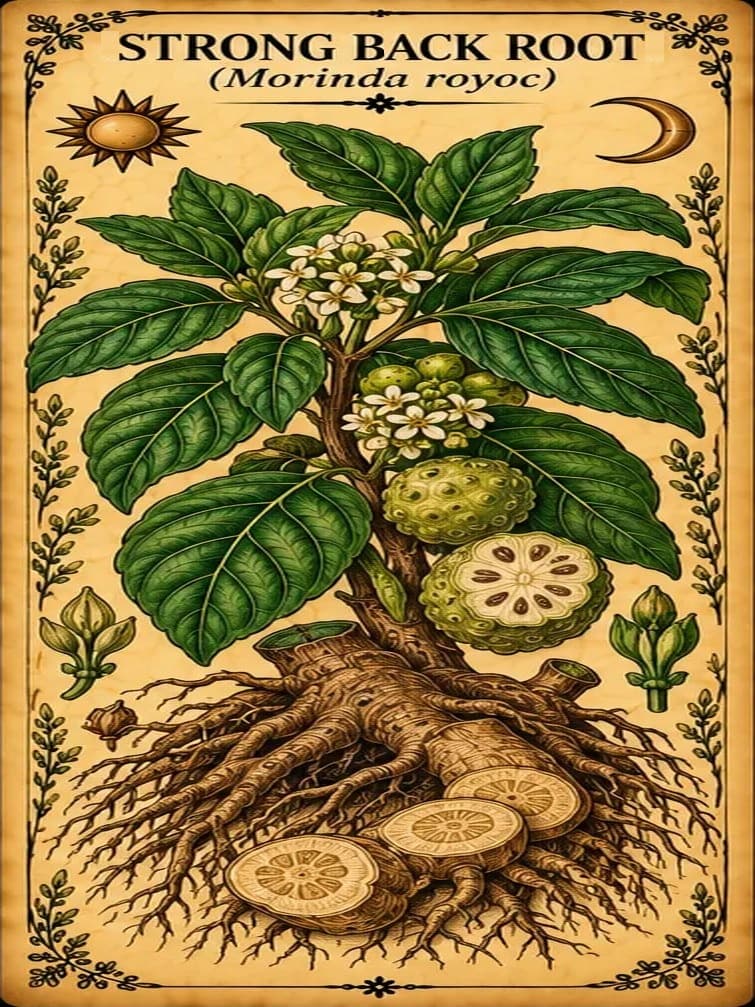
Strong Back Root
Morinda royoc
Redgal, a root boiled into Jamaica's "strong back" roots tonic, used by men for impotence and stamina. It hasn't been studied in people.
What is Strong Back Root?
- Plant family
- Rubiaceae, the coffee family
- Parts used
- The root, boiled with other roots into a tonic
- Genus
- Morinda
- Species
- royoc
Regional names
Redgal, Strong Back
Traditionally used for
- Roots tonic
- Impotence (traditional)
- Stamina (traditional)
- Stomach pain (traditional)
Traditionally described as
- Kills Giardia (in lab tests)
Health topics
Where Strong Back Root appears in symptom search, and why. Being listed doesn't mean it's a proven treatment.
- SIBO and Intestinal Parasites
In lab tests, a root extract killed the gut parasite Giardia. It hasn't been tested in people.
- Sexual Health
Part of Jamaica's "strong back" roots tonic for impotence and stamina. This use hasn't been tested in research.
Traditions that use it
Caribbean Folk Medicine
One of the roots in Jamaica's "strong back" roots tonic, used by men for impotence and stamina.
Native American Ethnobotany
Used in traditional Mayan medicine for stomach and bowel pain.
What does the research say?
Traditional use
These are traditional uses, not proven treatments.
In Jamaica, Morinda royoc (redgal) is one of the plants boiled into a "roots tonic" or "strong back" drink. Men commonly use this drink for impotence and to increase stamina. Other plants in the mix include chany root, sarsaparilla, ginger, medina, tick clover, ramoon and nerve west.[1]
It's used in traditional Mayan medicine for stomach and bowel pain.[2]
Laboratory & animal research
Lab and animal results show what might be worth studying in people. They don't show that the herb has these effects in humans.
In lab tests, an extract of the root killed Giardia, a gut parasite that causes diarrhea. The extract didn't harm human blood cells in the lab. It hasn't been tested in animals or people.[2]
Technical detail: hexane fraction of a methanol root extract, IC50 0.08 µg/mL against G. lamblia trophozoites; main compound an anthraquinone; no toxicity to HL-60, K562 or human mononuclear cells.
In short
Its safety hasn't been studied.
Sources
- [1] Antiviral Activity of Jamaican Medicinal Plants and Isolated Bioactive Compounds — Molecules · DOI: 10.3390/molecules26030607Peer-reviewed study
- [2] A Morinda royoc Root Extract and Fractions Exhibit Antigiardial Activity without Affecting Cell Viability — Iranian Journal of Parasitology · DOI: 10.18502/ijpa.v17i2.9544Peer-reviewed study
This information is educational and traditional in nature, and is not a substitute for professional medical advice.