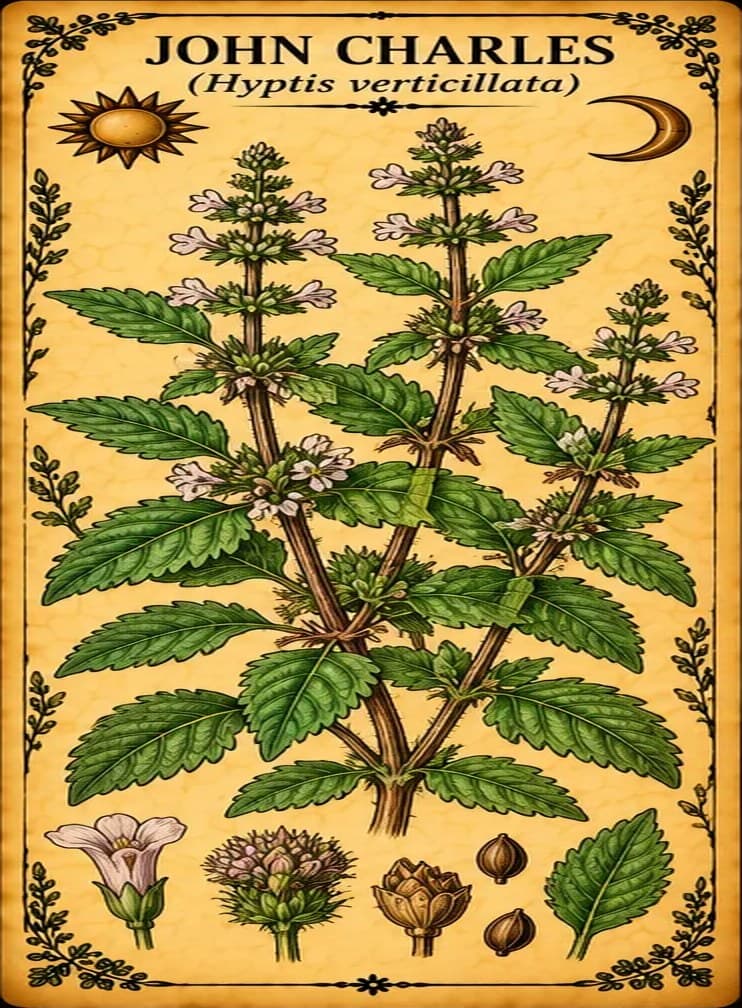
John Charles
Hyptis verticillata
A Caribbean bush in the mint family, used since Maya and Aztec times for breathing, digestive, women's health and skin problems. It hasn't been tested in clinical trials.
What is John Charles?
- Plant family
- Lamiaceae, the mint family
- Where it grows
- Originally from Central America; now grows from Florida to Colombia and across the Caribbean
- Genus
- Hyptis
- Species
- verticillata
Older scientific names
Condea verticillata
Traditionally used for
- Breathing problems
- Digestion
- Women's health
- Skin conditions
- Muscle and joint pain
Traditionally described as
- May help reduce inflammation (in lab tests)
- Fights germs (in lab tests)
Health topics
Where John Charles appears in symptom search, and why. Being listed doesn't mean it's a proven treatment.
- Colds and Nasal Congestion
Traditionally used for breathing problems. It hasn't been tested in clinical trials.
- Cough
Traditionally used for breathing problems. It hasn't been tested in clinical trials.
- Indigestion
Traditionally used for digestive problems. It hasn't been tested in clinical trials.
- Joint Discomfort
Traditionally put on the skin for muscle and joint problems. It hasn't been tested in clinical trials.
- Menstrual Discomfort
Traditionally used for women's health problems; lab studies suggest it affects hormones. Not tested in clinical trials.
- Skin Irritation, Rashes and Itching
Traditionally put on the skin for skin conditions. It hasn't been tested in clinical trials.
Traditions that use it
Caribbean Folk Medicine
Widely used across the Caribbean for breathing, digestive, women's health, skin and muscle problems.
What does the research say?
Traditional use
These are traditional uses, not proven treatments.
John Charles has a long history of use, going back to the ancient Maya and Aztec cultures. It is used widely in the Americas but not elsewhere. Traditional uses include:
- Taken by mouth for breathing problems, digestive problems and women's health problems
- Put on the skin for skin conditions and muscle and joint problems
Laboratory & animal research
Lab and animal results show what might be worth studying in people. They don't show that the herb has these effects in humans.
Lab and animal studies support some traditional uses. Extracts may help reduce inflammation, fight bacteria, fungi and viruses, reduce fluid secretion in the gut, and affect hormones. They also showed effects against cancer cells, protected the liver, and killed insects, mites and snails.[1]
Technical detail: activities include antimitotic, antiproliferative, cytotoxic, antioxidant, anti-inflammatory, antibacterial, antifungal, antiviral, anti-HIV, antisecretory, hepatoprotective, insecticidal, acaricidal and molluscicidal; 17 lignans, 4 triterpenes, 11 diterpenes, 3 sesquiterpenes, 3 monoterpenes, 2 flavonoids, 1 polyphenol and 1 alkaloid identified.
Research in people
No clinical trials in people had been done by the time of the 2013 review. The reviewers called for trials.[1]
In short
Not tested in people, so its safety and effects are unknown.
Sources
- [1] Hyptis verticillata Jacq: a review of its traditional uses, phytochemistry, pharmacology and toxicology — Journal of Ethnopharmacology · DOI: 10.1016/j.jep.2013.01.039Peer-reviewed study
This information is educational and traditional in nature, and is not a substitute for professional medical advice.