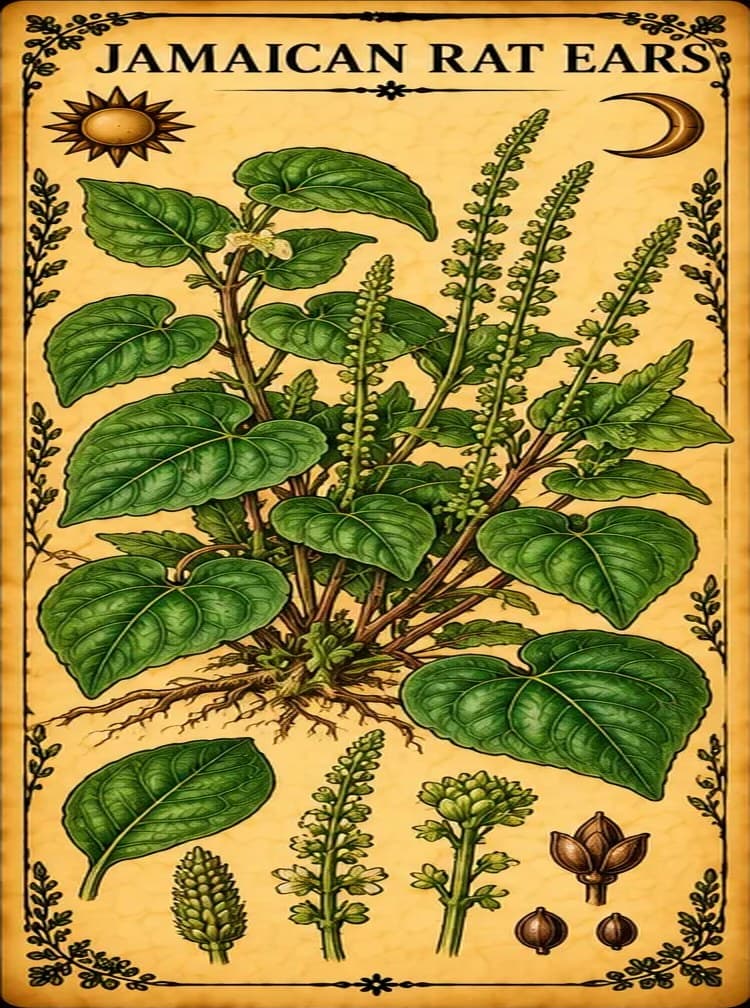
Jamaican Rat Ears
Peperomia pellucida
A small weed of damp, shady places, also called shining bush, used in Caribbean folk medicine as a cooling remedy and for skin sores. Research so far is limited and often weak.
What is Jamaican Rat Ears?
- Plant family
- Piperaceae, the pepper family
- Where it grows
- Grows mainly in the tropical Americas, Africa, Southeast Asia and Australia, in damp, shady places
- Genus
- Peperomia
- Species
- pellucida
Also called
Rat Ears
Regional names
Shining Bush
Traditionally used for
- Cooling (traditional)
- Skin sores
- Belly pain
- Blood pressure
Traditionally described as
- Antioxidant (in lab tests)
Health topics
Where Jamaican Rat Ears appears in symptom search, and why. Being listed doesn't mean it's a proven treatment.
- High Blood Pressure
Reviews report it lowered blood pressure in studies, but the research is limited.
- High Blood Sugar
Lab and animal studies suggest it may lower blood sugar; many of these studies were weak.
- High Cholesterol
Lab and animal studies suggest it may lower cholesterol; many of these studies were weak.
- Skin Irritation, Rashes and Itching
Used in folk medicine for abscesses and skin sores. This use hasn't been well tested in people.
Traditions that use it
Caribbean Folk Medicine
Used in Trinidad and Tobago, where it's called shining bush, as a "cooling" remedy.
Safety
Toxicity testing
Extracts were mildly toxic in animal studies. Its safety in people hasn't been well studied.[1]
What does the research say?
Traditional use
These are traditional uses, not proven treatments.
In Trinidad and Tobago, where it's called shining bush, it's used as a "cooling" remedy.[2]
It's used in folk medicine for:
- Abscesses and skin sores
- Belly pain
- Conjunctivitis (pink eye)
- Measles
- Kidney problems
Laboratory & animal research
Lab and animal results show what might be worth studying in people. They don't show that the herb has these effects in humans.
A 2019 review found reports that it may fight germs, act as an antioxidant, help bones heal, and lower blood sugar and cholesterol. But the reviewers said many of these studies were weak: some didn't identify the active compounds or lacked proper comparison groups. More research is needed.[3]
A 2022 review reported that, in lab, animal and some clinical studies, its extracts lowered blood pressure and blood sugar, may help reduce inflammation, and acted as antioxidants. Extracts weren't toxic to normal cells in lab tests but were mildly toxic in animals.[1]
In short
Mildly toxic in animal studies; its safety in people hasn't been well studied.
Sources
- [1] Peperomia pellucida (L.) Kunth and eye diseases: A review on phytochemistry, pharmacology and toxicology — Journal of Integrative Medicine · DOI: 10.1016/j.joim.2022.02.002Peer-reviewed study
- [2] Ethnomedicines used in Trinidad and Tobago for urinary problems and diabetes mellitus — Journal of Ethnobiology and Ethnomedicine · DOI: 10.1186/1746-4269-2-45Peer-reviewed study
- [3] The chemistry and biological activities of Peperomia pellucida (Piperaceae): A critical review — Journal of Ethnopharmacology · DOI: 10.1016/j.jep.2018.12.021Peer-reviewed study
This information is educational and traditional in nature, and is not a substitute for professional medical advice.