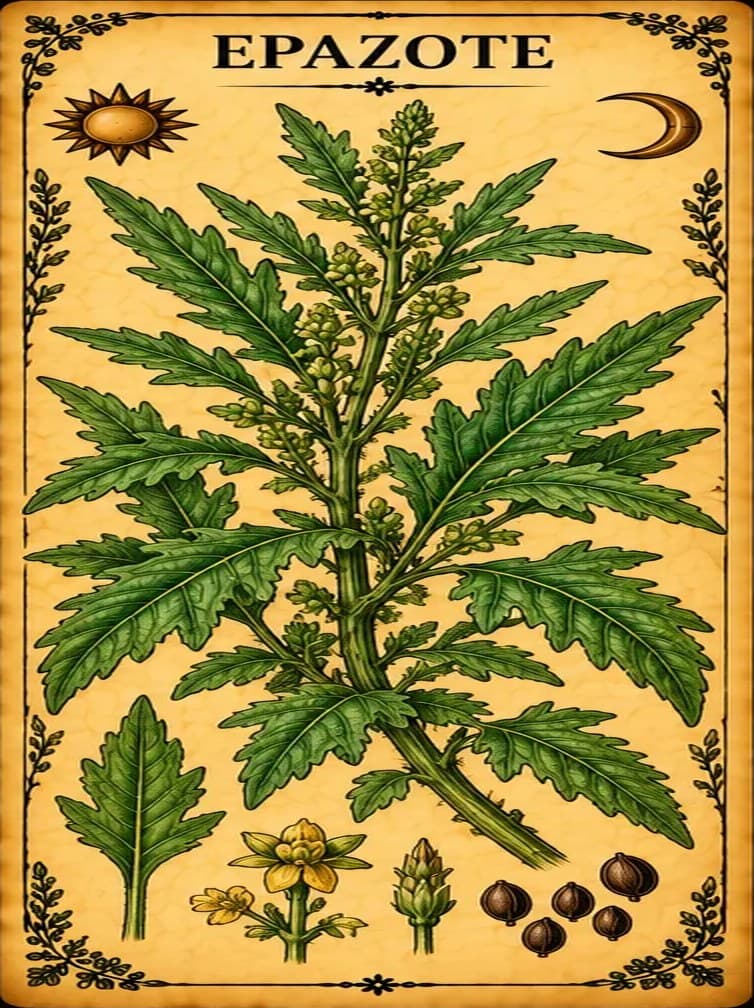
Epazote
Dysphania ambrosioides
An herb used in Jamaican and Latin American folk medicine against worms. It can cause serious, even deadly, poisoning, especially in children.
What is Epazote?
- Plant family
- Amaranthaceae, the amaranth family
- Genus
- Dysphania
- Species
- ambrosioides
Regional names
M'khinza
Older scientific names
Chenopodium ambrosioides
Traditionally used for
- Worms (traditional)
- Fever (traditional)
- Pain (traditional)
Traditionally described as
- Kills parasites (in lab tests)
Health topics
Where Epazote appears in symptom search, and why. Being listed doesn't mean it's a proven treatment.
- Fever
Used as a tea for fever in Morocco. A child died after repeated strong doses given for fever.
- Liver Safety Warnings
Poisoning can affect the liver. High doses strained the liver and kidneys in rats.
- SIBO and Intestinal Parasites
A Jamaican folk remedy for roundworms, and used against hookworm in the early 1900s. It can cause deadly poisoning, especially in children.
Traditions that use it
Caribbean Folk Medicine
Used in Jamaican folk medicine to treat roundworms; the same plant was used by Jamaica's Hookworm Commission in the early 1900s.
Safety
Toxicity testing
Epazote can cause serious and even deadly poisoning, especially in babies and children. Reported problems affect the nerves, digestion, liver and kidneys.
In a 2024 case, a 4-year-old girl died after being given repeated strong doses of epazote tea for a fever. She lost consciousness 4 hours after drinking it.[1]
In rats, it took a very large single dose of flower extract to be deadly. But a high daily dose for 15 days raised blood signs of liver and kidney strain and caused mild changes in the liver and kidneys.[2]
Technical detail: oral LD50 of the hydroethanolic extract 5000 mg/kg; at 500 mg/kg/day for 15 days, ALT, AST and urea rose significantly.
What does the research say?
Traditional use
These are traditional uses, not proven treatments.
In early 20th-century Jamaica, people treated roundworms (Ascaris) with this plant as a folk remedy. The Jamaica Hookworm Commission (1919–1936) used the same plant to treat hookworm. A 2025 study found that this shared knowledge made people more willing to accept the deworming programme.[3]
Known as epazote, it is an important plant in traditional Latin American medicine.[4]
It's traditionally taken as a tea for fever and pain, and used against worms.[1]
Laboratory & animal research
Lab and animal results show what might be worth studying in people. They don't show that the herb has these effects in humans.
A 2025 review reported that in lab and animal studies it acted against parasites, including worms, schistosomes and malaria parasites, and also against germs, as an antioxidant and against cancer cells. The authors say clinical trials are needed to test whether it is safe and effective.[4]
In short
Can cause deadly poisoning, especially in babies and children; a child died after repeated strong doses of the tea.
Sources
- [1] A Fatal Case Report of Chenopodium ambrosioides L. (M'khinza) Intoxication — Cureus · DOI: 10.7759/cureus.60351Peer-reviewed study
- [2] Evaluation of Acute and Subacute Toxicity and LC-MS/MS Compositional Alkaloid Determination of the Hydroethanolic Extract of Dysphania ambrosioides (L.) Mosyakin and Clemants Flowers — Toxins · DOI: 10.3390/toxins14070475Peer-reviewed study
- [3] The impact of multiple infections and community knowledge on engagement with a historical deworming programme: hookworm and Ascaris in Jamaica, 1913-1936 — Transactions of the Royal Society of Tropical Medicine and Hygiene · DOI: 10.1093/trstmh/traf010Peer-reviewed study
- [4] Essential Oils and Extracts from Epazote (Dysphania ambrosioides): A Phytochemical Treasure with Multiple Applications — Plants · DOI: 10.3390/plants14131903Peer-reviewed study
This information is educational and traditional in nature, and is not a substitute for professional medical advice.