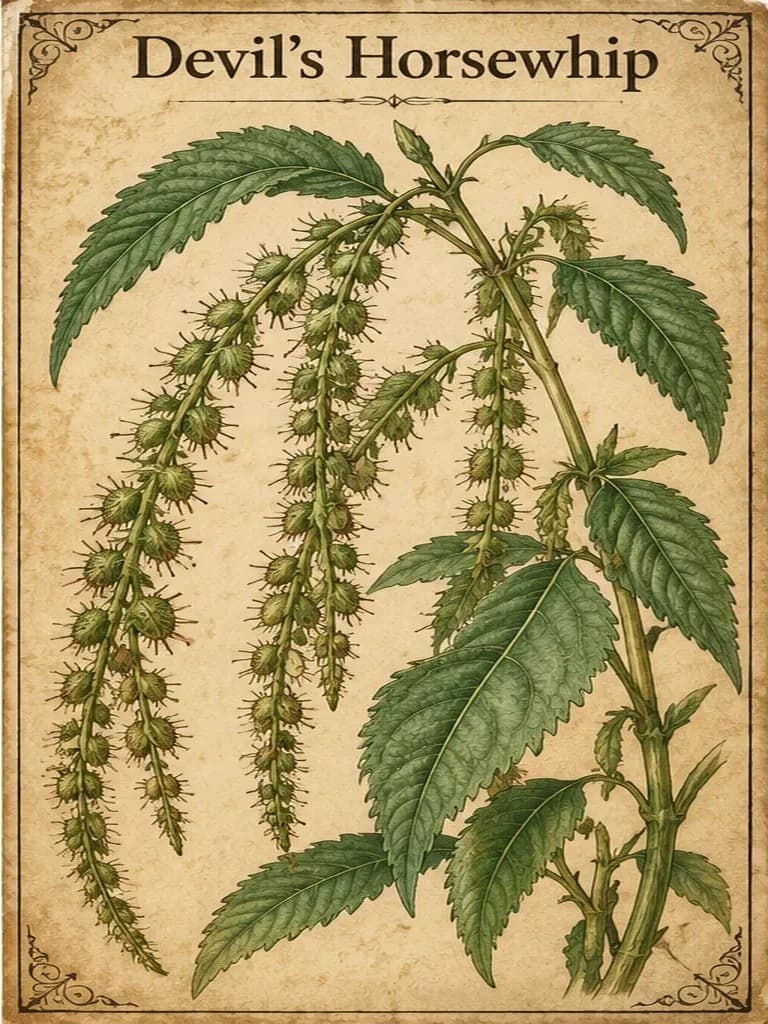
Devil's Horsewhip
Achyranthes aspera
Prickly chaff flower, a weedy plant used in folk medicine around the world, including for menstrual problems and fertility control. Research so far is in lab and animal studies.
What is Devil's Horsewhip?
- Plant family
- Amaranthaceae, the amaranth family
- Genus
- Achyranthes
- Species
- aspera
Also called
Devils Horsewhip, Devil's Horse Whip, Prickly Chaff Flower
Traditionally used for
- Menstrual problems (traditional)
- Fertility control (traditional)
Traditionally described as
- Estrogen-like (in lab tests)
- Antioxidant (in lab tests)
Health topics
Where Devil's Horsewhip appears in symptom search, and why. Being listed doesn't mean it's a proven treatment.
- Fertility
Used for fertility control in Ethiopia. In pregnant rats, high doses harmed developing babies.
- Memory and Thinking
Lab and animal studies suggest it may protect brain cells. It hasn't been tested in people.
- Menopause Symptoms
Lab tests found estrogen-like effects, which researchers link to its traditional use for menopause problems. It hasn't been tested in people.
- Menstrual Discomfort
Traditionally used for menstrual problems in India. This use hasn't been tested in people.
- Pregnancy and Childbirth
In pregnant rats, high doses harmed developing babies.
Traditions that use it
African Traditional Medicine
Used for fertility control in Ethiopia and as an herbal medicine in Ivory Coast.
Safety
Pregnancy
In pregnant rats, a high dose of leaf extract reduced the number of embryos that implanted, slowed their development, and caused fetal deaths and smaller babies. The researchers concluded it may harm developing babies at high doses.[1]
Technical detail: 70% ethanol leaf extract at 250, 500 and 1000 mg/kg by mouth on gestation days 6–12; effects at 1000 mg/kg; no external malformations seen.
What does the research say?
Traditional use
These are traditional uses, not proven treatments.
In Ethiopia, it's widely used in local health practice for fertility control.[1]
Known as prickly chaff flower, it's used as an herbal medicine in Ivory Coast.[2]
It has been widely used in traditional and folk medicine for many different ailments.[3]
In India, it's traditionally used for menstrual problems.[4]
Laboratory & animal research
Lab and animal results show what might be worth studying in people. They don't show that the herb has these effects in humans.
A 2025 review reported that, in lab and animal studies, it protected the heart, blood vessels and brain cells, affected the immune system, and acted as an antioxidant.[3]
In lab tests, an extract acted like the hormone estrogen, making estrogen-sensitive breast cancer cells grow almost as much as estrogen itself did.[4]
Technical detail: methanol fraction at 100 µg/mL; MCF-7 proliferation effect 138% vs 143% for 17β-estradiol; upregulated TFF1 and progesterone receptor via an ERα-associated mechanism.
In lab tests, extracts acted as antioxidants and blocked enzymes linked to Alzheimer's disease and type 2 diabetes.[2]
Technical detail: inhibited AChE, BChE, α-glucosidase, α-amylase and tyrosinase to varying degrees; the infusion had the highest phenolic content and antioxidant activity.
In short
High doses harmed developing babies in pregnant rats.
Sources
- [1] Developmental Toxicity of Ethanolic Extracts of Leaves of Achyranthes aspera, Amaranthaceae in Rat Embryos and Fetuses — Journal of Experimental Pharmacology · DOI: 10.2147/jep.s312649Peer-reviewed study
- [2] Qualitative Phytochemical Fingerprint and Network Pharmacology Investigation of Achyranthes aspera Linn. Extracts — Molecules · DOI: 10.3390/molecules25081973Peer-reviewed study
- [3] Role of Achyranthes aspera in neurodegenerative diseases: current evidence and future directions — Frontiers in Pharmacology · DOI: 10.3389/fphar.2025.1511011Peer-reviewed study
- [4] Estrogenic post-menopausal anti-osteoporotic mechanism of Achyranthes aspera L.: Phytochemicals and network pharmacology approaches — Heliyon · DOI: 10.1016/j.heliyon.2024.e38792Peer-reviewed study
This information is educational and traditional in nature, and is not a substitute for professional medical advice.