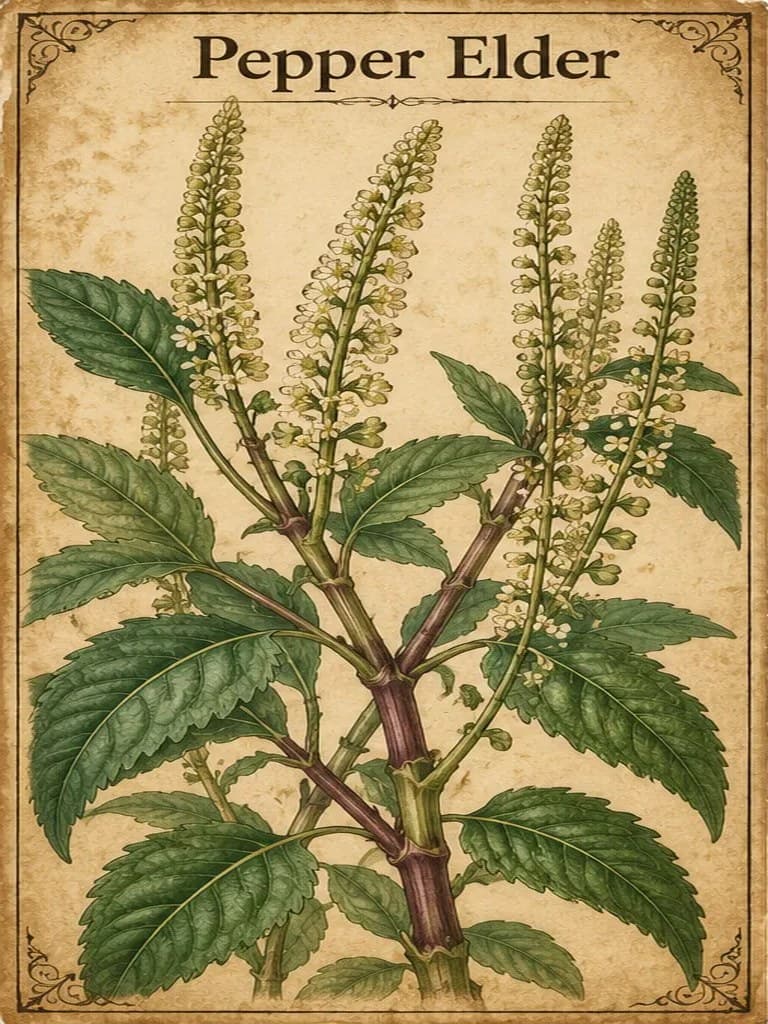
Pepper Elder
Piper amalago
A plant in the pepper family whose leaves are made into a Jamaican bush tea for colds and flu. Research so far is mostly in rats.
What is Pepper Elder?
- Plant family
- Piperaceae, the pepper family
- Parts used
- The leaves
- Where it grows
- Native to the Caribbean and Latin America
- Genus
- Piper
- Species
- amalago
Also called
Pepper Elders
Traditionally used for
- Colds
- Flu
- Inflammation (traditional)
- Anxiety (traditional)
- Wounds
Traditionally described as
- May increase urination (in animal studies)
Health topics
Where Pepper Elder appears in symptom search, and why. Being listed doesn't mean it's a proven treatment.
- Anxiety
Used for anxiety in Brazilian traditional medicine. This use hasn't been tested in people.
- Colds and Nasal Congestion
An anecdotal Jamaican remedy for colds. This use hasn't been tested in people.
- Cuts, Wounds, Burns and Skin Ulcers
In one case report, leaves boiled in water helped a wound heal in a person with diabetes. This hasn't been tested in a controlled study.
- Immune Support (Colds and Flu)
An anecdotal Jamaican remedy for colds and flu. This use hasn't been tested in people.
Traditions that use it
Caribbean Folk Medicine
In Jamaica, a leaf tea is an anecdotal remedy for colds and flu.
Safety
Toxicity testing
In rats given an alcohol-based leaf extract every day for 28 days, it caused liver changes and changes in blood tests. The researchers advise using it with caution, especially for long periods. It didn't damage DNA.[1]
Technical detail: 100, 200 or 300 mg/kg by mouth in female Wistar rats; increased liver weight and relative heart and kidney weights, liver histopathology changes, lower hematocrit and albumin, higher platelets, alkaline phosphatase and cholesterol. No genotoxicity in mice at up to 1750 mg/kg.
What does the research say?
Traditional use
These are traditional uses, not proven treatments.
In Jamaica, pepper elder is an anecdotal remedy for colds and flu. 1 to 2 teaspoons of leaves are brewed in a cup of water, left to steep for about 10 minutes, and sweetened as desired. How it might work against viruses is unknown.[2]
In Brazilian traditional medicine, it's used for inflammation, chest pain and anxiety.[3]
It's traditionally used to ease pain and inflammation, to increase urination, and against parasites.[1]
Laboratory & animal research
Lab and animal results show what might be worth studying in people. They don't show that the herb has these effects in humans.
In rats, single doses of leaf extracts and the essential oil caused no deaths or organ damage. Given daily for 7 days, they increased urination without lowering blood pressure or changing the heart's rhythm. One extract relaxed blood vessels in lab tests.[3]
Technical detail: volatile oil, aqueous and hydroalcoholic extracts; increased urine volume and electrolyte excretion; hydroalcoholic extract caused vasodilation in isolated mesenteric vascular beds via the nitric oxide/cGMP pathway and voltage-dependent potassium channels.
Research in people
In a single case report, a person with type 2 diabetes soaked a cut thumb in water in which dried leaves had been boiled, with the leaves placed on the wound. The wound healed over 15 days. This was one case, not a controlled study.[4]
In short
Long-term daily use caused liver and blood changes in rats; use with caution, especially for long periods.
Sources
- [1] Evaluation of the safety of ethanolic extract from Piper amalago L. (Piperaceae) leaves in vivo: Subacute toxicity and genotoxicity studies — Regulatory Toxicology and Pharmacology · DOI: 10.1016/j.yrtph.2022.105118Peer-reviewed study
- [2] Antiviral Activity of Jamaican Medicinal Plants and Isolated Bioactive Compounds — Molecules · DOI: 10.3390/molecules26030607Peer-reviewed study
- [3] The Cardiorenal Effects of Piper amalago Are Mediated by the Nitric Oxide/Cyclic Guanosine Monophosphate Pathway and the Voltage-Dependent Potassium Channels — Pharmaceuticals · DOI: 10.3390/ph16111630Peer-reviewed study
- [4] The wound healing effect of aqueous extract from Piper amalago L. in diabetic patient — Explore · DOI: 10.1016/j.explore.2019.12.001Peer-reviewed study
This information is educational and traditional in nature, and is not a substitute for professional medical advice.