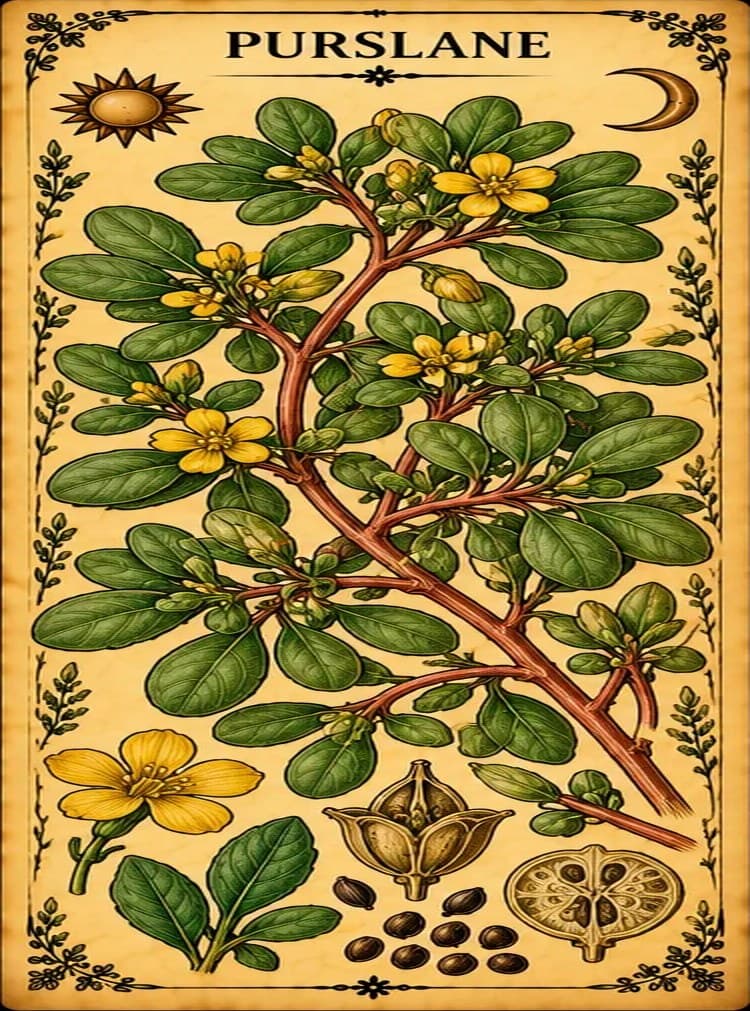
Purslane
Portulaca oleracea
A leafy plant eaten as a vegetable and used as a folk medicine, called pussley in Trinidad. Reviews of trials found it may lower fasting blood sugar a little and improve cholesterol in people with type 2 diabetes.
What is Purslane?
- Plant family
- Portulacaceae, the purslane family
- Parts used
- The whole plant. The leaves and stems are eaten as a vegetable, fresh, blanched or pickled.
- Genus
- Portulaca
- Species
- oleracea
Regional names
Pussley
Traditionally used for
- Vegetable
- Blood sugar
- Cholesterol
- Shortness of breath (traditional)
- Dysentery (traditional)
Traditionally described as
- Rich in omega-3 and vitamins C and E
Health topics
Where Purslane appears in symptom search, and why. Being listed doesn't mean it's a proven treatment.
- Asthma and Wheezing
Traditionally used for shortness of breath in Trinidad. This use hasn't been tested in people.
- Diarrhea
Traditionally used for dysentery (bloody diarrhea). This use hasn't been tested in people.
- High Blood Sugar
Reviews of trials found purslane lowered fasting blood sugar a little, but not long-term blood sugar (HbA1c). Better trials are needed.
- High Cholesterol
Traditionally used for high cholesterol in Trinidad. A 2024 review of trials in people with type 2 diabetes found it improved cholesterol and triglycerides; better trials are needed.
Traditions that use it
Caribbean Folk Medicine
In Trinidad and Tobago, where it's called pussley, the whole plant is used for high cholesterol and shortness of breath.
Safety
Depends on how it's prepared
Purslane is high in oxalates, natural compounds that reduce how well the body absorbs minerals. Blanching lowers the oxalate content, and pickling lowers it further.[1]
What does the research say?
Traditional use
These are traditional uses, not proven treatments.
In Trinidad and Tobago, where it's called pussley, the whole plant is used for high cholesterol and shortness of breath. The 2006 review that recorded this judged there was enough evidence to support its traditional use for high cholesterol.[2]
Purslane is a classic plant used as both food and medicine. It has a long traditional use for:
- Inflammation
- Dysentery (bloody diarrhea)
- Skin infections
- Diabetes and high blood fats
Laboratory & animal research
Lab and animal results show what might be worth studying in people. They don't show that the herb has these effects in humans.
Lab analyses show purslane is rich in an omega-3 fat (alpha-linolenic acid), vitamins C and E, carotenoids and minerals. Its nutrient content varies a lot depending on how and where it's grown.[4]
Research in people
A 2023 review that combined randomized trials found purslane supplements lowered fasting blood sugar a little. They didn't change insulin levels or insulin resistance. The authors say longer, high-quality trials are needed to confirm this.[5]
Technical detail: GRADE-assessed meta-analysis; fasting blood glucose WMD −6.37 (95% CI −9.34 to −3.40, p < 0.001); no significant effect on insulin, HOMA-IR or QUICKI.
A 2024 review of randomized trials in people with type 2 diabetes found purslane lowered fasting blood sugar, total cholesterol, triglycerides, LDL ("bad") cholesterol and CRP, a marker of inflammation. It raised HDL ("good") cholesterol. It didn't change insulin or HbA1c, a measure of long-term blood sugar. The authors say high-quality trials are needed to confirm the results.[6]
Technical detail: WMDs — FBG −15.01 (95% CI −25.31 to −4.71); TC −17.75; TG −21.30; LDL-C −6.10; CRP −1.44; HDL-C +6.17; no significant effect on insulin, HbA1c or HOMA-IR.
In short
High in oxalates, which reduce how well minerals are absorbed; blanching or pickling lowers them.
Sources
- [1] Assessment of Purslane (Portulaca oleracea L.) Total Oxalate Content, Ascorbic Acid, and Total Organic Acids Using Near-Infrared Spectroscopy — Plants · DOI: 10.3390/plants14223426Peer-reviewed study
- [2] Ethnomedicines used in Trinidad and Tobago for urinary problems and diabetes mellitus — Journal of Ethnobiology and Ethnomedicine · DOI: 10.1186/1746-4269-2-45Peer-reviewed study
- [3] Progress in extraction, purification, chemical structure, bioactivities, and food preservation applications of polysaccharides from Portulaca oleracea L. — Journal of Ethnopharmacology · DOI: 10.1016/j.jep.2026.122317Peer-reviewed study
- [4] Agronomic management enhances nutritional quality and functional food potential of purslane (Portulaca oleracea L.): a review — Frontiers in Plant Science · DOI: 10.3389/fpls.2026.1898609Peer-reviewed study
- [5] The effects of purslane (Portulaca oleracea) on glycemic indices: A GRADE-assessed systematic review and meta-analysis of randomized controlled trials — Phytotherapy Research · DOI: 10.1002/ptr.7997Review or clinical trial
- [6] The effects of purslane (Portulaca oleracea) on C-reactive protein, lipid profile, and glycemic control in patients with type 2 diabetes mellitus: A GRADE-assessed systematic review and meta-analysis of randomized controlled trials — Prostaglandins & Other Lipid Mediators · DOI: 10.1016/j.prostaglandins.2024.106917Review or clinical trial
This information is educational and traditional in nature, and is not a substitute for professional medical advice.