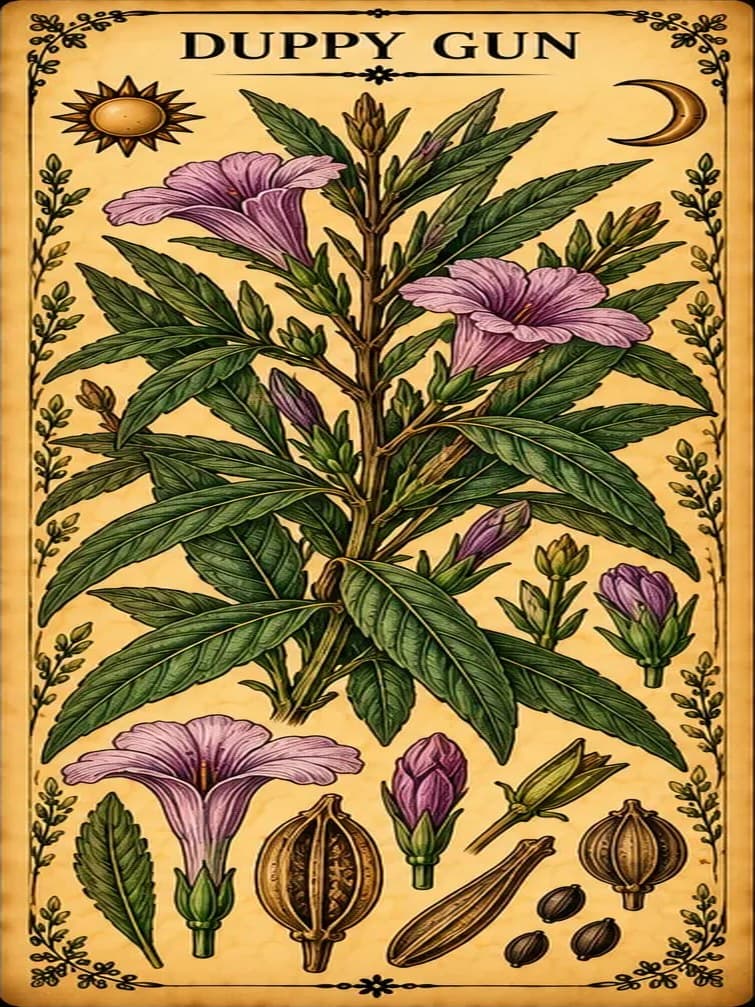
Duppy Gun
Ruellia tuberosa
Ruellia tuberosa, also called Mexican bluebell, a folk medicine for diabetes in Asia. It lowered blood sugar in diabetic rats but hasn't been tested in people.
What is Duppy Gun?
- Plant family
- Acanthaceae, the acanthus family
- Where it grows
- Originally from Central America; now spread to other tropical regions, including Southeast Asia
- Genus
- Ruellia
- Species
- tuberosa
Also called
Mexican Bluebell
Traditionally used for
- Blood sugar (traditional)
- High blood pressure (traditional)
- Fever
- Pain
Traditionally described as
- May lower blood sugar (in animal studies)
Health topics
Where Duppy Gun appears in symptom search, and why. Being listed doesn't mean it's a proven treatment.
- Fever
Used in Southeast Asian folk medicine for fever. This use hasn't been tested in people.
- High Blood Pressure
Used in Southeast Asian folk medicine for high blood pressure. This use hasn't been tested in people.
- High Blood Sugar
A folk medicine for diabetes in East and Southeast Asia. It lowered blood sugar in diabetic rats, but hasn't been tested in people.
Traditions that use it
Ayurveda
Used since ancient times as a Rasayana, a rejuvenating tonic.
What does the research say?
Traditional use
These are traditional uses, not proven treatments.
It has been used for decades as a folk medicine for diabetes in East Asia.[1]
In folk medicine in Southeast Asia, including Indonesia, it has been used for:
- Diabetes
- High blood pressure
- Fever
- Pain
Known as Mexican bluebell, it has been used since ancient times as a Rasayana, an Ayurvedic rejuvenating tonic.[3]
Laboratory & animal research
Lab and animal results show what might be worth studying in people. They don't show that the herb has these effects in humans.
A 2024 review reported that, in lab and animal studies, its extracts and compounds acted against cancer cells, fungi, other germs and worms. They also helped wounds heal, may help reduce inflammation, lowered blood sugar and blood fats, and protected the stomach.[3]
Technical detail: anticancer, anti-inflammatory, wound healing, antifungal, antimicrobial, anti-diabetic, hypoglycemic, hypolipidemic, gastroprotective and anthelmintic activity; constituents include alkaloids, flavonoids, saponins and phenolic compounds.
In diabetic rats, an extract given for 2 weeks brought fasting blood sugar down close to normal. In lab tests, the extract blocked an enzyme the body uses to break starch down into sugar.[2]
Technical detail: hexane fraction of a methanol extract (HFME), 450 mg/kg body weight; fasting blood glucose fell from 399 ± 82.7 to 114 ± 21.3 mg/dL; α-amylase inhibition IC50 0.14 ± 0.005 mg/mL.
In diabetic rats, a root extract reduced signs of kidney damage and inflammation in the kidneys.[4]
Technical detail: streptozotocin-induced diabetes; 250 mg/kg body weight lowered malondialdehyde by 52.70% and TNF-α expression by 42.24%, with improved kidney histopathology.
In diabetic rats, water-based and alcohol-based extracts helped bring the liver's toxin-clearing enzymes back to normal and boosted its antioxidant defenses.[1]
Technical detail: normalized hepatic CYP2E1, UGT1A7 and GSTM1 expression; increased superoxide dismutase (SOD) activity.
In short
Hasn't been studied in people, so its safety is unknown.
Sources
- [1] Protective effect of Ruellia tuberosa L. extracts against abnormal expression of hepatic detoxification enzymes in diabetic rats — RSC Advances · DOI: 10.1039/c8ra03321hPeer-reviewed study
- [2] Antidiabetic Activity of Ruellia tuberosa L., Role of α-Amylase Inhibitor: In Silico, In Vitro, and In Vivo Approaches — Biochemistry Research International · DOI: 10.1155/2015/349261Peer-reviewed study
- [3] Ethnomedicinal Uses, Phytochemistry, Pharmacology, and Toxicology of Ruellia tuberosa L.: A Review — Chemistry & Biodiversity · DOI: 10.1002/cbdv.202400292Peer-reviewed study
- [4] Ruellia tuberosa L. Extract Improves Histopathology and Lowers Malondialdehyde Levels and TNF Alpha Expression in the Kidney of Streptozotocin-Induced Diabetic Rats — Veterinary Medicine International · DOI: 10.1155/2020/8812758Peer-reviewed study
This information is educational and traditional in nature, and is not a substitute for professional medical advice.