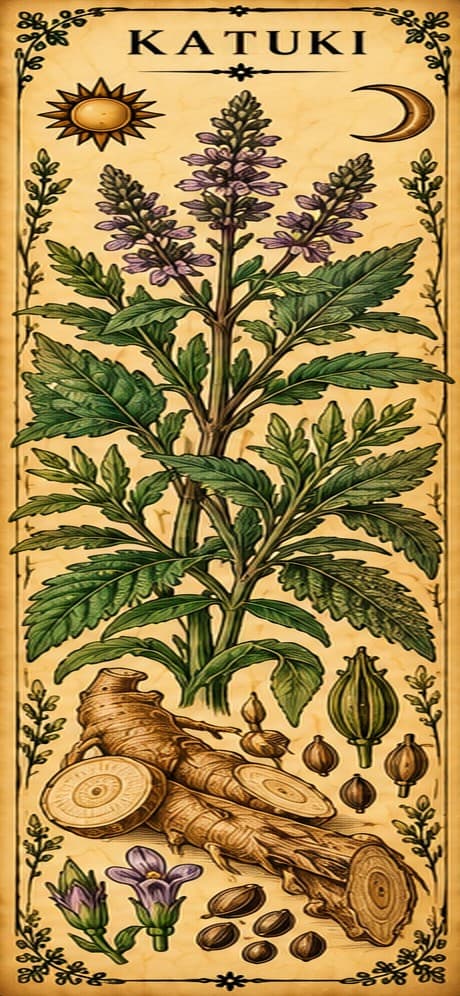
Katuki
Picrorhiza kurroa
Kutki, a bitter root used in Ayurveda for thousands of years for fever, jaundice, the liver and breathing problems. It is now endangered in the wild.
What is Katuki?
- Plant family
- Plantaginaceae, the plantain family
- Parts used
- The root and underground stem
- Genus
- Picrorhiza
- Species
- kurroa
Also called
Picrorhiza, Indian Gentian
Traditional names
Kutki
Traditionally used for
- Fever
- Liver
- Immune support
- Breathing problems
Traditionally described as
- Bitter
- Immune support (traditional)
Health topics
Where Katuki appears in symptom search, and why. Being listed doesn't mean it's a proven treatment.
- Fatty Liver (NAFLD)
Its liver-protective effect has been seen in experimental and clinical studies; it is being developed for fatty liver disease.
- Immune Support (Colds and Flu)
Traditionally used for recurring fevers; immune effects have been seen only in lab and animal studies.
Traditions that use it
Ayurveda
Used for millennia, with certain cautions, for fever, jaundice, the liver and breathing problems.
Natural compounds
Safety
Pregnancy
Katuki can cause miscarriage and shouldn't be used during pregnancy.[1]
How much to use
It's usually taken as capsules of standardized extract, 400 to 1,500 mg a day for adults. Only a few toxicity studies have been done, so its side effects aren't well known.[1]
Contamination
Katuki has become endangered in the wild through overharvesting, habitat loss and slow growth.[2]
What does the research say?
Traditional use
These are traditional uses, not proven treatments.
Katuki has been used in Ayurveda for thousands of years, with certain cautions. Traditional and folk uses include:
- Recurring fever and jaundice
- Constipation (as a laxative) and digestion
- Breathing problems, asthma and allergies
- Skin problems
Its bitter taste comes from compounds called picrosides.[1]
Laboratory & animal research
Lab and animal results show what might be worth studying in people. They don't show that the herb has these effects in humans.
In lab and animal studies, katuki and its compounds protected the liver from many toxins, reduced inflammation, and showed antioxidant, immune-modulating and antimicrobial effects.[2]
Research in people
Its protective effect on the liver has been seen in experimental and clinical studies, and it is being developed as a standardized product for fatty liver disease.[3]
In short
Can cause miscarriage; don't use during pregnancy.
Sources
- [1] Pharmacological and Clinical Efficacy of Picrorhiza kurroa and Its Secondary Metabolites: A Comprehensive Review — Molecules · DOI: 10.3390/molecules27238316Peer-reviewed study
- [2] Advances in Ethnobotany, Synthetic Phytochemistry and Pharmacology of Endangered Herb Picrorhiza kurroa (Kutki): A Comprehensive Review (2010-2020) — Mini Reviews in Medicinal Chemistry · DOI: 10.2174/1389557521666210401090028Peer-reviewed study
- [3] Picrorhiza kurroa, Royle ex Benth: Traditional uses, phytopharmacology, and translational potential in therapy of fatty liver disease — Journal of Ayurveda and Integrative Medicine · DOI: 10.1016/j.jaim.2022.100558Peer-reviewed study
This information is educational and traditional in nature, and is not a substitute for professional medical advice.