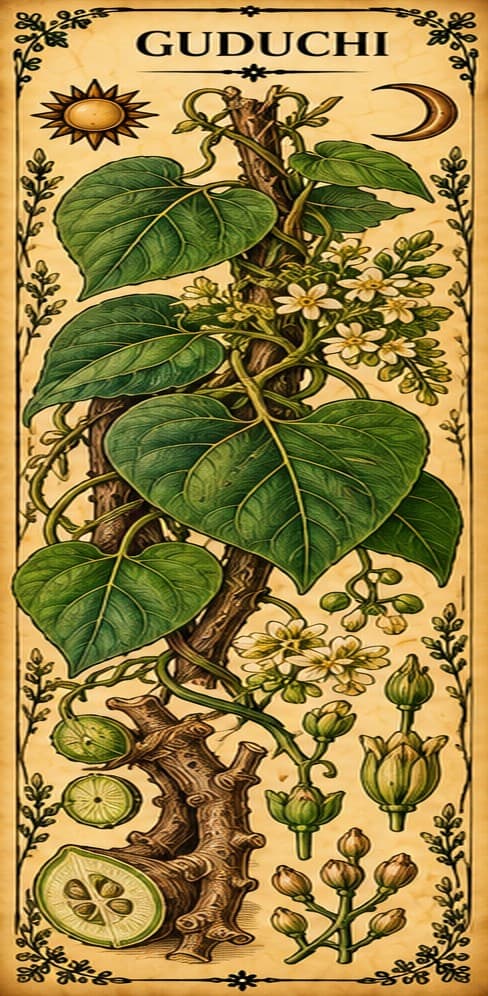
Giloy (Guduchi)
Tinospora cordifolia
An Ayurvedic climbing vine promoted in India as an immunity booster, including during COVID-19. Cases of liver injury have been reported, though some may involve a look-alike plant.
What is Giloy (Guduchi)?
- Plant family
- Menispermaceae, the moonseed family
- Parts used
- The stem and leaves
- Genus
- Tinospora
- Species
- cordifolia
Traditional names
Giloy, Guduchi
Traditionally used for
- Immune support
- Fever
- Liver (traditional)
Traditionally described as
- Immune support (traditional)
Health topics
Where Giloy (Guduchi) appears in symptom search, and why. Being listed doesn't mean it's a proven treatment.
- Immune Support (Colds and Flu)
Promoted in India as an immunity booster; evidence is from lab and animal studies, and liver injury has been reported.
- Liver Safety Warnings
Cases of liver injury, including autoimmune-like hepatitis, have been reported.
Traditions that use it
Ayurveda
Described in Ayurvedic texts as one of the most important medicinal plants; used for jaundice, fever and immunity.
Safety
Toxicity testing
Liver injury has been reported with giloy, mostly from India. A 2021 case series described 6 patients who developed autoimmune-like hepatitis (the immune system attacking the liver) after taking giloy or giloy-containing products during the COVID-19 pandemic.[1]
A 50-year-old woman developed severe liver inflammation two weeks after starting a supplement containing giloy. She recovered after stopping it and a short course of steroids.[2]
Contamination
Several other plants are sold as, or mixed up with, giloy, which may explain some liver-injury reports.[1]
What does the research say?
Traditional use
These are traditional uses, not proven treatments.
Ayurvedic texts describe giloy as one of the most potent and important medicinal plants, and its leaves have been used for centuries for many ailments.[3]
Giloy has traditionally been used for jaundice.[4]
In India, the government's Ministry of AYUSH recommended giloy for COVID-19 care because of its reputation for easing inflammation and supporting the immune system.[1]
Laboratory & animal research
Lab and animal results show what might be worth studying in people. They don't show that the herb has these effects in humans.
In short
Liver injury, including autoimmune-like hepatitis, has been reported; stop and see a doctor if you notice yellow skin or dark urine.
Sources
- [1] Can Guduchi (Tinospora cordifolia), a well-known ayurvedic hepato-protectant cause liver damage? — Journal of Ayurveda and Integrative Medicine · DOI: 10.1016/j.jaim.2022.100658Peer-reviewed study
- [2] Tinospora cordifolia (Guduchi/Giloy)-Induced Liver Injury: A Case Review — Cureus · DOI: 10.7759/cureus.39793Peer-reviewed study
- [3] Immunomodulatory properties of Giloy (Tinospora cordifolia) leaves and its applications in value-added products — Heliyon · DOI: 10.1016/j.heliyon.2024.e40948Peer-reviewed study
- [4] Traditional uses, hepatoprotective potential, and phytopharmacology of Tinospora cordifolia: a narrative review — Journal of Pharmacy and Pharmacology · DOI: 10.1093/jpp/rgae013Peer-reviewed study
This information is educational and traditional in nature, and is not a substitute for professional medical advice.