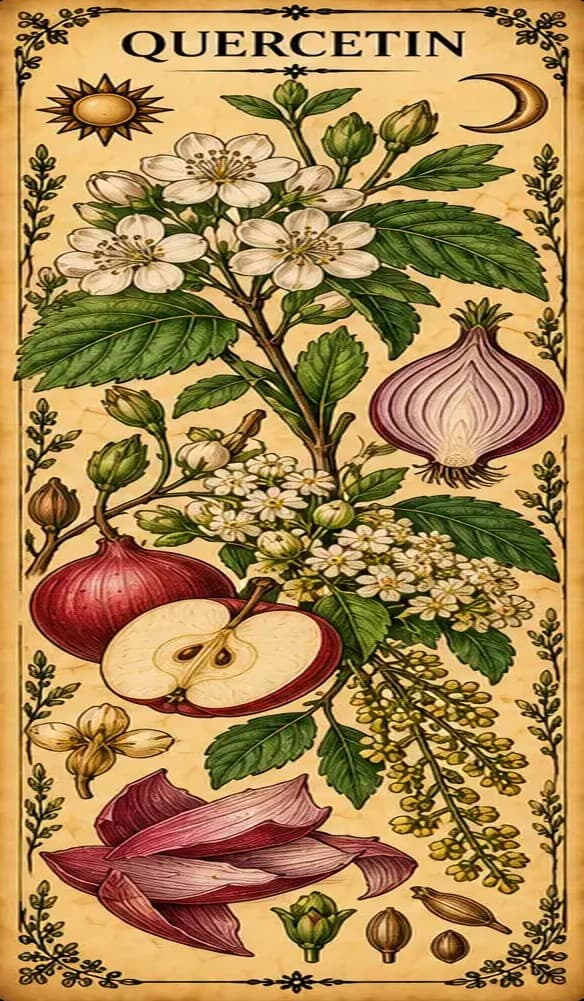
Quercetin
Plant flavonoid (found in apples, onions and other foods)
A natural plant compound found in apples, onions, grapes, citrus and parsley, and sold as a supplement. In a trial of 1,002 people it didn't prevent colds overall.
What is Quercetin?
- Plant family
- Not a single plant: found in many plant families
- Parts used
- Found in fruits and vegetables such as apples, onions, grapes, citrus and parsley
Traditionally used for
- Immune support
- Colds
- Antioxidant
Traditionally described as
- Antioxidant
Health topics
Where Quercetin appears in symptom search, and why. Being listed doesn't mean it's a proven treatment.
- Immune Support (Colds and Flu)
In a large trial it didn't prevent colds overall; a subgroup of fitter older adults had milder illness.
Natural compounds
What does the research say?
Traditional use
These are traditional uses, not proven treatments.
Quercetin is a natural plant compound (a flavonoid). Fruits and vegetables such as apples, citrus, grapes, onions and parsley are the main food sources. It is also sold as a supplement, in doses up to 1,000 mg a day.[1]
Laboratory & animal research
Lab and animal results show what might be worth studying in people. They don't show that the herb has these effects in humans.
A review of 11 animal studies found quercetin-type compounds lowered deaths and viral levels in animals with lung virus infections, and reduced inflammation, mucus and airway tightness.[2]
Research in people
In a 12-week trial, 1,002 adults aged 18 to 85 took 500 mg or 1,000 mg of quercetin a day, or a placebo. Overall, it didn't reduce colds or other upper respiratory infections. In a subgroup of fitter adults over 40, the higher dose was linked to milder illness and fewer sick days.[3]
Technical detail: randomized, double-blind; Wisconsin Upper Respiratory Symptom Survey; subgroup n = 325, 36% lower severity (p = 0.020), 31% fewer sick days (p = 0.048).
In a trial of 50 older or metabolically at-risk adults, taking quercetin for 4 weeks before a COVID-19 booster didn't change the immune response to the vaccine compared with placebo.[4]
In short
Very little is absorbed from ordinary supplements; research in people is mixed.
Sources
- [1] Therapeutic Potential and Clinical Effectiveness of Quercetin: A Dietary Supplement — Recent Advances in Food, Nutrition & Agriculture · DOI: 10.2174/012772574x269376231107095831Peer-reviewed study
- [2] Effectiveness of supplementation with quercetin-type flavonols for treatment of viral lower respiratory tract infections: Systematic review and meta-analysis of preclinical studies — Phytotherapy Research · DOI: 10.1002/ptr.7122Review or clinical trial
- [3] Quercetin supplementation and upper respiratory tract infection: A randomized community clinical trial — Pharmacological Research · DOI: 10.1016/j.phrs.2010.05.001Peer-reviewed study
- [4] Immune Preconditioning with Oral Quercetin Supplement and COVID-19 mRNA Vaccine Responses: A Randomized, Double-Blind, Placebo-Controlled Trial — The Journal of Nutrition · DOI: 10.1016/j.tjnut.2026.101431Peer-reviewed study
This information is educational and traditional in nature, and is not a substitute for professional medical advice.