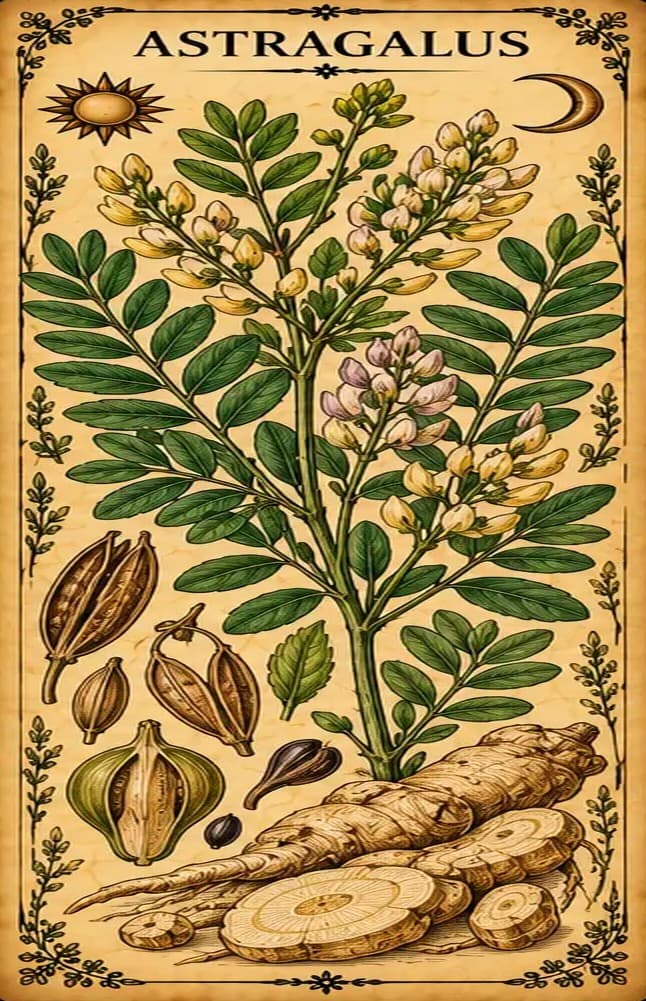
Astragalus
Astragalus membranaceus
A root (huang qi) used for centuries in traditional Chinese medicine and promoted to strengthen the immune system. There isn't enough reliable evidence to know whether it helps any condition.
Astragalus may interact with some medicines. If you take any medicine, read Interactions with medicines below and talk to your doctor or pharmacist before using it.
What is Astragalus?
- Plant family
- Fabaceae, the pea and bean family
- Parts used
- The root
- Genus
- Astragalus
- Species
- membranaceus
Also called
Milk Vetch, Astragale
Traditional names
Huang Qi
Traditionally used for
- Immune support
- Colds
- Fatigue
- Kidney health
- Alongside cancer chemotherapy (studied)
Traditionally described as
- Immune support
Health topics
Where Astragalus appears in symptom search, and why. Being listed doesn't mean it's a proven treatment.
- Immune Support (Colds and Flu)
Promoted to strengthen the immune system; small studies suggest it boosts immune responses, but evidence isn't reliable enough to know if it helps.
Traditions that use it
Traditional Chinese Medicine
The root (huang qi) has been used for centuries, often combined with other herbs.
Safety
Interactions with medicines
Astragalus may interact with medicines that suppress the immune system.[1]
Who should avoid it
Avoid astragalus if you have an autoimmune disease, because it might worsen symptoms.[1]
Pregnancy
There's not enough information on its safety during pregnancy or breastfeeding, and animal research suggests it may harm an unborn baby.[1]
How much to use
Astragalus may be safe by mouth. Up to 60 grams a day for up to 4 months doesn't seem to cause side effects.[1]
What does the research say?
Traditional use
These are traditional uses, not proven treatments.
Astragalus root has been used in traditional Chinese medicine for centuries, often combined with other herbs. It is promoted for colds and other upper respiratory infections, hay fever, asthma, chronic fatigue, chronic kidney disease and diabetes, to strengthen the immune system, and on the skin for wound healing.[1]
Research in people
There isn't enough reliable evidence to know whether astragalus helps any health condition. Recent reviews found:
- Added to metformin, it lowered blood sugar more than metformin alone in diabetes studies, though most were of poor quality.
- It boosted immune responses and lowered inflammation markers, but the studies were small and varied.
- Added to standard care, it improved some measures in kidney disorders.
A 2006 review of 34 trials with 2,815 people with advanced lung cancer (non-small cell) found that adding astragalus-based Chinese herbal formulas to platinum chemotherapy lowered the risk of death at 12 months and more often shrank tumours. The reviewers said this needs confirming in well-controlled trials.[2]
Technical detail: death at 12 months RR 0.67 (95% CI 0.52 to 0.87; 12 studies, 940 people); tumour response RR 1.34 (95% CI 1.24 to 1.46; 30 studies).
A 2021 review of trials in advanced stomach cancer found that adding astragalus-containing Chinese medicines to platinum chemotherapy shrank tumours more often, raised some immune cell counts and caused fewer side effects. The evidence was low to moderate quality, and more high-quality trials are needed.[3]
Technical detail: objective response rate RR 1.24 (95% CI 1.15 to 1.34).
A 2023 review of 19 studies with 1,094 people found astragalus lowered blood markers of inflammation and raised some immune cell counts. The results varied a lot between studies.[4]
Technical detail: cytokines IL-2, IL-4, IL-6, IL-10, TNF-α and IFN-γ fell; CD3 and the CD4/CD8 ratio rose.
In a small trial, 18 Polish national team rowers took 500 mg of astragalus root or a dummy pill a day during 6 weeks of hard training. Astragalus helped keep some immune cell levels steady after an all-out rowing test.[5]
Technical detail: NK and regulatory T cells stayed at baseline; changes in IL-2 and the IL-2/IL-10 ratio after exertion.
In short
Avoid with autoimmune diseases or immune-suppressing medicines.
Sources
- [1] Astragalus: Usefulness and Safety — National Center for Complementary and Integrative Health (NIH)Government health agency
- [2] Astragalus-based Chinese herbs and platinum-based chemotherapy for advanced non-small-cell lung cancer: meta-analysis of randomized trials — Journal of Clinical Oncology · DOI: 10.1200/JCO.2005.03.6392Review or clinical trial
- [3] Efficacy and Safety of Astragalus-Containing Traditional Chinese Medicine Combined With Platinum-Based Chemotherapy in Advanced Gastric Cancer: A Systematic Review and Meta-Analysis — Frontiers in Oncology · DOI: 10.3389/fonc.2021.632168Review or clinical trial
- [4] The Effect of Astragalus on Humoral and Cellular Immune Response: A Systematic Review and Meta-Analysis of Human Studies — Complementary Medicine Research · DOI: 10.1159/000534826Review or clinical trial
- [5] Standardized astragalus extract for attenuation of the immunosuppression induced by strenuous physical exercise: randomized controlled trial — Journal of the International Society of Sports Nutrition · DOI: 10.1186/s12970-021-00425-5Peer-reviewed study
This information is educational and traditional in nature, and is not a substitute for professional medical advice.