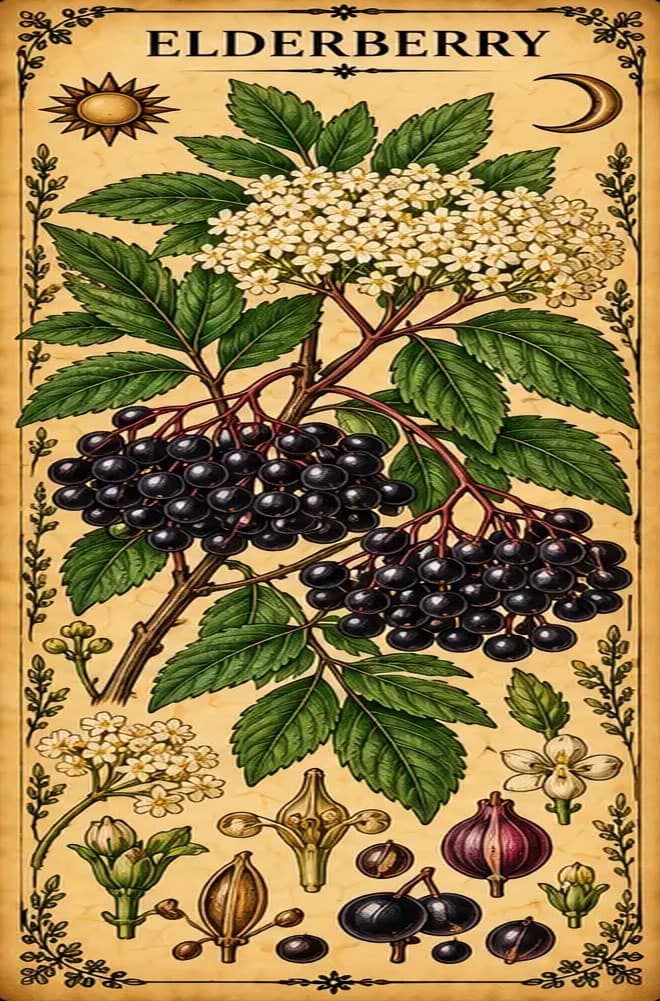
Elderberry
Sambucus nigra
The European elder, whose berries are used in folk medicine for colds and flu and whose flowers are recognized in Europe for early cold symptoms. Raw berries, leaves and stems are poisonous.
Elderberry may interact with some medicines. If you take any medicine, read Interactions with medicines below and talk to your doctor or pharmacist before using it.
What is Elderberry?
- Plant family
- Viburnaceae, the viburnum and elder family
- Parts used
- The berries (cooked) and the flowers
- Genus
- Sambucus
- Species
- nigra
Also called
European Elder, Black Elderberry, Elder Flower, Sambucus, Elderflower
Traditionally used for
- Colds
- Flu
- Immune support
Traditionally described as
- Immune support
Health topics
Where Elderberry appears in symptom search, and why. Being listed doesn't mean it's a proven treatment.
- Colds and Nasal Congestion
Elder flower is recognized in Europe for early cold symptoms.
- Immune Support (Colds and Flu)
Traditionally used for colds and flu; a meta-analysis found it eased upper respiratory symptoms, though evidence is preliminary.
- Poisonous Plants
Raw or unripe berries, and the leaves and stems, contain substances that produce cyanide.
Traditions that use it
European Folk Medicine
Berries used for colds and flu; elder flower recognized in Europe as a traditional medicine for early cold symptoms.
Safety
Interactions with medicines
Talk with your healthcare provider before using elderberry with medicines; some herbs and medicines interact in harmful ways.[1]
Pregnancy
Little is known about whether elderberry is safe for health purposes during pregnancy or breastfeeding.[1]
Breastfeeding
There's no information on whether elderberry passes into breast milk or is safe for nursing mothers and babies. It has been used in Türkiye to increase breast milk, but this hasn't been tested in trials. Allergic reactions to elderberry products are rare.[2]
Toxicity testing
Raw or unripe elderberries, and other parts of the elder such as the leaves and stems, contain poisonous substances that produce cyanide. They can cause nausea, vomiting and severe diarrhea. Cooking destroys this toxin.[1]
How much to use
Elder flower medicines aren't recommended for children under 12. See a doctor if symptoms last more than a week or get worse, or if you get shortness of breath, fever or colored phlegm.[3]
Depends on how it's prepared
Heat lowers the cyanide-producing substances in elderberries. In elderberry products, levels fell by 44% in juice, 80% in tea and 96% in liqueur and spread compared with unprocessed berries. Heating also lowered the berries' beneficial antioxidant compounds.[4]
What does the research say?
Traditional use
These are traditional uses, not proven treatments.
Elderberry has been used in folk medicine for colds and flu, and is sold as a supplement for these and other upper respiratory infections.[1]
Based on long-standing use, the European Medicines Agency recognizes elder flower as a traditional herbal medicine to relieve early symptoms of a common cold, in adults and teens over 12. It is taken as a tea or liquid preparation.[3]
Laboratory & animal research
Lab and animal results show what might be worth studying in people. They don't show that the herb has these effects in humans.
In lab tests on skin cells, elderflower extracts made with alcohol calmed an inflammation signal, an effect linked mainly to naringenin, one of their flavonoids. The flowers are rich in rutin and chlorogenic acid. These results haven't been tested in people.[5]
Technical detail: inhibition of TNFα-induced NF-κB activation in HaCaT keratinocytes; best extraction yielded rutin 4.87% and chlorogenic acid 8.22%.
In lab tests, elderflower extracts weren't toxic to several kinds of human and animal cells.[6]
Research in people
Only a small number of studies have looked at elderberry for colds, flu and other upper respiratory infections. One meta-analysis found black elderberry supplements eased upper respiratory symptoms in randomized trials, but the evidence overall is preliminary. There isn't enough evidence to know whether it helps COVID-19 symptoms, and US regulators have taken action against companies making unsupported COVID-19 claims.[1]
In short
Never eat raw or unripe berries, leaves or stems: they contain cyanide-producing substances. Cooking removes them.
Sources
- [1] Elderberry: Usefulness and Safety — National Center for Complementary and Integrative Health (NIH)Government health agency
- [2] Elderberry. Drugs and Lactation Database (LactMed) — National Institute of Child Health and Human Development (NIH)Government health agency
- [3] European Union herbal monograph on Sambucus nigra L., flos, Revision 1 (EMA/HMPC/611512/2016) — European Medicines Agency, Committee on Herbal Medicinal Products (HMPC)Government health agency
- [4] Processed elderberry (Sambucus nigra L.) products: A beneficial or harmful food alternative? · DOI: 10.1016/j.lwt.2016.04.056Peer-reviewed study
- [5] From Elderflower to Bioactive Extracts: Phytochemical Characterization and Anti-Inflammatory Activity · DOI: 10.3390/molecules31030561Peer-reviewed study
- [6] Elderberry and Linden Flowers Ethanol-Water Extracts: Extraction Type Effect, Analysis and Biological Activity Determination · DOI: 10.3390/molecules31050764Peer-reviewed study
This information is educational and traditional in nature, and is not a substitute for professional medical advice.