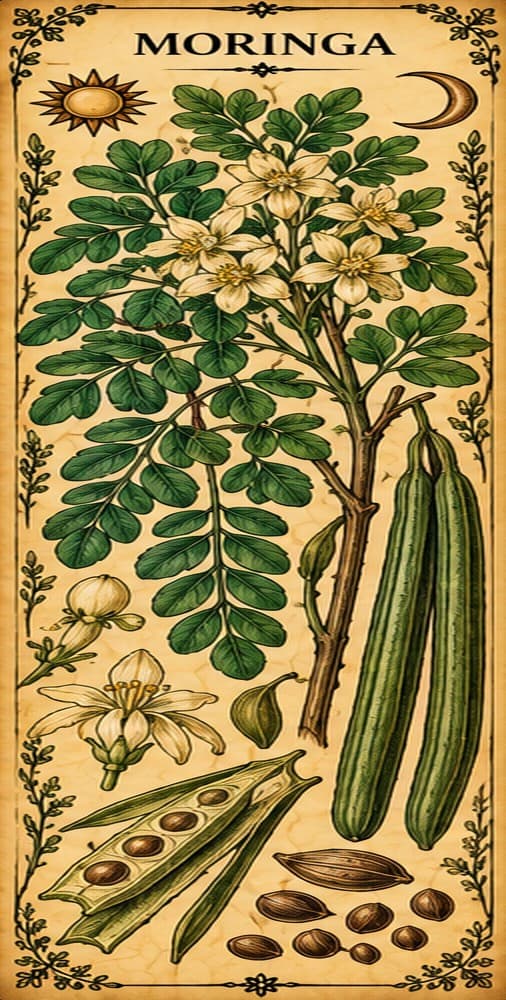
Moringa
Moringa oleifera
A nutritious tree used as food and traditional medicine, including for stomach and gut problems. In animal studies it helped heal stomach ulcers; in people it has been studied mainly for blood pressure and blood sugar.
What is Moringa?
- Plant family
- Moringaceae, the moringa family
- Parts used
- The leaves, seeds and pods
- Genus
- Moringa
- Species
- oleifera
Also called
Miracle Tree
Traditionally used for
- Nutrition
- Stomach ulcers
- Blood pressure
- Blood sugar
Traditionally described as
- Antioxidant
- Nutritious
Health topics
Where Moringa appears in symptom search, and why. Being listed doesn't mean it's a proven treatment.
- High Blood Pressure
A review of 8 trials found it lowered blood pressure modestly.
- Stomach Ulcers and H. pylori
Helped stomach ulcers heal in animal studies; there are no trials in people.
Safety
Side effects
In healthy volunteers, moringa showed no toxic effects at the doses studied. Large clinical trials are still needed to confirm its safety, effects and dosing.[1]
What does the research say?
Traditional use
These are traditional uses, not proven treatments.
Moringa is used as food, especially in low- and middle-income countries, to fight malnutrition. In traditional medicine it has been used for many conditions, including sore throat, intestinal worms, diabetes and supporting breast milk.[1]
Moringa has traditionally been used for stomach and gut disorders.[2]
Laboratory & animal research
Lab and animal results show what might be worth studying in people. They don't show that the herb has these effects in humans.
A review of 11 animal studies found moringa extracts consistently protected the stomach and helped ulcers heal, though not better than standard ulcer medicines. There are no clinical trials in people for ulcers. In animals, moringa seed extract also reduced the severity of colitis.[2]
Research in people
A 2026 review of 8 randomized trials found moringa lowered blood pressure (by about 6 points on the top number and 7 on the bottom), but didn't change body weight.[3]
Technical detail: SBP WMD −6.00 mm Hg, DBP WMD −7.32 mm Hg (p < 0.001); larger effect with 5 to 10 g/day for more than 4 weeks.
In short
Large clinical trials are lacking, so its effects and safety aren't well established.
Sources
- [1] Unveiling the Miracle Tree: Therapeutic Potential of Moringa oleifera in Chronic Disease Management and Beyond — Biomedicines · DOI: 10.3390/biomedicines13030634Peer-reviewed study
- [2] Preclinical evidence of the therapeutic effect of Moringa oleifera in peptic ulcer disease: a systematic review and meta-analysis — Frontiers in Pharmacology · DOI: 10.3389/fphar.2026.1689789Review or clinical trial
- [3] The Effect of Moringa oleifera on Body Weight and Blood Pressure: A Systematic Review and Meta-Analysis of Randomized Controlled Trials — Food Science & Nutrition · DOI: 10.1002/fsn3.71899Review or clinical trial
This information is educational and traditional in nature, and is not a substitute for professional medical advice.