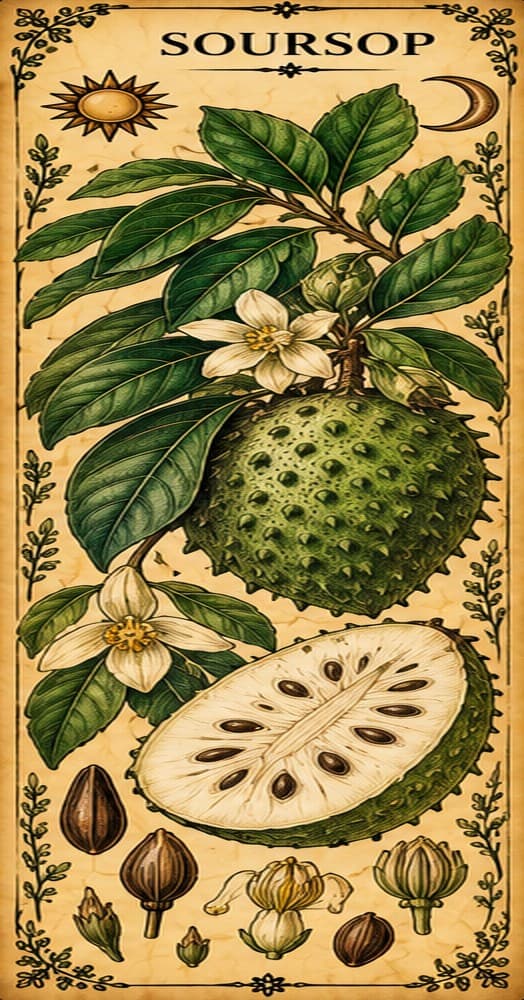
Soursop
Annona muricata
A tropical fruit (graviola) used in folk medicine for stomachache, diarrhea and intestinal parasites. Eating it has been linked to more severe Parkinson's disease in the Caribbean.
What is Soursop?
- Plant family
- Annonaceae, the custard-apple family
- Parts used
- The fruit, leaves, bark, seeds and roots
- Where it grows
- Grown in tropical and subtropical regions around the world
- Genus
- Annona
- Species
- muricata
Also called
Graviola
Regional names
Durian Belanda
Traditionally used for
- Stomachache
- Diarrhea
- Intestinal parasites
- Food
Traditionally described as
- Traditionally used for the gut
Health topics
Where Soursop appears in symptom search, and why. Being listed doesn't mean it's a proven treatment.
- Diarrhea
Traditionally used for diarrhea; not studied in people. It contains a compound toxic to nerve cells.
- SIBO and Intestinal Parasites
The juice is traditionally drunk in South America to get rid of intestinal parasites; not studied in people.
Natural compounds
Safety
What does the research say?
Traditional use
These are traditional uses, not proven treatments.
All parts of soursop are used in folk medicine:
- The fruit juice is used for diarrhea, and in South America it is drunk to get rid of intestinal parasites.
- Toasted, powdered seeds are used to cause vomiting and as a laxative.
- In parts of Africa, all parts are used for stomachache, parasites, malaria, diabetes and cancer.
The fruit is widely eaten in sweets, ice cream and juices.[1]
Laboratory & animal research
Lab and animal results show what might be worth studying in people. They don't show that the herb has these effects in humans.
Soursop contains more than 200 plant compounds, including acetogenins. In lab and animal studies, extracts killed cancer cells and showed antioxidant and antimicrobial effects. These effects haven't been shown in people.[3]
Research in people
A study compared 74 people with Parkinson's disease in the Caribbean, nearly all of whom had eaten soursop-family fruits, with 104 people with Parkinson's in mainland France. The Caribbean group had more severe movement and thinking symptoms. The authors say growing evidence points to these fruits being toxic and call for public warnings.[2]
In short
Contains annonacin, a compound toxic to nerve cells; linked to more severe Parkinson's disease.
Sources
- [1] Annona muricata: Comprehensive Review on the Ethnomedicinal, Phytochemistry, and Pharmacological Aspects Focusing on Antidiabetic Properties — Life (Basel) · DOI: 10.3390/life13020353Peer-reviewed study
- [2] The Clinical Effect of Annonaceae Fruit Consumption on Caribbean Parkinson's Disease Severity — Behavioural NeurologyPeer-reviewed study
- [3] Anticancer Properties of Graviola (Annona muricata): A Comprehensive Mechanistic Review — Oxidative Medicine and Cellular Longevity · DOI: 10.1155/2018/1826170Peer-reviewed study
This information is educational and traditional in nature, and is not a substitute for professional medical advice.