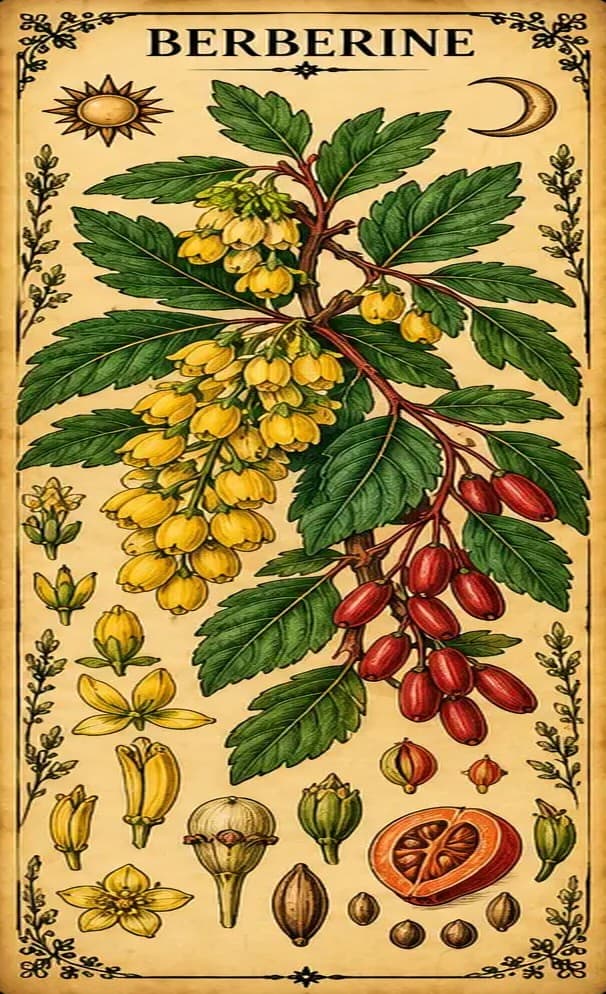
Berberine
Berberis vulgaris
A natural compound found in barberry (shown here) and other plants such as goldenseal. It is widely used in China for diarrhea, and has been studied for H. pylori infection and blood sugar.
What is Berberine?
- Plant family
- Berberidaceae, the barberry family
- Parts used
- Mostly the bark and root, which contain the most berberine
- Genus
- Berberis
- Species
- vulgaris
Also called
Barberry, Berberis
Traditionally used for
- Diarrhea
- H. pylori
- Blood sugar
- Gut health
Traditionally described as
- Antibacterial
Health topics
Where Berberine appears in symptom search, and why. Being listed doesn't mean it's a proven treatment.
- Diarrhea
A review of 38 trials found it improved cure rates and shortened diarrhea; evidence quality was low.
- SIBO and Intestinal Parasites
An ingredient in herbal SIBO formulas; evidence comes from a very small chart review.
- Stomach Ulcers and H. pylori
Added to standard H. pylori treatment, it raised cure rates and helped ulcers heal in trials in China.
Natural compounds
Safety
Side effects
Some side effects have been reported, but berberine is generally regarded as safe.[1]
Pregnancy
Berberine can harm newborns. Don't use berberine-containing products during pregnancy or breastfeeding, and never give them to babies.[2]
What does the research say?
Traditional use
These are traditional uses, not proven treatments.
Berberine is found in the roots, stems and fruits of plants in several plant families, including the barberry family. The bark and root contain the most.[1]
Barberry (Berberis vulgaris) contains 22 alkaloids, of which berberine is the main one.[3]
Berberine has a broad antibiotic effect and is very widely used to treat diarrhea in China.[4]
Laboratory & animal research
Lab and animal results show what might be worth studying in people. They don't show that the herb has these effects in humans.
Very little berberine (less than 1%) is absorbed into the blood when taken by mouth, which has limited its use as a medicine.[3]
Research in people
A 2020 review of 38 trials with 3,948 people (2,702 of them children) found berberine, alone or added to antibiotics, generally improved cure rates and shortened diarrhea compared with other treatments. No serious side effects or deaths were reported. Most children's trials gave it as an enema, and the quality of evidence was moderate to very low.[4]
A 2020 review of 13 trials in China found that adding berberine to standard triple therapy for H. pylori raised the rate of clearing the infection, helped stomach ulcers heal and relieved symptoms, with fewer side effects than standard therapy alone.[5]
Technical detail: eradication RR 1.22 (95% CI 1.16 to 1.27); ulcer healing RR 1.15; adverse events RR 0.65.
A review of berberine research describes possible benefits for obesity, diabetes, heart and gut diseases, and some infections, and says it is generally regarded as safe. The authors caution against assuming it prevents disease.[1]
In a small chart review of 13 people with SIBO (bacterial overgrowth in the small intestine), herbal antimicrobial formulas containing berberine, barberry, black walnut and wormwood among other herbs cleared SIBO in 60% to 100% of people. The study was too small to draw firm conclusions.[6]
In short
Can harm newborns: avoid in pregnancy, breastfeeding and babies.
Sources
- [1] Potential Health Effects of the Natural Alkaloid Berberine: A Narrative Review — Nutrition Reviews · DOI: 10.1093/nutrit/nuaf192Peer-reviewed study
- [2] Goldenseal: Usefulness and Safety — National Center for Complementary and Integrative Health (NIH)Government health agency
- [3] Berberis vulgaris and its role in atherosclerosis improvement: A review of in vitro and in vivo data — Avicenna Journal of Phytomedicine · DOI: 10.22038/ajp.2025.25922Peer-reviewed study
- [4] Berberine for diarrhea in children and adults: a systematic review and meta-analysis — Therapeutic Advances in Gastroenterology · DOI: 10.1177/1756284820961299Review or clinical trial
- [5] The Efficacy of Berberine-Containing Quadruple Therapy on Helicobacter Pylori Eradication in China: A Systematic Review and Meta-Analysis of Randomized Clinical Trials — Frontiers in Pharmacology · DOI: 10.3389/fphar.2019.01694Review or clinical trial
- [6] Biofilm Disruption Enhances Antimicrobial Therapy for Small Intestinal Bacterial Overgrowth and Intestinal Methanogen Overgrowth — Cureus · DOI: 10.7759/cureus.99116Peer-reviewed study
This information is educational and traditional in nature, and is not a substitute for professional medical advice.