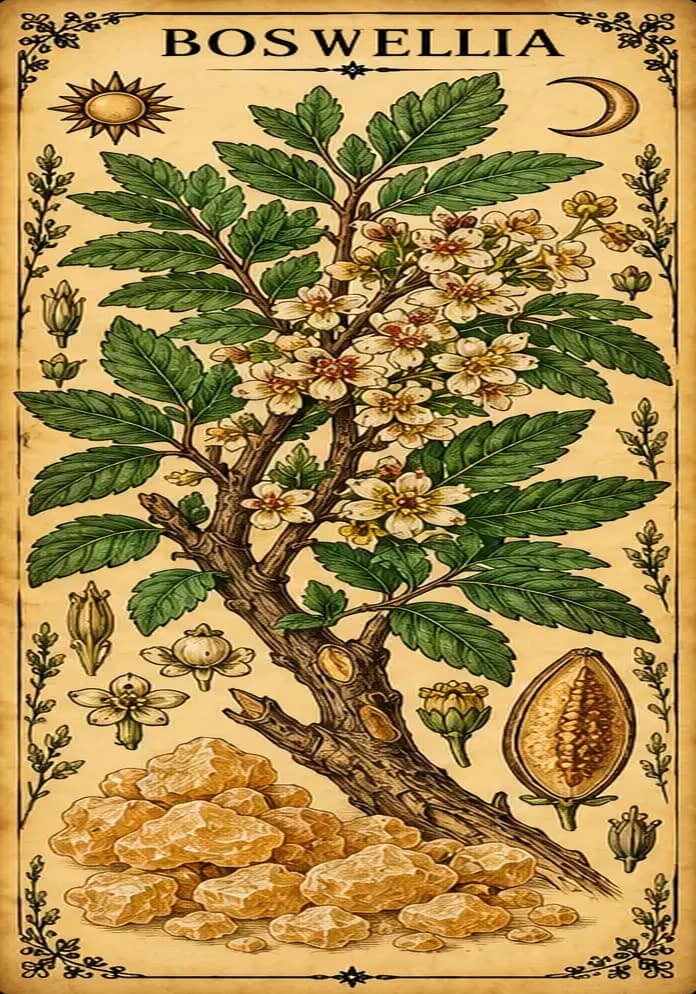
Boswellia
Boswellia serrata
Indian frankincense, a gum resin from a tree used for centuries in Ayurveda for inflammation. It is marketed for arthritis and colitis, and has been studied with curcumin for IBS bloating.
What is Boswellia?
- Plant family
- Burseraceae, the frankincense and myrrh family
- Parts used
- The gum resin from beneath the bark
- Where it grows
- Native to India, the Middle East and northern Africa
- Genus
- Boswellia
- Species
- serrata
Also called
Indian Frankincense, Frankincense
Traditionally used for
- Inflammation
- Arthritis
- Colitis
- IBS
Traditionally described as
- May help reduce inflammation
Health topics
Where Boswellia appears in symptom search, and why. Being listed doesn't mean it's a proven treatment.
- Bloating
In a trial of people with IBS, a curcumin and boswellia supplement reduced bloating.
- Irritable Bowel Syndrome (IBS)
Combined with curcumin and a low-FODMAP diet, it reduced bloating and pain in a 30-day trial.
Traditions that use it
Ayurveda
Used for centuries for inflammatory conditions, arthritis and pain, and for some breathing and heart problems.
Safety
Pregnancy
Little is known about whether boswellia in medicinal amounts is safe during pregnancy or breastfeeding.[1]
Toxicity testing
Boswellia extracts haven't been linked to raised liver enzymes or liver injury.[2]
How much to use
Boswellia is likely safe by mouth. Up to 1,000 mg a day was used safely in trials lasting up to 6 months, and 2,400 mg a day for up to a month.[1]
What does the research say?
Traditional use
These are traditional uses, not proven treatments.
Boswellia has been used for centuries in Ayurvedic medicine for arthritis, inflammation and pain, and for some breathing and heart problems. Today extracts are marketed for arthritis, colitis and asthma.[2]
Research in people
Boswellia taken by mouth may help reduce inflammation and pain from osteoarthritis, but larger, better studies are needed. A few small studies suggest it may reduce asthma symptoms, but the evidence isn't strong enough to know.[1]
In a 30-day trial, 67 people with IBS and bacterial imbalance in the small intestine followed a low-FODMAP diet, with or without a supplement combining curcumin and boswellia. The supplement group had much less bloating and belly pain. Because the supplement combined two herbs, the effect of boswellia alone isn't known.[3]
Technical detail: randomized; Curcumin Boswellia Phytosome 500 mg twice daily; p < 0.0001 for bloating, pain and urinary indican.
In short
Likely safe by mouth in studied doses; little is known about use in pregnancy or breastfeeding.
Sources
- [1] Boswellia: Usefulness and Safety — National Center for Complementary and Integrative Health (NIH)Government health agency
- [2] Boswellia Serrata. In: LiverTox: Clinical and Research Information on Drug-Induced Liver Injury — LiverTox, National Institute of Diabetes and Digestive and Kidney Diseases (NIH)Government health agency
- [3] Beneficial Effects on Abdominal Bloating with an Innovative Food-Grade Formulation of Curcuma longa and Boswellia serrata Extracts in Subjects with Irritable Bowel Syndrome and Small Bowel Dysbiosis — Nutrients · DOI: 10.3390/nu14030416Peer-reviewed study
This information is educational and traditional in nature, and is not a substitute for professional medical advice.