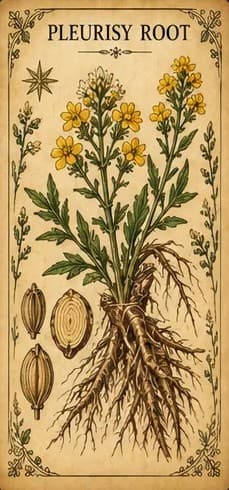
Pleurisy Root
Asclepias tuberosa
A milkweed whose root was traditionally used for breathing problems and to loosen mucus. It contains heart-affecting compounds, and its sap has injured people's eyes.
What is Pleurisy Root?
- Plant family
- Apocynaceae, the dogbane and milkweed family
- Parts used
- The root
- Genus
- Asclepias
- Species
- tuberosa
Also called
Milkweed
Traditionally used for
- Breathing problems (traditional)
- Chest congestion (traditional)
Traditionally described as
- Contains heart-affecting compounds (cardiac glycosides)
Health topics
Where Pleurisy Root appears in symptom search, and why. Being listed doesn't mean it's a proven treatment.
- Chest Congestion and Bronchitis
Traditionally used for breathing problems and to loosen mucus. There's little research, and it contains heart-affecting compounds.
Natural compounds
Safety
Toxicity testing
The plant contains cardiac glycosides, compounds that block the pumps moving sodium and potassium in and out of cells.[1]
Depends on how it's prepared
Its milky sap can seriously injure the eyes. A 70-year-old woman got blurred vision and eye pain after handling the plant; the swelling of her cornea cleared after about 4 days of treatment and her sight fully recovered.[2]
A gardener who wore contact lenses lost most of her sight hours after handling the plant. It was first mistaken for simple conjunctivitis, and improved quickly with steroid and antibiotic treatment.[1]
What does the research say?
Traditional use
These are traditional uses, not proven treatments.
Pleurisy root has traditionally been used to treat breathing problems and to help bring up mucus. Despite its long history of use, there is little research on it.[3]
In short
Contains cardiac glycosides; its sap can seriously irritate the eyes.
Sources
- [1] Toxic Keratoconjunctivitis from Milkweed (Asclepias tuberosa) Exposure in a Contact Lens Wearer — The Journal of Emergency Medicine · DOI: 10.1016/j.jemermed.2026.03.001Peer-reviewed study
- [2] Corneal Toxicity Following Exposure to Asclepias Tuberosa — The Open Ophthalmology Journal · DOI: 10.2174/1874364101711010001Peer-reviewed study
- [3] Pandemics and Traditional Plant-Based Remedies. A Historical-Botanical Review in the Era of COVID19 — Frontiers in Plant Science · DOI: 10.3389/fpls.2020.571042Peer-reviewed study
This information is educational and traditional in nature, and is not a substitute for professional medical advice.